

[For Seniors] Songs Everyone Can Sing Together! A Roundup of Recommended Crowd-Pleasers

In many elder care facilities, such as day service centers, they often incorporate singing as a recreational activity, don’t they?
By singing, older adults can relieve the stress they feel on a daily basis, and it’s said to help maintain cardiopulmonary function, which tends to decline with age.
It also creates opportunities to spend enjoyable time with others and can be expected to serve as a place for social interaction.
With that in mind, this time we’ll introduce songs for older adults that everyone can enjoy together and get excited about.
We’ve gathered many songs that are very popular among seniors—tunes they’ve likely heard at least once or may have sung before.
For those who feel reluctant to sing in front of others, it’s a good idea to have them participate with hand claps.
By all means, make use of these popular, lively songs and enjoy a fun time together.
- [For Seniors] Popular Karaoke Songs That Everyone Can Enjoy Together
- [For Seniors] Let’s Have Fun Together! Introducing Uplifting, Energizing Songs
- Ranking of popular songs for senior citizens
- [For Seniors] A heartwarming round song. Let’s layer our voices with this nostalgic classic.
- [For Seniors] Crowd-Pleasers! A Collection of Classic Karaoke Songs
- [Sing for your health!] Popular songs among seniors. Also recommended for recreational activities.
- [For Seniors] Recommended Songs for Care Activities and Events! Crowd-Pleasers That Bring Joy
- [For Seniors] September Song Special: Introducing Nostalgic Classics and Children’s Songs that Evoke Autumn
- [For Seniors] Introducing recommended songs to give on Respect for the Aged Day
- [For Seniors] Spring Songs You'll Want to Hum: Feel the Season with Nostalgic Classics
- [For Seniors] Winter Classics to Sing in January: Heartwarming Moments with Nostalgic Children’s Songs and Kayōkyoku (Japanese Popular Songs)
- [For Seniors] Popular Summer Songs: Selections That Liven Up Karaoke
- [For Seniors] Recommended for Recreation! A Collection of Fun and Lively Parody Songs
[For Seniors] Songs Everyone Can Sing! A Roundup of Crowd-Pleasing Recommendations (81–90)
The Song of the Red Dragonflyanonenone
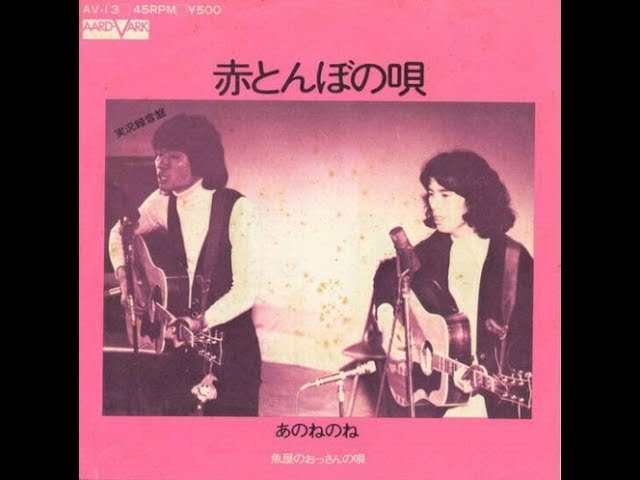
A witty, humorous piece of musical nonsense that sparkles with clever wordplay.
The March 1973 debut single released by Anone-none features distinctive lyrics that morph from one thing to another like a word-association game.
Woven with self-referential lines that incorporate the group’s own name and sprinkled with metaphorical phrases open to multiple interpretations, the song even drew scrutiny from the Japan Commercial Broadcasters Association at the time.
Its melody is a simple folk-song style, sung breezily over guitar accompaniment.
Said to be an arrangement of a comedy routine from a manzai duo active from the Taisho to Showa eras, it carries a nostalgic flavor as well.
A perfect tune to bring smiles to everyone’s faces at parties or fun family gatherings.
Let’s meet in Yurakucho.Furanku Nagai

This is a piece with an urban, sophisticated vibe that is truly captivating.
Set against the backdrop of department stores and tea rooms, it conjures up the lively scenes of the Showa era.
Showcasing the full charm of Frank Nagai, known for his baritone voice, it was released by Nippon Victor in 1957.
In 1958, it was also used in a film of the same name, which drew significant attention.
During the rainy season, when people spend more time indoors, this work—one that lets you share memories of the Showa period—is sure to warmly embrace the hearts of older adults.
Its gentle atmosphere encourages conversation and makes for an enjoyable time—truly a classic choice for music recreation.
What a nice bath.Za Dorifutāzu

This is a song that celebrates the charms of hot spring resorts, beloved from the Showa-era hit TV program “It’s 8 o’clock! Everybody, Gather Round!” The original version, sung by the Duke Aces, was themed around hot spring areas in Gunma Prefecture, and The Drifters covered it on the B-side of their debut single.
The lyrics were adapted to feature hot spring resorts across Japan—such as Noboribetsu and Kusatsu—expressing fondness for onsen through a lively rhythm and call-and-response shouts.
The song was used as the ending theme for both “It’s 8 o’clock! Everybody, Gather Round!” and “Drifters’ Big Laughter,” and it also appeared in a 1969 film.
Humming it together with older adults while reminiscing about hot spring trips can make for a heartwarming moment.
Life is like a Naniwa-bushi (a melodramatic ballad).Hosokawa Takashi

This classic enka song, inspired by the traditional Japanese musical art of rōkyoku, vividly portrays the subtleties of life with deep emotion.
Takashi Hosokawa’s powerful vocals beautifully express life’s joys and sorrows.
Released in 1977, the piece captivated many, earning appearances on NHK’s Kōhaku Uta Gassen and winning multiple awards, including the Japan Cable Radio Awards.
With its universal themes that resonate with each listener’s life experiences, it’s perfect for recreational activities in care facilities or for enjoying music with family.
We hope everyone can form a circle, sing together, clap along, and share a joyful moment.
Tokyo Olympic OndoMinami Haruo

As the name suggests, Tokyo Olympic Ondo was the theme song for the 1964 Tokyo Olympics, and in addition to Haruo Minami, it was performed by prominent singers such as Yukio Hashi, Michiya Mihashi, Kyu Sakamoto, and Saburo Kitajima.
It is said that the association with Haruo Minami became fixed because his version sold the most.
At the time, Minami said, “Japan worked hard and achieved such a remarkable recovery.
The Tokyo Olympics is an opportunity to show that to the world, and I poured my strong desire to make it a success into the song.” For seniors, it may be a track that brings back the feelings of that era.
