

Trivia about hydrangeas. A collection of fun facts related to ajisai (hydrangeas).


Hydrangeas are a common sight in parks, city streets, and temples once the rainy season arrives.
They come in a variety of colors—blue, purple, red, and more—and many people find their rain-dappled appearance especially charming.
In this article, we’ll introduce a collection of fun facts about hydrangeas, a quintessential symbol of early summer.
We’ve gathered information from various angles, including the structure of hydrangeas, the origin of their name, and the reasons behind their colors.
We hope this article inspires you to learn more about hydrangeas.
After reading, be sure to go out and observe real hydrangeas for yourself!
- [For General Audience] Little-Known Trivia and Fun Facts About Hay Fever
- Fireworks Trivia & Fun Facts Summary
- Rainy season trivia roundup: fun facts you'll want to share with someone
- [Snake Quiz] Surprisingly fascinating once you know! Snake ecology & characteristics
- Trivia & fun facts about June
- Trivia about cherry blossoms: a roundup of fun facts to make springtime hanami even more enjoyable
- Collection of trivia and fun facts about stars shining in the night sky
- Learn to Love the Rain! Fun Facts & Trivia Quiz about the Rainy Season for Kids
- Let's take on a four-choice quiz that everyone can enjoy together!
- Useful right away in daily life! Surprising trivia and handy tips
- [3-Choice Quiz] Cherry Blossom Trivia You'll Want to Share with Someone
- Let’s learn more about hydrangeas! Trivia quiz and fun facts about hydrangeas for kids
- [Rain Songs] Songs to listen to on rainy days. A special feature on Japanese rain-themed songs [2026]
Hydrangea Trivia: A Collection of Fun Facts About Hydrangeas (11–20)
Hydrangeas that change to antique colors are called ‘aki-iro ajisai’ (autumn-colored hydrangeas).
When you think of hydrangea colors, what comes to mind? Calm purples and blues, or pinks and whites that brighten up a gentle rain.
Each color has its own charm that suits the scenery, doesn’t it? Among them, there are hydrangeas whose blossoms change into subdued antique tones as the season turns.
It may sound like a rare variety, but they’re already sold at florists.
Achieving those antique colors is said to be quite challenging, but once you manage it, why not display them just as they are?
Writing hydrangea as “紫陽花” began from a misunderstanding.
In Japanese, hydrangea is written as “紫陽花” (ajisai).
In fact, it seems this writing became established due to a misunderstanding.
Minamoto no Shitagō, a mid-Heian period poet and scholar, misinterpreted a Chinese poem he introduced to Japan at the time.
He apparently assumed that the “ajisai” mentioned in a poem by a Chinese poet of that era referred to the Japanese hydrangea.
After the kanji 紫陽花 were assigned to ajisai, that usage became established in Japan as-is.
Incidentally, the specific flower referred to as “紫陽花” in the original Chinese poem has still not been identified.

There are broadly two types: ball-shaped (temari-zaki) and lacecap (gaku-zaki).

There are many kinds of hydrangeas, and they are broadly divided into two types.
A hydrangea is made up of two parts: decorative (sterile) flowers and perfect (bisexual) flowers.
In fact, the parts that look like petals are the decorative flowers—the outermost structures surrounding the actual petals.
At the center of the decorative flowers is the true flower, which is the perfect (bisexual) flower.
When the decorative flowers rim and surround the tiny, bead-like perfect flowers, it’s called lacecap.
A cultivated variation of the lacecap is the mophead, which has few perfect flowers.
Its hallmark is decorative flowers blooming in a rounded, hemispherical cluster like a pom-pom.
During the hydrangea season in the rainy months, it might be fun to look for the differences among hydrangeas.
There are also varieties of hydrangeas that bloom in midsummer.
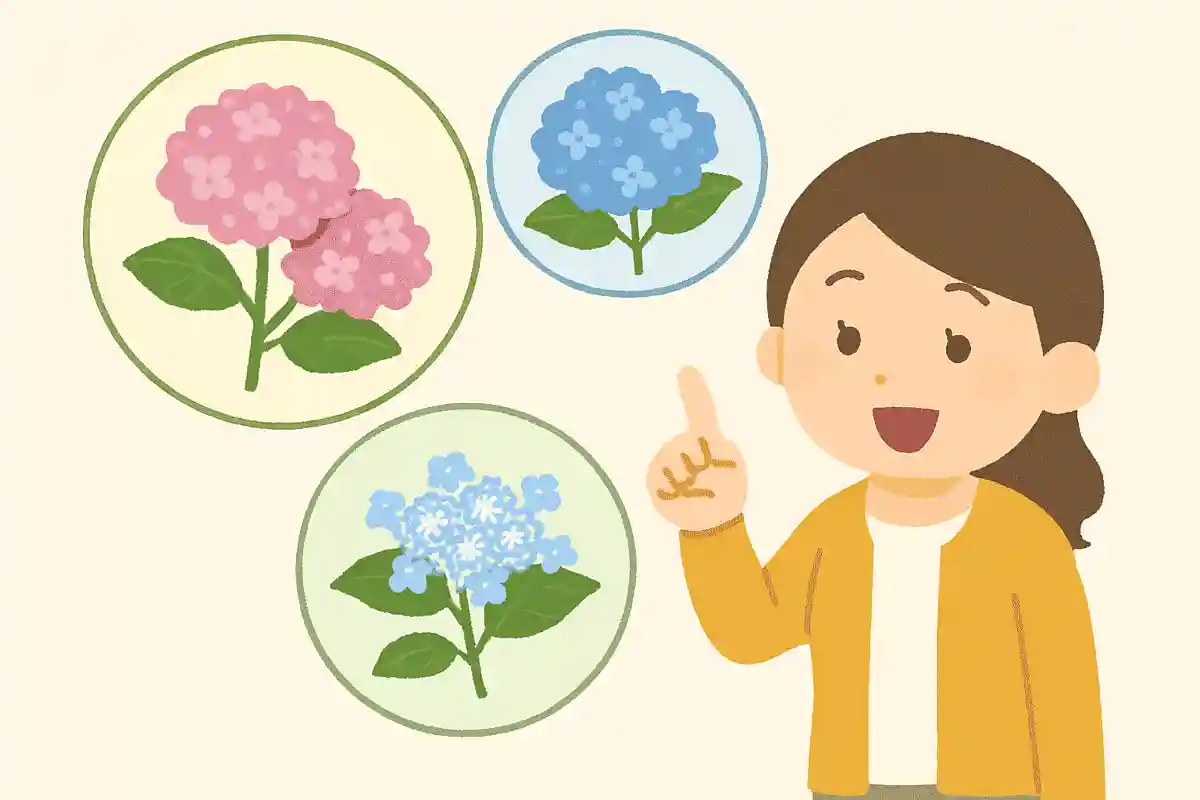
Hydrangeas are strongly associated with blooming during the rainy season, but some varieties actually bloom in midsummer.
The tama-ajisai (Hydrangea involucrata) flowers from around July, when common hydrangeas finish, through autumn.
Its round, bead-like buds—where its name comes from—are also part of its charm.
Panicle hydrangea (Hydrangea paniculata), which blooms from July to September, bears conical clusters with showy white flowers.
As its name suggests, the pyramid hydrangea, with its fresh-looking, triangular pyramid-shaped blooms, also flowers in summer.
Gazing at these cool-looking blossoms might just make you forget the heat of the season.

They can sometimes be affected by a disease called ‘hydrangea phyllody,’ in which petals and other parts turn green.
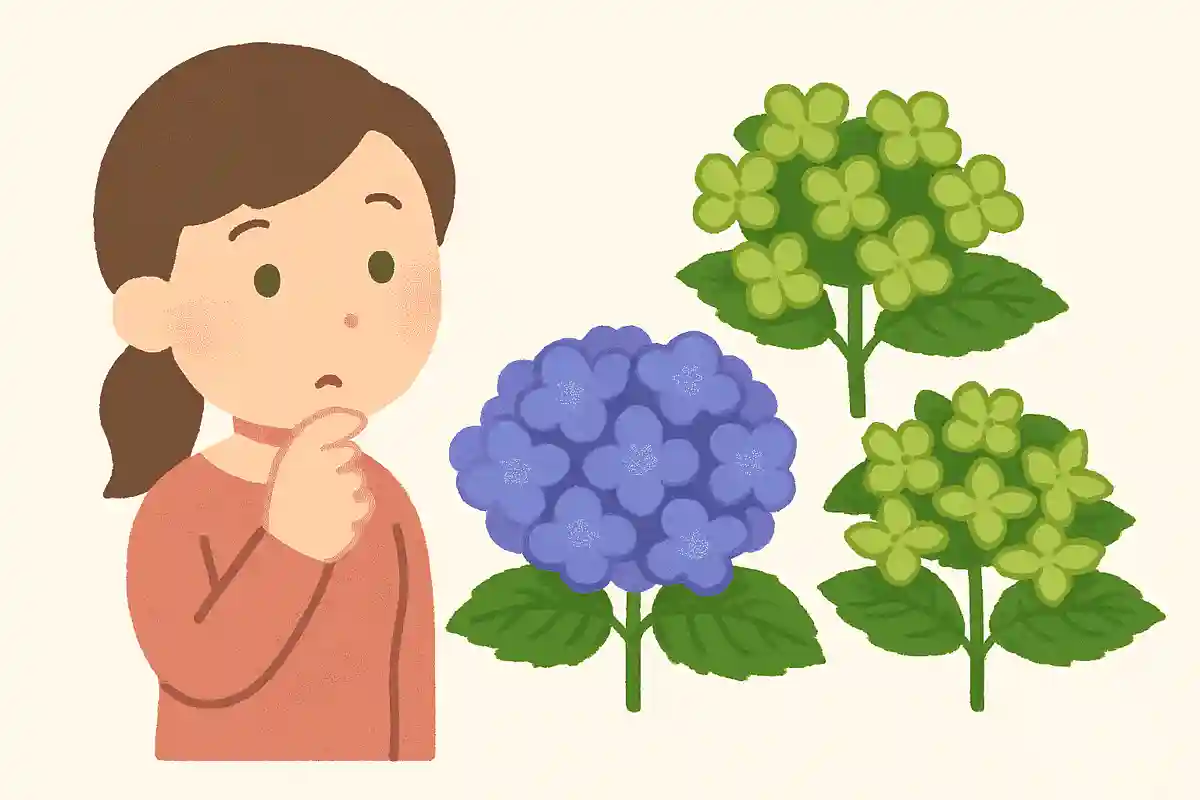
With their color that changes like a kaleidoscope, hydrangeas are beloved by many gardening enthusiasts.
However, hydrangeas can suffer from a disease called “hydrangea phyllody,” in which the flowers and sepals turn green.
It’s caused by a microorganism known as a phytoplasma, and there is no cure.
As a result, infected plants will eventually die.
If there are other hydrangea plants nearby, the disease may spread to them, so once infection is detected, promptly remove the diseased plant.
Daily monitoring is important to prevent the problem from affecting all your plants.
The etymology of hydrangea (ajisai) is ‘atsumari mashite aoi’ (assembled blues), expressed as ‘ashide ai’/‘shūshinran’ meaning ‘many blues gathered together.’
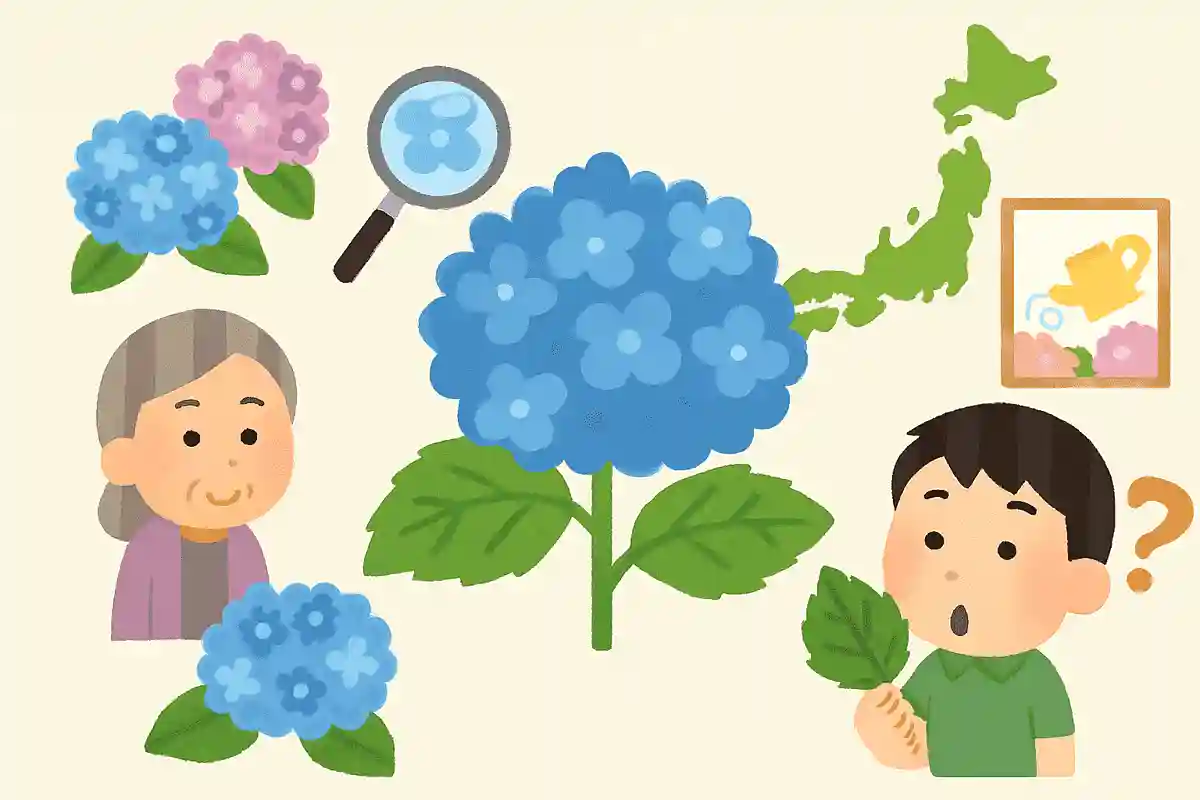
Hydrangeas are cherished as a hallmark of June’s damp, rainy season.
They’re often planted along roadsides and elsewhere, so we see them frequently.
The Japanese word “ajisai” (hydrangea) comes from “adzusai.” Written as 集真藍 (adzusai), it is said to mean “a gathering of true indigo,” referring to many small, indigo-dyed-looking flowers clustered together.
By the way, indigo here refers to a slightly greenish shade of blue.
Hydrangea flower color changes with soil composition, turning blue or purple, among others.
Blue indicates acidic soil, while purple or pink points to alkalinity.
From this, we can also infer that Japan’s native soils were originally acidic.
Hydrangea trivia. A collection of fun facts about hydrangeas (21–30)
There is a hydrangea that won Flower of the Year.
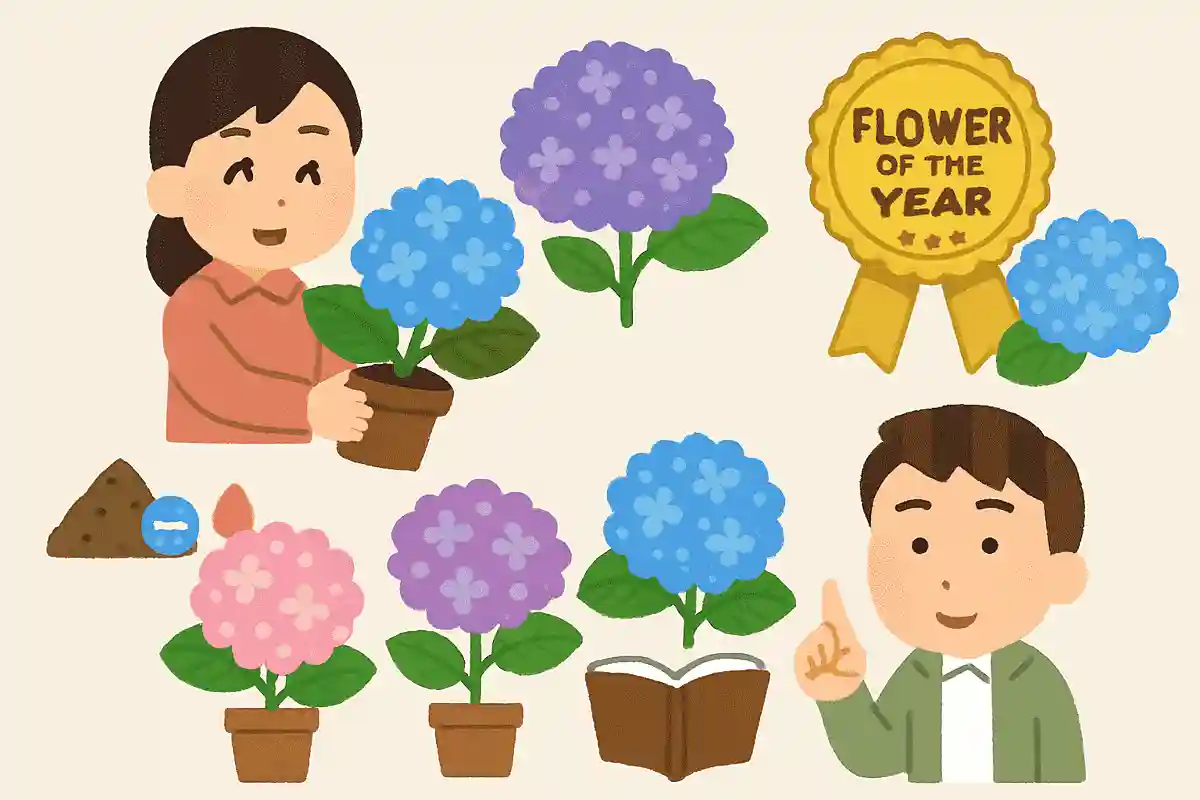
When it comes to hydrangeas, they are most often appreciated as potted plants or in the ground, but they have also been selected several times as Flower of the Year in the Japan Flower Selection.
For example, in 2011, the top prize in the potted plant category went to a variety called Nishoku no Gekko (Two-Tone Moonbow), which is said to gradually change from a lacecap to a mophead as it blooms.
In addition, hydrangeas from Shimane Prefecture, such as Kaleidoscope and Galaxy, have also been highly praised and have been selected as Flower of the Year.
