

Johann Strauss II | Introducing Famous and Classic Pieces

Johann Strauss II, a leading Romantic composer who was active in Vienna, Austria.
Focusing on dance music such as the Viennese waltz and the polka, a Czech folk dance, he was known as the “Waltz King” and the “Sun of Vienna.”
Moreover, having produced masterpieces in operetta as well, he was also called the “King of Operetta,” enjoying immense popularity not only in Austria but throughout Europe.
In this article, we introduce some of Strauss II’s famous and staple pieces.
Why not immerse yourself in his dazzling music?
- [Masterpiece Classics] A special showcase of gem-like masterpieces so beautiful they’ll move you to tears
- A masterpiece by Richard Strauss. Popular classical music.
- Cool classical masterpieces. Recommended classical music.
- [Orchestra] Introducing famous and popular pieces
- Timelessly beautiful classical masterpieces. Recommended classical music.
- Dvořák’s masterpiece. Popular classical music.
- Jean-Philippe Rameau Popular Songs Ranking [2026]
- A poignant classic masterpiece. Recommended classical music.
- Classical Masterpieces: Recommended Works You Should Hear at Least Once
- Elgar’s masterpiece. Popular classical music.
- Mozart: An Introduction to His Signature and Popular Works
- Today's Classics: Recommended classical music and great performances to listen to today
- Robert Schumann | Introduction to his famous and representative works
Johann Strauss II | Introducing Famous and Classic Pieces (21–30)
Thunder and LightningJohann Strauss II

With the bass drum evoking thunder and the cymbals suggesting lightning, it skillfully imitates thunder and lightning.
Although the piece progresses rapidly, rather than painting an eerie image from thunder and lightning, it has the light and enjoyable feel of riding a roller coaster.
Revolutionary MarchJohann Strauss II

When the Revolutions of 1848 broke out, Johann Strauss II was on a concert tour to Eastern Europe.
From Styria in southern Austria, he checked on the situation of the revolution in Vienna, and, judging that the citizens had the upper hand, he declared himself a supporter of the revolution and returned to Vienna.
Taking the lead among the mainly student revolutionaries, he composed pieces such as the “Revolution March,” and even performed “La Marseillaise,” the French revolutionary song that was banned in Austria, engaging in anti-government activities; as a result, he fell out of favor with the court of the time.
Johann Strauss II | Introducing Famous and Classic Pieces (31–40)
In the Forest of KrapfenJohann Strauss II
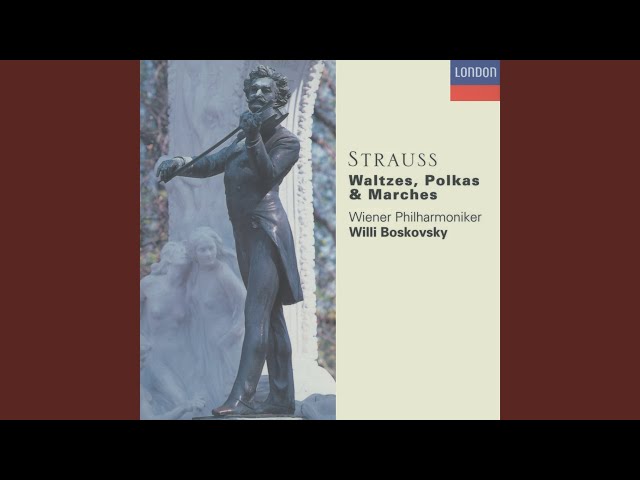
Because Johann Strauss II came to spend half of each year in Pavlovsk, many of his works were composed in Russia.
“In the Krapfenwaldl,” published in 1869, is one such piece; its original title was “In the Forests of Pavlovsk.” The current title was substituted for the Vienna audience.
A bird whistle is used in performance to depict the birds living in the forest.
A Night in VeniceJohann Strauss II

It premiered on October 9, 1883.
The libretto was clumsy, which led to poor reception.
However, the excellence of the music began to attract attention, and with various revisions and adjustments, performances have continued.
There are multiple revised versions.
The opening section is a very striking piece.
Champagne PolkaJohann Strauss II

This piece was composed in a short period of time in Saint Petersburg, Russia.
Its original title was “Champagne at the Ball,” but it was later changed to the current title.
The sound of a champagne bottle being opened appears multiple times throughout the piece, making it a lively number.
The Blue and Beautiful DanubeJohann Strauss II
Here is a Viennese waltz composed by Johann Strauss II in 1867.
The Viennese waltz is a style of waltz that was popular in 19th-century Vienna, characterized by uneven lengths within the three beats, with the second beat played slightly early.
Along with “Tales from the Vienna Woods” and the “Emperor Waltz,” it is regarded as one of the three great waltzes by Johann Strauss II and is affectionately known in Austria as a second national anthem.
It was originally written as a choral work, but its lyrics have been rewritten several times to suit the times.

Overture from the comic opera ‘Die Fledermaus’Johann Strauss II
It opens with a highly energetic phrase.
You’re drawn in by one delightful melody after another.
It feels like a song that makes you unable to wait for tomorrow.
It overflows with hope and vitality.
I think it suits a romance between young people.