

Stand out with your junior high school independent research! A collection of fun experiment and craft ideas

To all middle schoolers who want to wow teachers and friends with a “That’s awesome!” in your independent research project! There are tons of experiments in science and crafts that lead to surprising discoveries—even with simple materials.
Make a train run with copper wire and a battery, pop a balloon with an orange peel…
The real charm is getting to witness strange phenomena you’d never notice in everyday life with your own eyes.
Here, we’ll introduce fun experiments and crafts that can spark ideas for your project.
Whether you love science or not, you’re sure to find discoveries that make you go, “Aha!”
- Recommended for middle school students! A collection of quick science project ideas you can do in a short time.
- [I don't want to be like everyone else!] Recommended independent research topics for high school students
- [Middle School Students] Easy One-Day Science Projects and Crafts Ideas
- Simple and cute summer project crafts! A collection of ideas for girls that will make you want to create
- Recommended for high school students! A collection of easy one-day science project ideas
- For upper-grade boys! Simple yet awesome craft project [Don’t call it lazy]
- Stand out with your junior high school independent research! A collection of fun experiment and craft ideas
- Recommended for elementary school students' independent research! Experiment and observation ideas using everyday materials
- Recommended Independent Research Projects for 5th Graders [Elementary School Students]
- Adults will be hooked! A collection of craft ideas using toilet paper rolls
- [For Elementary School Students] Collection of Science-Related Games and Quizzes
- Amazing discoveries with everyday materials! Fun summer vacation independent research ideas
- [For Upper Elementary Students] Simple but Awesome! A Collection of Summer Vacation Craft Ideas
Stand out with your junior high school independent research! A collection of fun experiment and craft ideas (101–110)
Music Industry and Copyright

An indispensable issue when engaging in music and other artistic activities is copyright.
It’s a matter you’ll be involved with throughout the future, but its content is something even middle school students can understand.
By all means, let’s research it.
Precisely because yours is a generation accustomed to downloading music for free, it’s important to think about this.
DNA extraction experiment

Speaking of DNA, you’ve probably heard about it in contexts like criminal investigations or paternity testing.
DNA, the substance that carries genetic information, is contained in the nucleus of each cell.
How about doing an experiment to extract banana DNA over summer vacation? You can make a DNA extraction solution using distilled water, table salt, and household neutral detergent.
Mash the banana, add the extraction solution, and filter it through gauze to obtain a liquid in which the banana’s DNA is dissolved.
Then, by adding well-chilled ethanol, you can precipitate and extract the banana’s DNA.
It’s a genuine experiment you can do during the summer break when you have more time.

Animal sound cup
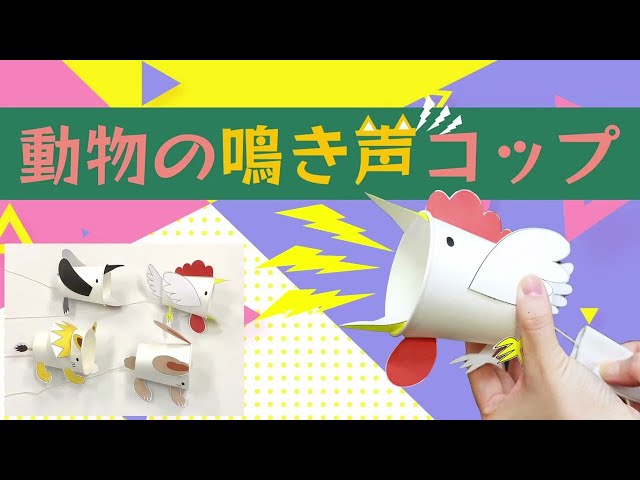
This is a simple craft where you attach a piece of twine to the bottom of a paper cup and stick on the parts of each animal.
By skillfully rubbing the twine installed at the bottom, the goal is to reproduce animal calls.
It’s important—and fun—to experiment with the material used to rub the twine and the rubbing technique to find sounds that are closer to the real thing.
It might also be interesting to modify the base paper cup to experiment with changing the resonance.
As you test different sounds, let’s discover new kinds of calls.

propeller airplane

How about making a propeller airplane that generates thrust through rotation? You can use a commercial kit, or build it from raw materials—which can deepen your attachment to the project and is highly recommended.
It’s important to carefully think through the design, such as how to transmit the rubber’s power to spin the propeller and how to adjust the wing angles to achieve lift.
It’s an experiment packed with different kinds of fun—aiming for your ideal flight through trial and error, and working toward completion while consulting with friends.
Citizen Jury Systems Around the World

In Japan, there is the lay judge system, introduced in 2009, in which citizens participate in court deliberations.
Similar systems have been adopted in countries outside Japan as well.
Let’s explore and summarize the differences in lay judge or jury systems across these countries.
Stand Out in Your Junior High School Independent Research! A Collection of Fun Experiment and Craft Ideas (111–120)
Researching uchimizu (the traditional Japanese practice of sprinkling water to cool streets)

Do you know uchimizu? It’s the practice of sprinkling water on the ground or roads on hot days.
In recent years, fewer households have been doing it and there are fewer opportunities to see it, so many people may not be familiar with it.
In fact, uchimizu has the effect of lowering the air temperature.
How about actually trying uchimizu yourself and measuring changes in temperature and humidity? You could also look into the underlying mechanism.
There are many videos and websites that explain how uchimizu works in an easy-to-understand way, so even those who aren’t confident in science can feel at ease.

Remaking a 100-yen shop clock
https://www.tiktok.com/@nantomokuzai/video/7265645972984827143The part you can see from the back of a table clock or wall clock—the section with the battery compartment and the knob for setting the time—is called the movement.
You could say it’s the heart of the clock.
In fact, clock movements are sold on their own at 100-yen shops and home improvement stores, and you can use them to make your own original clock! If you’re good at woodworking, try starting from scratch by buying a wooden board and cutting a groove to fit the movement.
If that’s not your strong suit, there are also assembly kits with pre-cut grooves available, so you can use those instead.
