

Stand out with your junior high school independent research! A collection of fun experiment and craft ideas


To all middle schoolers who want to wow teachers and friends with a “That’s awesome!” in your independent research project! There are tons of experiments in science and crafts that lead to surprising discoveries—even with simple materials.
Make a train run with copper wire and a battery, pop a balloon with an orange peel…
The real charm is getting to witness strange phenomena you’d never notice in everyday life with your own eyes.
Here, we’ll introduce fun experiments and crafts that can spark ideas for your project.
Whether you love science or not, you’re sure to find discoveries that make you go, “Aha!”
- Recommended for middle school students! A collection of quick science project ideas you can do in a short time.
- [I don't want to be like everyone else!] Recommended independent research topics for high school students
- [Middle School Students] Easy One-Day Science Projects and Crafts Ideas
- Simple and cute summer project crafts! A collection of ideas for girls that will make you want to create
- Recommended for high school students! A collection of easy one-day science project ideas
- For upper-grade boys! Simple yet awesome craft project [Don’t call it lazy]
- Stand out with your junior high school independent research! A collection of fun experiment and craft ideas
- Recommended for elementary school students' independent research! Experiment and observation ideas using everyday materials
- Recommended Independent Research Projects for 5th Graders [Elementary School Students]
- Adults will be hooked! A collection of craft ideas using toilet paper rolls
- [For Elementary School Students] Collection of Science-Related Games and Quizzes
- Amazing discoveries with everyday materials! Fun summer vacation independent research ideas
- [For Upper Elementary Students] Simple but Awesome! A Collection of Summer Vacation Craft Ideas
Stand Out in Your Junior High School Independent Research! A Collection of Fun Experiment and Craft Ideas (111–120)
A science project you can just leave alone
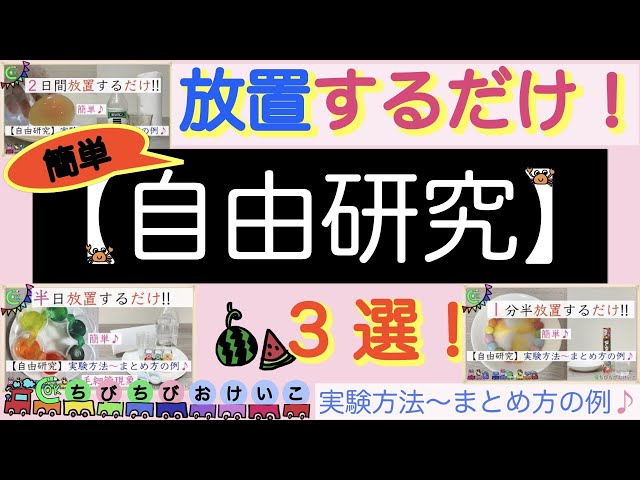
It’s hard to decide what to do for an independent research project, and you don’t want to spend too much time on it, right? So why not try some ideas that you can basically just set and forget? Here are three simple projects.
The first is to line colorful candy-coated chocolates around the rim of a plate, pour in water, and observe what happens.
The second is to soak an egg in vinegar to make a “skeleton egg.” The third is to dip kitchen paper into colored water and observe how it absorbs and changes color.
All of them are very easy, so give them a try!

Stand out with your junior high school independent project! A collection of fun experiment and craft ideas (121–130)
Let’s try mixing water and oil

This is an experiment to see what happens when you mix water and oil.
First, make colored water by adding food coloring to a glass of water.
In a separate glass, pour in some oil, then carefully pour the colored water on top.
Strangely, the colored water you added last will settle at the bottom of the glass, and the oil will form a layer on top.
Even if you stir it with a stick, they won’t mix at all.
It’s a fun experiment that overturns the common belief that liquids mix with each other.
Give it a try! The non-mixing liquid you make can also be put into a bottle to create a playful decorative piece.
Let’s explore the secrets of sound
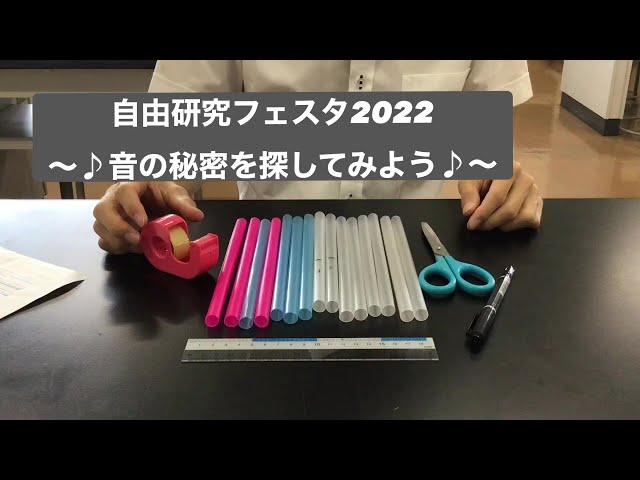
Here’s an idea for a flute you can make just by connecting straws.
Prepare straws that are all the same thickness and length.
You’ll need 8 straws for the mouthpiece, and since you’ll place spacer straws between them, prepare an additional 7, for a total of 15.
Cut the spacer straws to 5 cm.
The straws that become the flute pipes will vary in length depending on the pitch, so be sure to measure their lengths carefully with a ruler.
After cutting, seal one end of each straw with tape to make it a closed pipe.
Once everything is connected and glued together, it’s done.
Try experimenting with different lengths to see what sounds they make.
I tried expressing sound with salt

Have you ever used a tuning fork in a science class? There’s an experiment where you place two tuning forks side by side with a screen between them and strike one of the tuning forks.
The result shows that sound carries vibrations through the air to the other tuning fork, creating resonance.
How about a free research project where you visualize sound vibrations using salt? The patterns in the salt change with pitch, which is quite fascinating, and you could also study factors like room temperature and differences between instruments that produce the sound.
Doing this research might make you more sensitive to the “don-don” sound of drums!
Making battlefield midday meals in the Sengoku period

I think making and eating jinchūshoku called hyōrōgan—field rations actually eaten on battlefields during the Sengoku period—will spark interest in history.
The ingredients are easy to gather at any supermarket, and even those who aren’t good at cooking can make them with no trouble.
Historical research of the area where you live

Some of you may be struggling to find a subject to research, even though you want to study something.
In that case, researching the history of the area where you live might be a good idea.
You might discover unexpected history behind the park you usually play in, or find that a building you never paid attention to is actually historically significant.
Searching online is convenient, but asking local residents or visiting the library can also be fun and give you a real sense of doing research.
As a variation, you could also look into the history of your school.

Electric string telephone production

String telephones are a classic kids’ craft, but they’re a bit too simple for middle schoolers, aren’t they? So this time, I’d like to introduce the idea of an electric string telephone.
It looks just like a regular string telephone, but by using components built into a personal safety alarm, we’ll make a string telephone that carries your voice as an electrical signal.
It’s a simple yet authentic project that uses tools and a soldering iron, so middle school students should have fun building it.
Once the string telephone is complete, please also put together a summary of the steps and an explanation of how the voice transmission works.