

Stand out with your junior high school independent research! A collection of fun experiment and craft ideas


To all middle schoolers who want to wow teachers and friends with a “That’s awesome!” in your independent research project! There are tons of experiments in science and crafts that lead to surprising discoveries—even with simple materials.
Make a train run with copper wire and a battery, pop a balloon with an orange peel…
The real charm is getting to witness strange phenomena you’d never notice in everyday life with your own eyes.
Here, we’ll introduce fun experiments and crafts that can spark ideas for your project.
Whether you love science or not, you’re sure to find discoveries that make you go, “Aha!”
- Recommended for middle school students! A collection of quick science project ideas you can do in a short time.
- [I don't want to be like everyone else!] Recommended independent research topics for high school students
- [Middle School Students] Easy One-Day Science Projects and Crafts Ideas
- Simple and cute summer project crafts! A collection of ideas for girls that will make you want to create
- Recommended for high school students! A collection of easy one-day science project ideas
- For upper-grade boys! Simple yet awesome craft project [Don’t call it lazy]
- Stand out with your junior high school independent research! A collection of fun experiment and craft ideas
- Recommended for elementary school students' independent research! Experiment and observation ideas using everyday materials
- Recommended Independent Research Projects for 5th Graders [Elementary School Students]
- Adults will be hooked! A collection of craft ideas using toilet paper rolls
- [For Elementary School Students] Collection of Science-Related Games and Quizzes
- Amazing discoveries with everyday materials! Fun summer vacation independent research ideas
- [For Upper Elementary Students] Simple but Awesome! A Collection of Summer Vacation Craft Ideas
Stand Out with Your Junior High School Independent Research! A Collection of Fun Experiment & Craft Ideas (141–150)
Straw thermometer

How about making a thermometer using a straw, water, and paint? You can tell changes in temperature by the height of the water rising inside the straw, so try placing the thermometer in different spots like under direct sunlight or in the shade of a tree.
While it won’t give you an exact temperature, the changes will be easy to see, which makes it quite fun.
The History of Instant Ramen

The story of Momofuku Ando, the founder of instant ramen, was even featured in an NHK morning drama and became a hot topic.
Instant ramen is one of Japan’s delicious and remarkable preserved foods, and it’s something everyone has eaten.
Nowadays, many kinds of instant ramen are enjoyed not only in Japan but in many countries around the world.
Wouldn’t it be fascinating to look into the history of instant ramen—along with the historical context surrounding it?

Research about Japanese tea

When time is limited, it’s hard to prepare anything unusual, isn’t it? So here’s something to try: a study of Japanese tea.
You should be able to find tea leaves at nearby stores like supermarkets or shopping malls.
Once you get some, explore how the flavor changes with water temperature and steeping time, and figure out the best way to brew it for the most delicious taste.
Since you’ll probably be brewing a lot of tea, having paper cups on hand will be convenient! You could also look for traditional Japanese sweets that pair well with tea.

Stand out with your junior high school independent research! A collection of fun experiment and craft ideas (151–160)
Programming

How about making “programming,” which has been a required subject in elementary schools since 2020, the theme of a free research project? When you hear programming, you might think of memorizing special command code and feel it’s difficult, but there are free tools that even children can learn with easily.
For example, Scratch, which is also popular as teaching material.
It’s free to use, and since you don’t have to type code, it’s fine even if you’re not good at typing.
You can program simply by selecting and stacking blocks that replace code from categories like “Events” and “Motion”! For junior high school students, after creating a program in Scratch, it might be a good idea to research and summarize what actual code would look like.

Shiny 10-yen coin experiment
Even though a 10-yen coin is just 10 yen, a brand-new, shiny one somehow feels special, doesn’t it? It shouldn’t be worth more than 10 yen, and yet… The human heart really is a mystery.
Let’s try making a 10-yen coin shine.
This is a popular independent study topic for elementary school students, so as a plus, let’s add a middle-school-level perspective.
For example, experiments using strong acids or weak alkaline chemicals that elementary students likely wouldn’t know about.
You could also add originality by using purified water for rinsing, employing a high-pressure washer, and so on—these touches will give your research more credibility.
Mold Growth Experiment

Mold is something you see a lot during the rainy season.
It doesn’t just show up in the back of closets or storage spaces—it can also grow on foods like bread and cookies, which can be really unpleasant.
However, some types of mold are actually useful for making vaccines.
And of course, they’re the unsung heroes essential for producing things like cheese and bacon.
Doing an independent study on different kinds of mold is also recommended! Researching types of anti-mold agents and the environments where mold grows easily could even lead to unexpected discoveries.
Just be sure not to forget your mask when studying mold!
Experiment to make clear ice
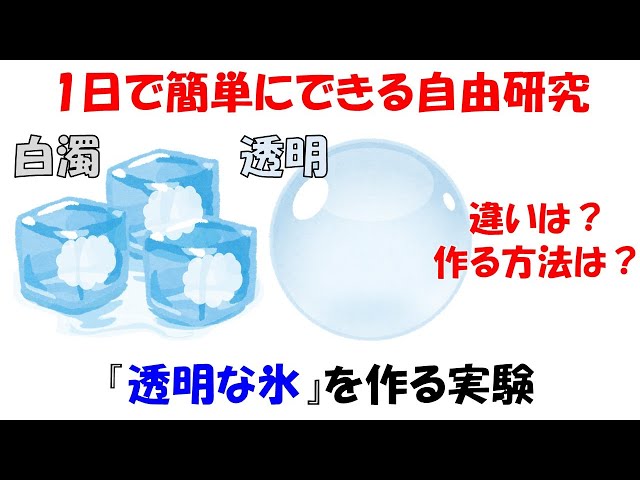
If you take a close look at the ice in drinks served at shops or the ice cubes sold in stores, they’re beautifully clear.
Meanwhile, the ice you make at home often looks cloudy, doesn’t it? That’s because clear ice contains fewer impurities and is frozen slowly over time.
Once you know the trick, it’s nothing special—but turning this mystery into a science project could be fun.
People often say you can make clear ice by wrapping water in bubble wrap (the cushioning material) and chilling it, but it would be great to run comparative experiments on those conditions.
Ultra-clear ice really draws attention!