

A collection of nostalgic hits from the ’70s to 2000s that are perfect for livening up karaoke


When you go to karaoke with people from the same generation—like at class reunions, year-end parties, or New Year’s gatherings—nothing gets the energy up like nostalgic hits! The real charm of these retro tunes is that only those who lived through the same era can sing and listen while reminiscing about those days.
In this article, we’ve carefully selected hit songs from the 1970s, 80s, 90s, and 2000s—tracks that were beloved back then and are still cherished by many today.
Use this as a guide when choosing songs for karaoke with friends from your generation!
- [Recommended for people in their 70s] Songs that get everyone excited. Songs you’ll want to sing at karaoke.
- Songs Everyone Knows: A Popular Karaoke Collection You Can Sing Regardless of Age
- [Recommended for people in their 70s] Classic nostalgic hits: A collection of youth songs
- A collection of nostalgic hits from the Heisei era: Let’s look back at iconic songs from the 1990s and 2000s.
- From Showa-era kayōkyoku to J-POP! A nostalgia-packed roundup of karaoke crowd-pleasers
- [Karaoke] A roundup of songs that are easy for women to sing!
- Even karaoke beginners can relax! Easy-to-sing songs for men
- Karaoke Popularity Ranking by Generation [50s] [2026]
- Karaoke songs you’ll want to sing for men in their 70s: Enka and nostalgic Showa-era pop
- When you want to hype it up with your peers! Karaoke songs recommended for Gen Z
- [For People in Their 40s] Karaoke Songs That Are Easy to Sing: 2026 Ranking
- [Nostalgic Songs] A compilation of classic anime themes that hit home for those born in the Showa and Heisei eras
- Timeless classics only! Showa-era hit songs perfect for acoustic sing-alongs
1970s–1980s (31–40)
High School LullabyImokin Torio

This song was by a unit formed on Kinichi Hagimoto’s variety show “Kin-Don! Good Kids, Bad Kids, Ordinary Kids,” consisting of Kenji Nagae, Ryoichi Yamaguchi, and Koji Nishiyama.
As the show’s popularity grew, the track also became a major hit.
By today’s standards, it was the forerunner of those TV show tie-in novelty projects, but in reality it was created by an amazing duo—lyrics by Takashi Matsumoto and music by Haruomi Hosono.
Countless musicians were later influenced by it, and I consider it a classic of the 1980s.
Aoba Castle Love Songsatou muneyuki

This is the debut single by Muneyuki Sato, released in 1978.
The lyrics evoke the scenery and scenes of his hometown, Sendai City in Miyagi Prefecture, and over time the song has come to be regarded as a song of Sendai itself.
It’s said that the phrase “Mori no Miyako” (City of Trees) gained nationwide recognition thanks to this song.
In Sendai, it has become a beloved classic, used as the train departure melody and as a cheer song for the Rakuten baseball team.
Words of FarewellKaientai

This is the 16th single by Kaientai, a three-member folk group centered around Tetsuya Takeda, who continues to be active across a wide range of fields including dramas and variety shows.
It’s also known as the theme song for the TV drama “Mr.
Kinpachi in Class 3B,” which became a social phenomenon, and has long been sung as a classic graduation song.
Its beautiful melody, tinged with melancholy yet distinctly pop, is soothing to the heart no matter the era.
It’s a quintessential hit of the 1980s that’s guaranteed to liven up karaoke sessions with members of any generation.

applausechiaki naomi
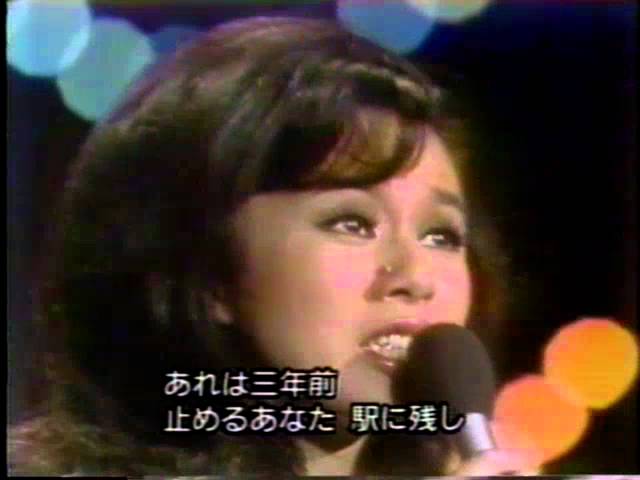
This is an award-winning song from the 1972 Japan Record Awards and one of Naomi Chiaki’s signature numbers.
The lyrics, written from the perspective of someone mourning a deceased lover, are heartrending and captured the hearts of many fans at the time.
Its richly atmospheric, quintessentially Showa-era accompaniment pairs perfectly with Chiaki’s expansive, deeply resonant vocals.
Hugely popular at karaoke as well, this song can make you feel as if you’ve traveled back to the moment it was released.

1970s–1980s (ages 41–50)
dragonflyNagabuchi Tsuyoshi

This was Tsuyoshi Nagabuchi’s 20th single, released in October 1988.
It was used as the theme song for the TBS drama “Tonbo,” in which Nagabuchi himself starred, and it became a million-seller.
It’s one of the great folk-rock songs of the Heisei era.
When it comes to singing this song well at karaoke, the key is, above all, the “ma,” the sense of space between phrases and between lines of the lyrics.
Melodically, there aren’t many particularly difficult parts to sing, so try to keep a solid sense of the rhythm as you perform.
Since Nagabuchi has a very distinctive vocal style, it can also be fun to lean into an impression of him—including the scat-like parts in the intro.

Dream GuideYamaguchi Momoe

This is the 17th single, released in April 1977.
Written and composed by the duo Yoko Aki and Ryudo Uzaki, it marks a stylish bossa nova number that shifts dramatically from the previous rock style.
Try singing this timeless classic with a light touch.
City LightsSakai Masaaki

Masakazu Sakai’s 1973 work, with lyrics by Yū Aku and music by Keisuke Hama.
While Sakai has excellent solo songs like “Saraba Koibito” and “Kitakaze Kozō no Kantarō,” I personally think his greatest masterpiece is “Kono Machi no Akari.” It was also used as an insert song in the drama “Jikan Desu yo,” in which Sakai himself appeared.