

How many can you solve? Brain-flexing math riddle quiz


Math is truly fascinating! It’s not just about calculation drills—there are rules and puzzles you can use in everyday life hidden within it.
Here, we’ve gathered math quizzes that nurture children’s thinking skills and number-based riddles that spark inspiration, all designed to make learning fun.
From intuitive, illustration-based questions to logical problems where you fill in the blanks with numbers, we’ll share the full appeal of math.
There might even be some problems that adults surprisingly can’t solve.
Gather the whole family and dive in together with excitement!
- Math quiz for elementary school students
- [For Elementary School Students] Cipher Quiz: Fun Puzzle Riddles
- [Interesting] Collection of Math Quiz Problems
- [Easy] Quizzes That Elementary School Students Can Solve! A Collection to Nurture Wisdom
- [Satisfying When Solved] Challenging Quizzes Recommended for Elementary School Students!
- [Interesting] Collection of Matchstick Quiz Problems
- A math quiz for adults. Can you solve it?
- Fun quizzes for elementary school kids: a collection of questions everyone can enjoy together
- [Get Friendly with Games] Math Games, Apps, and Activities
- Easy Riddles for Elementary School Students
- [For Elementary School Students] Recommended Riddle Collection
- Do you get tripped up too? A fun roundup of 10-time quiz questions
- [Trick Quiz] Quiz Questions That Excite Everyone from Kids to Adults
How many can you solve? Brain-flexing math riddle quiz (1–10)
[Math Quiz] 5-Yen Coin Savings
![[Math Quiz] 5-Yen Coin Savings](https://i.ytimg.com/vi/E2SfqU5cTnM/sddefault.jpg)
This is a 5-yen coin saving quiz that’s also effective as brain training.
In this quiz, there’s a boy who saves 5 yen every day.
Since his piggy bank was small, he would exchange coins as follows: when he had two 5-yen coins, he exchanged them for a 10-yen coin; when he had five 10-yen coins, he exchanged them for a 50-yen coin; when he had two 50-yen coins, he exchanged them for a 100-yen coin; and when he had five 100-yen coins, he exchanged them for a 500-yen coin.
Based on these conditions, let’s determine the coin amounts at specific counts.
The trick is to think in terms of the smallest possible denominations.

Math Quiz: What are the ages of the five siblings?

High difficulty! Here’s a puzzle to determine the ages of five siblings.
In this quiz, you’ll figure out each of their ages.
The only information given is the sums of the ages of pairs of siblings.
There are 10 sums in total, each representing the sum of two different siblings’ ages.
Using these, let’s uncover how old each sibling is.
The key to solving this problem is that the eldest is older than the second eldest, and the second eldest is older than the third.
Keep that in mind as you set up equations and plug in the numbers.
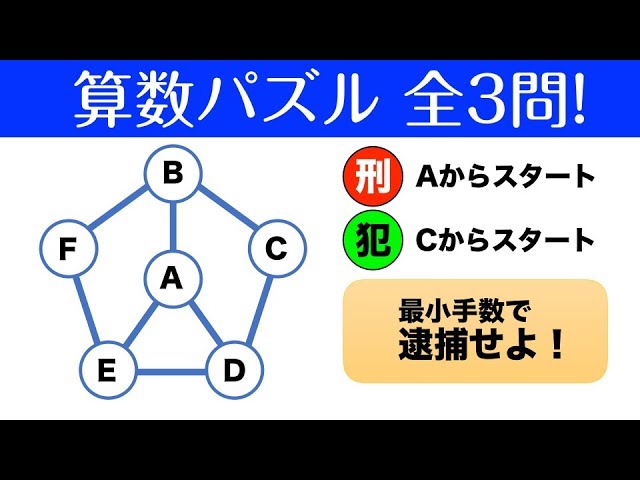
[Arithmetic Puzzle] 3 Maze Problems in Total
![[Arithmetic Puzzle] 3 Maze Problems in Total](https://i.ytimg.com/vi/AW-Y8F2T1vg/sddefault.jpg)
This is a math quiz recommended for elementary school students who love mazes! The problem works like a maze from start to goal, and you have to reach the goal—or guess where the goal is—while following set rules such as “You can’t use the same path twice” and “Each door can only be opened once.” Unlike problems with letters or numbers, you can progress visually while thinking it through, so it’s great fun to get together with a few friends and solve it as a group! Read the rules carefully and figure out the correct route!

How many can you solve? Brain-flexing math riddle quiz (11–20)
Shape Quiz

Shape puzzles are really fascinating, aren’t they? It’s so much fun to discover rules that aren’t obvious at first glance, and you can’t help but get absorbed in them.
Elementary school students can probably solve them with more flexible thinking than adults! Be sure to read the questions carefully so you don’t miss any hints.
That “Aha!” moment when you figure out the answer is such a great feeling.
Solving shape puzzles really boosts your thinking and reasoning skills.
It’s also fun to work on them together, so definitely try tackling lots of different problems!
Area Quiz

Want to try a math quiz with some shapes partially hidden? It might feel difficult at first, but if you use the known areas as hints, you’ll arrive at the answer.
It’s a quiz that both kids who are good at math and those who find it challenging can enjoy.
The charm is that you can approach it like a riddle.
As you solve the problems, you’ll naturally pick up the basics of mathematics.
Give it a try with your child—you’re sure to discover how fun math can be!
Insert ‘+’, ‘-‘, ‘×’, and ‘÷’ to complete the equation!

Let me introduce a relatively basic fill-in-the-blank puzzle.
You’re given blanks and numbers, and your task is to insert +, −, ×, or ÷ to complete the equation.
It’s not just about calculating—the key is flexible thinking.
By the way, this type of fill-in-the-blank quiz appears in various problems on YouTube and in books.
It’s perfectly fine to enjoy using those.
Some of them even ask you to complete quite complex equations.
Math puzzles that children excel at but adults struggle with
There are problems that use playing cards and ones where you fill in numbers in blanks like a crossword.
Kids with flexible thinking often solve these surprisingly easily, but adults tend to struggle.
It’s fun to compete with your family.
