

Prefectural anthems you might not know well. Explore the lyrics and history of your hometown

You may have heard prefectural anthems at least once in your school music classes or at local events.Did you know that not every prefecture actually has one, and that some prefectures have even established multiple songs as their prefectural anthems?In this article, we’ll introduce all the prefectural anthems from around the country.The more you learn about these songs—filled with hometown scenery, history, and the pride of their residents—the deeper the world they reveal becomes.Be sure to check out the songs from your own hometown or any regions you’re curious about!
- [Japanese School Anthems] A Hot Topic at Koshien! From Beautiful Anthems to Unique Ones, All Introduced at Once
- [Local Songs] Recommended tracks packed with Japan’s nationwide classics and hometown pride
- A roundup of regional enka songs: classic hits that feature places from all across Japan in their lyrics.
- A Nationwide Compilation of Timelessly Beloved Railway Songs
- [Elementary School Music] List of Popular and Nostalgic Songs That Have Appeared in Textbooks
- Party songs and official theme songs of Japanese political parties. Surprisingly catchy fight songs, too.
- Miyagi Songs: Popular tracks that celebrate famous sights and specialties, and timeless pieces filled with love for home
- [Elementary School Chorus Songs] A comprehensive introduction from classic standards to the latest hit songs!
- [Songs of Saitama] A Wealth of Humor-Filled Classics! Local Anthems Packed with Love for Saitama
- Chiba Songs: A comprehensive introduction, from famous tunes filled with hometown love to local theme songs
- [Akita Songs] A Collection of Gem-Like Local Tunes Filled with Love for Hometowns
- [Japanese Folk and Regional Songs] A Collection of Beloved Masterpieces from Across Japan, Brimming with Local Pride
- [Folk and Children's Songs of Hokkaido] Songs of Hokkaido that continue to be loved across generations
Tohoku and Hokkaido (1–10)
Fukushima Prefectural SongFukushima-ken

The Fukushima Prefectural Residents’ Song is adorned with the prefectural flower, tree, and bird throughout its lyrics, beautifully expressing the region’s natural beauty.
Established in February 1967, it is composed of lyrics and music selected through a public contest.
Created to strengthen residents’ sense of unity, the melody is cheerful yet somehow nostalgic—a work brimming with hometown pride.
After the Great East Japan Earthquake, it has also been used on television and at ceremonies as a symbol of hopes for recovery.
Even more than half a century later, it continues to be cherished and sung as a song that supports Fukushima’s recovery and hope for the future.
Akita Prefectural AnthemAkita-ken

This prefectural anthem, which sings of Akita’s mountains, rivers, and history in an elevated style, is a work of great historical significance established in October 1930.
It is the older of the two Akita prefectural songs.
The composition was created by Tamezo Narita from Kitaakita City, known for pieces such as “Hamabe no Uta,” with lyrics by Masashi Kurata from Daisen City and supplementary lyrics by Tatsuyuki Takano.
Its solemn and beautiful melody possesses an artistic resonance.
Although opportunities to sing it declined for a time after the war, it was reappraised when it was incorporated into the third movement of “Oinaru Akita,” a work for choir and wind band produced in 1968 as part of the Meiji centennial project, and it remains widely beloved today.
It is even hailed as one of Japan’s three greatest prefectural anthems.
Message from the Blue ForestAomori-ken
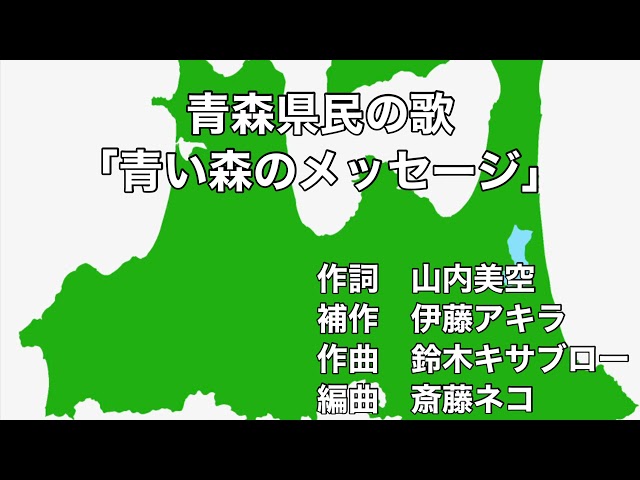
A song established in January 2001, marking the dawn of the 21st century, that can be called a new symbol of Aomori Prefecture.
Aomori has two officially designated prefectural songs, but this is the one primarily used.
It’s striking how the phrase “Aoi Mori” (“Blue Forest”) is portrayed not only as the natural landscape, but also as a symbol of people supporting one another.
Produced by Katsuhisa Hattori, the piece features a sound that combines grandeur with warmth.
Why not listen closely and savor Aomori’s rich four seasons?
Tohoku and Hokkaido (11–20)
Aomori Prefecture AnthemAomori-ken

This work magnificently sings of Aomori’s rich nature, its industries, and its hope for the future.
Established in September 1971 to commemorate the 100th anniversary of the prefectural government, it is a prefectural anthem with a long history.
The lyrics were written by local haiku poet Yosuke Nagasawa, with additional lyrics by poet Hachiro Sato and music by Toshimitsu Tanaka.
The words evoke mountains and seas that symbolize the prefecture and express hopes for its development as an industrial city, conveying the fervor of Japan’s period of rapid economic growth at the time.
Although another song established in 2001 is now the mainstream, this piece has not been abolished under current regulations and can be regarded as a valuable work that tells the story of the prefecture’s journey.
Prefectural AnthemAkita-ken

December 1959, as Japan moved from postwar reconstruction into a period of rapid growth.
This work was selected through a public contest by Akita Prefecture as a symbol of a new era and enacted as the second prefectural anthem.
Reflecting the spirit of a “leaping-forward Akita” in anticipation of the Hachirōgata land reclamation project and the National Sports Festival, it is composed in a bright and lively style.
In 1961, King Records produced it on SP records, and it was later reissued as a single.
It was also incorporated into the fourth movement of “Great Akita,” a piece for chorus and wind band created in 1968 as part of the Meiji Centennial commemorations, and has been cherished deeply as more than a mere ceremonial song.
Kantō (1–10)
Ibaraki Prefecture Residents’ SongIbaraki-ken

Enacted in March 1963, this work captivates with lyrics depicting the beautiful ridgelines of Mount Tsukuba and its rich waterside scenery.
The melody, arranged by composer Kozo Hirai, is characterized by a bright, clear resonance.
In 2025, it will be re-recorded for the first time in about 60 years with the cooperation of local high school students, making it a piece that can be called a symbol of Ibaraki, passed down across generations.
Saitama Prefectural SongSaitama-ken

This march-style piece was created to unite the hearts of the prefecture’s residents in the lead-up to the 1967 Saitama National Sports Festival.
Its lyrics weave in natural beauties such as the Chichibu mountain range and the flow of the Tone River.
Established in September 1965 and released on record, it has the history of being born as the second generation, replacing the prewar original.
It is also used as the prefectural government’s telephone hold music, so many people may have heard it in unexpected places.