


You may have heard prefectural anthems at least once in your school music classes or at local events.Did you know that not every prefecture actually has one, and that some prefectures have even established multiple songs as their prefectural anthems?In this article, we’ll introduce all the prefectural anthems from around the country.The more you learn about these songs—filled with hometown scenery, history, and the pride of their residents—the deeper the world they reveal becomes.Be sure to check out the songs from your own hometown or any regions you’re curious about!
- [Japanese School Anthems] A Hot Topic at Koshien! From Beautiful Anthems to Unique Ones, All Introduced at Once
- [Local Songs] Recommended tracks packed with Japan’s nationwide classics and hometown pride
- A roundup of regional enka songs: classic hits that feature places from all across Japan in their lyrics.
- A Nationwide Compilation of Timelessly Beloved Railway Songs
- [Elementary School Music] List of Popular and Nostalgic Songs That Have Appeared in Textbooks
- Party songs and official theme songs of Japanese political parties. Surprisingly catchy fight songs, too.
- Miyagi Songs: Popular tracks that celebrate famous sights and specialties, and timeless pieces filled with love for home
- [Elementary School Chorus Songs] A comprehensive introduction from classic standards to the latest hit songs!
- [Songs of Saitama] A Wealth of Humor-Filled Classics! Local Anthems Packed with Love for Saitama
- Chiba Songs: A comprehensive introduction, from famous tunes filled with hometown love to local theme songs
- [Akita Songs] A Collection of Gem-Like Local Tunes Filled with Love for Hometowns
- [Japanese Folk and Regional Songs] A Collection of Beloved Masterpieces from Across Japan, Brimming with Local Pride
- [Folk and Children's Songs of Hokkaido] Songs of Hokkaido that continue to be loved across generations
Tohoku and Hokkaido (1–10)
Mogami RiverYamagata-ken
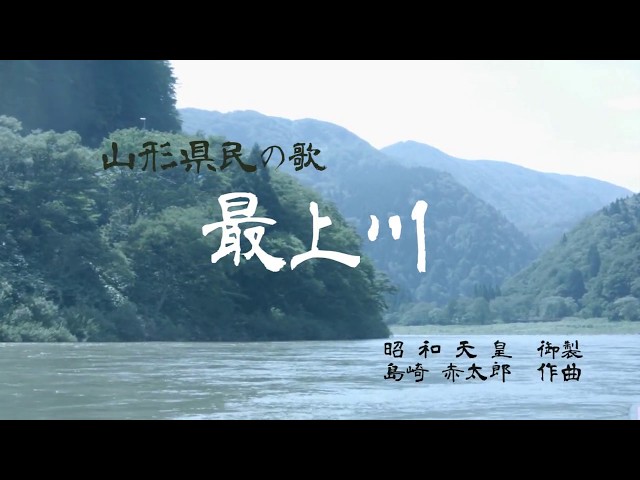
One of Japan’s three great prefectural songs, it eloquently sings—through a dignified melody—of the majestic figure of the mother river that flows throughout Yamagata Prefecture.
Based on a waka composed from impressions during Crown Prince Hirohito’s visit in 1925, Akataro Shimazaki set it to music in 1930.
Beloved by residents for many years, it was officially designated as the prefectural song in March 1982.
Though consisting of just a single tanka, it distills the purity of a river that flows gently across vast fields and empties into the sea.
It continues to be sung at school events and ceremonies within the prefecture, and a monument bearing the song stands in Hiyoriyama Park in Sakata City.
Long, Long Ago (Home Song)Hokkaidō

Among the three songs designated as songs of the people of Hokkaido in May 1967, this one is cherished as a home song.
In contrast to the vigorous march “Hikari Afurete,” it gently sings of the history of pioneering and everyday life, like an old folktale.
The lyrics were selected through a public contest, and the music was composed by Yoshinao Nakada, known for “Medaka no Gakkō.” Its warm melody remains deeply etched in the hearts of Hokkaido’s people today.
Radiant with Light (March)Hokkaidō

Do you know a march that captures the grand sense of scale unique to Hokkaido, with its vast lands? This piece celebrates the rich natural beauty of plains, forests, and lakes, while proclaiming a strong hope for the future.
Though a march, it is characterized by an accessible, friendly melody.
The composer is Hachidai Nakamura, famous for “Ue o Muite Arukō” (“Sukiyaki”).
When it was designated in May 1967 as the “Song of the People of Hokkaido” as part of the Hokkaido Centennial Project, the public call for lyrics drew an astonishing 1,463 submissions.
Among the three officially designated Hokkaido prefectural songs, this is the one most frequently performed.
Hokkai Bayashi (Hokkaido Residents’ Folk Dance)Hokkaidō

In fact, Hokkaido has as many as three songs that have been designated as “Songs of the People of Hokkaido.” Among them, the one introduced here is Hokkai Bayashi, an ondō-style piece beloved at festivals and Bon dances.
With a powerful rhythm that sings of the vast land and rich nature, the work perfectly embodies the very scale of Hokkaido.
It was produced in May 1967, based on lyrics solicited from the public as part of the Hokkaido Centennial Commemoration project.
Miyagi Prefectural AnthemMiyagi-ken

With lyrics by Tokuo Tōyama and music by Fumihiko Fukui, this work is a piece whose lyrics—expressing prayers for peace, the rich nature of the Sendai Plain, and a vow to rebuild industry—resonate alongside a solemn melody.
In September 1948, it was released by Nippon Columbia as an SP record, sung by Ichirō Fujiyama and Aiko Anzai with an arrangement by Yūji Koseki.
Performed at events such as the ceremonies for the 150th anniversary of the prefectural system and lobby concerts, it is an indispensable presence that connects the administration and the citizens, carrying forward the pride of Miyagi Prefecture.
Shining HometownMiyagi-ken

Shining Hometown was created during the postwar reconstruction period as part of efforts to revive a devastated homeland.
With lyrics by Tokuo Tohyama and music by Fumihiko Fukui, it carries a powerful message vowing the advent of peace, the promotion of industry, and the building of a new Miyagi.
Unlike the prewar prefectural anthem, the process of selecting the lyrics through a public call in collaboration with the Kahoku Shimpo reflects the residents’ own zeal to rebuild their homeland with their own hands.
It is also noteworthy that the song continues to be sung at official occasions to this day.
Iwate Prefecture Residents’ SongIwate-ken

This is a song established in March 1965 to commemorate the completion of the new Iwate Prefectural Government building.
The composition and arrangement were by Yoshinao Nakata, known for works such as “Summer Memories.” The lyrics, selected from a public contest, were written by Koji Tahara and depict Iwate’s vast skies, its storied culture, and hopes for the future.
Its bright, powerful melody stirs a sense of pride in one’s hometown.
At the time it was established, a single was released by Victor featuring performances by Sumito Tachikawa and Kyoko Ito.
Years later, in September 2007, a newly recorded version began airing within the prefectural office to build momentum for Hiraizumi’s World Heritage inscription and the hosting of the National Sports Festival.
Even as times change, it continues to be sung in evolving forms, serving as a symbol of Iwate.