

Maurice Ravel Popular Songs Ranking [2026]

He was a French composer born on March 7, 1875.
He is well known for composing the ballet music Boléro and for orchestrating Pictures at an Exhibition.
We’ve compiled a ranking of his popular pieces.
Whether you’re a longtime fan or just discovering him, be sure to check it out.
- Introducing Maurice Ravel’s Famous and Representative Works
- Jules Massenet Popular Song Rankings [2026]
- Jean-Philippe Rameau Popular Songs Ranking [2026]
- Claude Debussy Popular Songs Ranking [2026]
- Gabriel Fauré Popular Songs Ranking [2026]
- Igor Stravinsky Popular Songs Ranking [2026]
- Camille Saint-Saëns Popular Songs Ranking [2026]
- Modest Mussorgsky Popular Song Rankings [2026]
- Erik Satie Popular Songs Ranking [2026]
- Sergei Rachmaninov Popular Songs Ranking [2026]
- Emmanuel Chabrier Popular Song Rankings [2026]
- Déodat de Séverac Popular Song Rankings [2026]
- Manuel de Falla Popular Song Rankings [2026]
Maurice Ravel Popular Songs Ranking [2026] (71–80)
Suite ‘Miroirs’ No. 2 – Sad BirdsMaurice Ravel78rank/position

The five-piece suite Miroirs, dedicated to pianist Ricardo Viñes—a fellow artist—includes this work as its second piece, first performed by Viñes in January 1906.
Maurice Ravel based it on the scene of “birds lost in a dark forest on a hot summer day,” drawing listeners into a fantastical world where plaintive birdsong resonates through the silence.
This piece is perfect for those who want to explore a wide palette of timbres with a delicate touch.
It also offers valuable practice in richly evoking imagery by artfully controlling resonance with the pedal, so take your time engaging with Ravel’s painterly music.
Suite ‘Mirrors’ No. 5 – The Valley of the BellsMaurice Ravel79rank/position

Composed in 1905, the final piece of the suite Miroirs is a fantastical work said to have been inspired by the sound of church bells resonating through the streets of Paris, as heard by Maurice Ravel.
At its premiere in January 1906, its originality and unique sound world were highly praised.
The piece blends the sonorous tolling of bells evoked by the weighty low register with shimmering, delicate high tones, drawing listeners into a dreamlike, meditative realm.
It is an ideal work for those wishing to refine richly colored expression through skillful pedal use and to develop a sense of controlling tone while imagining vivid scenes.
Perform it with an emphasis on the image of sound dissolving into space.
mirrorMaurice Ravel80rank/position

A work composed by Ravel in 1904–1905, when he was in his late twenties.
It is a suite for solo piano consisting of Moths, Sad Birds, A Boat on the Ocean, Alborada del gracioso, and The Valley of the Bells.
In particular, Alborada del gracioso is frequently performed, and Ravel himself arranged it for orchestra.
The performance here is by the French pianist Jean-Efflam Bavouzet, born in 1962, who has recorded Ravel’s complete piano works.
Maurice Ravel Popular Songs Ranking [2026] (81–90)
Noble and Sentimental Waltzes: No. 1, Modéré (Moderato), G majorMaurice Ravel81rank/position
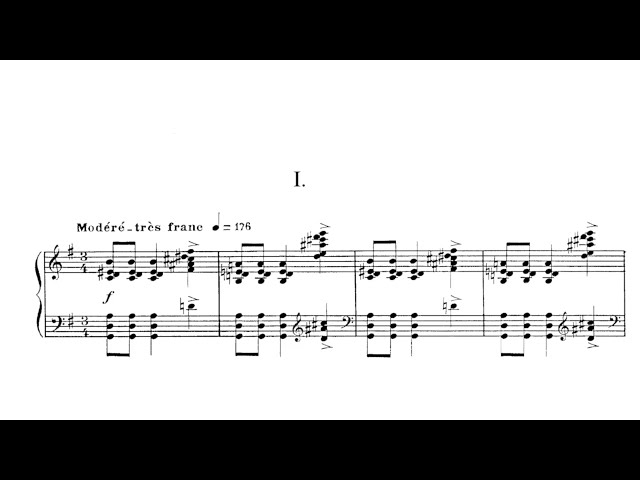
The suite Valses nobles et sentimentales fuses traditional waltz forms with Maurice Ravel’s characteristically modern sonorities.
Its opening piece is graceful yet tinged with melancholy, evoking a curious, elusive mood.
At its premiere in May 1911, the composer’s name was withheld, and the work astonished audiences with its originality.
One can almost picture a glittering ballroom where, amid the dancing, a secret, fleeting thought crosses the heart.
The work is also known in its ballet incarnation as Adélaïde, ou le langage des fleurs.
It’s perfect for those who want to experience the intriguing rhythms and harmonies that overturn conventional images of the waltz.
Aim for a rounded, gentle tone to convey the wistfulness that lies beneath the brilliance.
Noble and Sentimental Waltzes: No. 3 Waltz, Modéré in G majorMaurice Ravel82rank/position

Maurice Ravel’s suite Valses nobles et sentimentales, modeled after Schubert’s waltzes, was introduced to the world in 1911 as a piano work and staged the following year as ballet music.
Of the eight pieces that make up the suite, the third waltz is a beautiful number in which a faintly wistful expression emerges from within a calm and orderly surface.
In this work, the two spirits of “nobility” and “sentiment” are expressed in exquisite balance.
Its slightly intricate, transparent harmonies carried by a flowing triple meter evoke the subtle play of pale light and shadow in the heart.
Rather than flaunting virtuosity, the key is to carefully draw out the fine nuances embedded in the score.
Aim for an elegant atmosphere by playing with a rounded, gentle tone free of harsh edges.
Noble and Sentimental Waltzes, No. 4, Assez animé (fairly lively)Maurice Ravel83rank/position
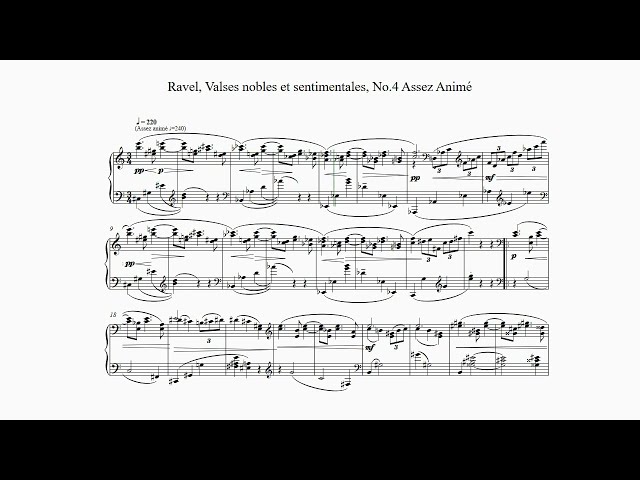
Maurice Ravel’s suite Valses nobles et sentimentales, written in homage to Schubert, contains many captivating pieces that blend traditional waltz idioms with a modern sensibility, and this particular number stands out for its verve and wit.
At the premiere in May 1911, the composer’s name was withheld, and there’s a charming anecdote that the audience tried to guess the author.
The orchestral version was staged as the ballet Adélaïde, ou le langage des fleurs, depicting the romantic intrigues of 1820s Paris.
If you imagine the give-and-take of love conveyed through the language of flowers, you’ll sense that “this sonority is more than merely elegant.” The key is to play the dense chords with lightness through the right hand’s virtuosic motion.
It’s a work that anyone seeking expression beyond classical boundaries should experience.
Noble and Sentimental Waltzes, Waltz No. 5, Presque lent in E majorMaurice Ravel84rank/position

It is a particularly introspective piece from the suite Valses nobles et sentimentales.
There is an anecdote that at its premiere in May 1911—an anonymous concert of new works—many critics nevertheless recognized the composer as Maurice Ravel.
Marked “avec une émotion intime” (“with intimate feeling”), the music is suffused with a very private atmosphere, like a whispered inner dialogue.
Its melody, ebbing and flowing like waves, feels like a sigh, like a secret longing, quietly drawing close to the listener’s heart.
It is perfect for those who wish to deepen their delicate touch and expressive nuance.
Cherish its sentimental, beautiful world, and play with rounded, gentle tones, carefully and tenderly.