

Maurice Ravel Popular Songs Ranking [2026]

He was a French composer born on March 7, 1875.
He is well known for composing the ballet music Boléro and for orchestrating Pictures at an Exhibition.
We’ve compiled a ranking of his popular pieces.
Whether you’re a longtime fan or just discovering him, be sure to check it out.
- Introducing Maurice Ravel’s Famous and Representative Works
- Jules Massenet Popular Song Rankings [2026]
- Jean-Philippe Rameau Popular Songs Ranking [2026]
- Claude Debussy Popular Songs Ranking [2026]
- Gabriel Fauré Popular Songs Ranking [2026]
- Igor Stravinsky Popular Songs Ranking [2026]
- Camille Saint-Saëns Popular Songs Ranking [2026]
- Modest Mussorgsky Popular Song Rankings [2026]
- Erik Satie Popular Songs Ranking [2026]
- Emmanuel Chabrier Popular Song Rankings [2026]
- Sergei Rachmaninov Popular Songs Ranking [2026]
- Déodat de Séverac Popular Song Rankings [2026]
- Manuel de Falla Popular Song Rankings [2026]
Maurice Ravel Popular Songs Ranking [2026] (21–30)
Gaspard of the NightMaurice Ravel29rank/position

A piano suite composed by Maurice Ravel in 1908.
It consists of three movements, each depicting a supernatural being.
The first portrays the water nymph Ondine luring a man; the second depicts a corpse on a gallows bathed in the setting sun; and the third captures the nocturnal mischief of the little demon Scarbo.
Ravel sought to express poetic imagery through music.
Technically demanding for pianists, it requires delicate touch and advanced expressive control.
With its Gothic atmosphere, it’s perfect for listening on Halloween night.
Gaspard of the Night, M. 55: II. The GallowsMaurice Ravel30rank/position

One of the pieces from Maurice Ravel’s 1908 piano suite Gaspard de la nuit, it sonically depicts the desolate scene portrayed in the poetry of Aloysius Bertrand.
A defining feature of this work is the relentless repetition of the same note—symbolizing a distant tolling bell—more than 150 times from beginning to end.
Over this monotonous resonance, eerie harmonies accumulate, drawing the listener into a meditative world dominated by the stillness of death.
For performers, maintaining strict tempo and a delicate balance of sonorities is essential; otherwise, the work’s overwhelming gloom may be compromised—making it a formidable challenge.
It is frequently programmed in competitions.
Consider listening to it when you wish to encounter the quiet beauty that lies at the depths of sorrow.
Maurice Ravel Popular Songs Ranking [2026] (31–40)
Suite ‘Mirrors’ No. 3 ‘A Boat on the Ocean’Maurice Ravel31rank/position

Maurice Ravel, a French composer, is a leading figure of Impressionist music who flourished from the late 19th to the early 20th century.
His music is renowned for its precision and impeccable style, and works like Boléro are widely beloved.
The third piece, “Une barque sur l’océan” (A Boat on the Ocean), from the suite Miroirs composed between 1904 and 1905, is a beautiful work that evokes the flow of the sea’s waves and the rocking of a boat.
Although it demands a high level of piano technique, its beautiful sonorities are irresistibly captivating.
It is a recommended piece for those who wish to feel the beauty and mystery of the sea, and for anyone who wants to immerse themselves in the world of Impressionist music.
From the suite “Ma mère l’Oye,” No. 3: “Laideronnette, Empress of the Pagodas”Maurice Ravel32rank/position

This is a masterpiece that unfolds a fairytale world imbued with an Oriental atmosphere.
It vividly portrays, through the unique four-hand resonance of piano duet, the tale of a beautiful princess cursed and transformed.
The piece is one of the five movements in a piano duet suite composed by Maurice Ravel between 1908 and 1910 for the children of his friends.
In this work, the sounds of Chinese instruments—such as xylophone and percussion—are brilliantly evoked using two pianos.
Amid its light and bright character, the timbre brims with exotic color, as if the distant toll of a gong were resounding.
Demanding rich expression across the piano’s high and low registers and close ensemble coordination, it is an ideal work for concerts and recitals.
Little Boat on the Ocean from the Suite ‘Mirrors’Maurice Ravel33rank/position

How about a cool piece by Maurice Ravel that you’ll want to listen to on a hot day? It’s the third piece from the piano suite Miroirs, published in Paris in 1906 and dedicated to the painter Paul Sordes.
You can picture a small boat gently drifting across a vast sea, and just listening to it feels cleansing for the soul.
The work’s charm lies in its depiction of water through shimmering arpeggios.
They evoke the glinting, rippling surface under light and the deep ocean’s calm, with an expressive range that hardly seems possible from a single piano.
The meter changes 36 times over 140 measures, deftly capturing the ceaseless motion of the waves.
If you’d like to cool off with beautiful sonorities, or if you’re a fan of Impressionist music, you’ll surely enjoy it.
It might also be nice to listen to it alongside the other pieces in the Miroirs suite.
Two Hebrew SongsMaurice Ravel34rank/position

A song cycle composed in 1914 for voice with piano accompaniment.
An orchestral version was also released in 1919.
It consists of Kaddish and The Eternal Enigma.
The lyrics of Kaddish are from an Aramaic liturgical text.
The lyrics of The Eternal Enigma are taken from Jewish folk songs.
BoleroMaurice Ravel35rank/position
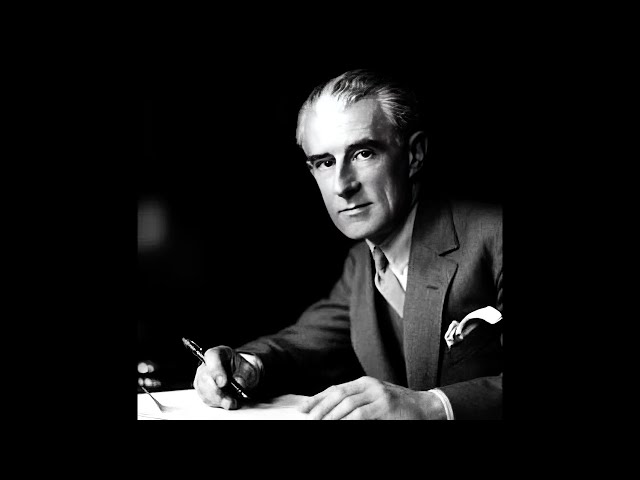
Maurice Ravel, a French composer who had a profound impact on the music world with his original structures.
He achieved success with works in various forms, and he also left masterpieces in the realm of ballet music.
Among them, one of his most famous works is Boléro.
In Japan it is known by the same title, “Bolero,” and it continues to be popular today as a standalone musical piece that transcends the framework of ballet.
The work features a highly distinctive structure in which two melodies are repeated, and by focusing on that aspect as you listen, you can appreciate the high level of craftsmanship in the piece.
