

Franz Schubert Popular Songs Ranking [2026]

His majestic music is so highly regarded in German Lieder that he is often called the King of Song.
The expansive, soothingly beautiful melodies he created are ones everyone has surely heard at least once.
We’ve compiled a ranking of Schubert’s pieces by popularity.
Please enjoy a graceful time!
- Masterpieces by Franz Schubert: Sparkling classical works left by the King of Song. Recommended classical music.
- Robert Schumann Popular Song Ranking [2026]
- Ludwig van Beethoven Popular Songs Ranking [2026]
- Franz Liszt Popular Song Ranking [2026]
- [Masterpiece Classics] A special showcase of gem-like masterpieces so beautiful they’ll move you to tears
- Johannes Brahms Popular Songs Ranking [2026]
- Robert Schumann | Introduction to his famous and representative works
- For Advanced Players: Showstopping Classics to Play at a Piano Recital
- Bedřich Smetana Popular Songs Ranking [2026]
- Frederic Chopin Popular Songs Ranking [2026]
- Johann Burgmüller Popular Song Rankings [2026]
- Antonín Dvořák Popular Songs Ranking [2026]
- What songs are popular among elementary schoolers? Well-known and sing-along favorites! [2026]
Franz Schubert Popular Song Rankings [2026] (91–100)
Unfinished SymphonyFranz Schubert92rank/position

Composed in 1822, this is one of Schubert’s most representative works.
The first and second movements were completed, and it is performed in that form.
Schubert stopped composing partway through the third movement, but in fact he is known for abandoning many works in a similar unfinished state.
The performance is by the Royal Concertgebouw Orchestra conducted by Leonard Bernstein.
Moments Musicaux, Op. 94, D. 780, No. 3 in F minorFranz Schubert93rank/position

Moments Musicaux is a collection of six piano pieces composed between 1823 and 1828 and published in 1828.
Among them, No.
3 is particularly famous; it had already been included in another collection published in 1823 under the title “Air Russe (Russian-style Song).” Today, it is a very popular piece frequently used in commercials and other media, so many people have likely heard it.
Gretchen at the Spinning Wheel, D118Franz Schubert94rank/position

This song was composed in 1814, when Schubert was 17 years old.
It sets a text from Goethe’s Faust, Part I.
Not only is it Schubert’s first Goethe song, but some commentators also regard it as the very moment of birth for the German-language art song—the German Lied.
Many other composers, including Wagner, Spohr, and Verdi, have also set this poem to music.
wild roseFranz Schubert95rank/position

This commercial shows Atsuko Takahata and Kengo Kora asking questions at a laboratory to find out what kind of effects Attack has.
Takahata, who can’t believe it whitens without even scrubbing, gradually becomes convinced as she watches the research process, clearly conveying the product’s astonishing effectiveness.
The music that further accentuates the fresh atmosphere of the predominantly white visuals is Franz Schubert’s Heidenröslein (Wild Rose).
With the piano at the center, it brings a sense of lightness within the refreshing mood and conveys a relaxed, everyday feeling.

Wild Rose D257Franz Schubert96rank/position

It is a work published in 1821.
This song sets to music Goethe’s poem “Heidenröslein” (“Wild Rose”), written around 1799.
It is said that the poem reflects Goethe’s remorse for betraying the daughter of a pastor with whom he had fallen in love and for breaking her heart.
In fact, not only Schubert but also many other composers—such as Beethoven, Schumann, and Brahms—set this poem to music.
Among them, Schubert’s Heidenröslein is especially beloved for its bright, charming, and approachable character.
To Music, Op. 88 No. 4, D 547Franz Schubert97rank/position
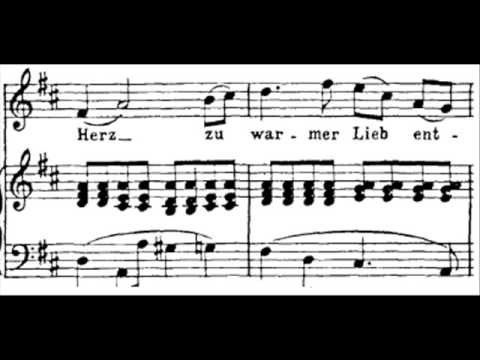
Composed in 1817, it is a song with piano accompaniment.
It sets to music a poem by his friend Ritter von Schober.
In D major and cut time (2/2), the music is written with clarity, yet it employs effects that make the voice and piano sound as if they are in dialogue.
It is regarded as a masterpiece that directly expresses Schubert’s love and gratitude for music.
Demon KingFranz Schubert98rank/position

A song composed by Franz Schubert when he was 18.
It is said he was so moved by Goethe’s poem that he completed it in a single night.
The piece depicts a father fleeing from the Erlking while galloping through the night on horseback, clutching his ailing son.
The piano’s repeated notes evoke the horse’s gallop and the parent and child’s anxiety and urgency, brilliantly expressing the Erlking’s seductive enticements, the father’s desperation, and the boy’s terror.
First performed in 1821, it has since been performed continually by many singers and pianists.
Its unique blend of fear and poignancy makes it perfect for Halloween.