

Franz Schubert Popular Songs Ranking [2026]

His majestic music is so highly regarded in German Lieder that he is often called the King of Song.
The expansive, soothingly beautiful melodies he created are ones everyone has surely heard at least once.
We’ve compiled a ranking of Schubert’s pieces by popularity.
Please enjoy a graceful time!
- Masterpieces by Franz Schubert: Sparkling classical works left by the King of Song. Recommended classical music.
- Robert Schumann Popular Song Ranking [2026]
- Ludwig van Beethoven Popular Songs Ranking [2026]
- Franz Liszt Popular Song Ranking [2026]
- [Masterpiece Classics] A special showcase of gem-like masterpieces so beautiful they’ll move you to tears
- Johannes Brahms Popular Songs Ranking [2026]
- Robert Schumann | Introduction to his famous and representative works
- For Advanced Players: Showstopping Classics to Play at a Piano Recital
- Bedřich Smetana Popular Songs Ranking [2026]
- Frederic Chopin Popular Songs Ranking [2026]
- Johann Burgmüller Popular Song Rankings [2026]
- Antonín Dvořák Popular Songs Ranking [2026]
- What songs are popular among elementary schoolers? Well-known and sing-along favorites! [2026]
Franz Schubert Popular Songs Ranking [2026] (51–60)
Masu Op. 32 D550Franz Schubert57rank/position

‘Die Forelle’ (The Trout), composed by Austrian composer Schubert around the age of 20, is one of his most popular German lieder.
While the brisk piano and refreshing melody are striking, the lyrics tell a somewhat cruel story: as the narrator pleasantly watches trout dart about in a clear, bright stream, a crafty fisherman uses underhanded means to catch them.
This tale serves as a metaphorical warning to beware of men who deceive women.
Schubert also used this melody as the basis for his Piano Quintet, which shows how deeply attached he was to it.

Arpeggione Sonata in A minor, D 821Franz Schubert58rank/position

Composed in 1824 and published posthumously in 1871.
The arpeggione is a six‑string instrument, sometimes called a “guitar cello,” that combines features of both the guitar and the cello.
It is said that by the time this piece was published, the instrument had already fallen into obscurity.
Although the arpeggione has since been reconstructed, it is now customary to perform the work on instruments such as the cello or viola.
Despite its many drawbacks, this piece has not faded away; it continues to be performed today, brimming with a mysterious charm.
Sonata in A minor, D 821, for Arpeggione and PianoFranz Schubert59rank/position

The chamber work Sonata in A Minor, D 821, for Arpeggione and Piano, composed by Franz Schubert in Vienna in 1824.
The arpeggione is a six‑string bowed instrument invented between 1823 and 1824, and because it had already fallen out of use by the time Schubert died, this piece has, to the present day, been performed and cherished on instruments such as the cello, viola, and guitar.
Since the arpeggione was played with a bow, performances on the guitar may differ from what Schubert intended.
However, the piece’s plaintive atmosphere pairs wonderfully with the guitar’s unadorned timbre.

Allegretto in C minor, D 915Franz Schubert60rank/position
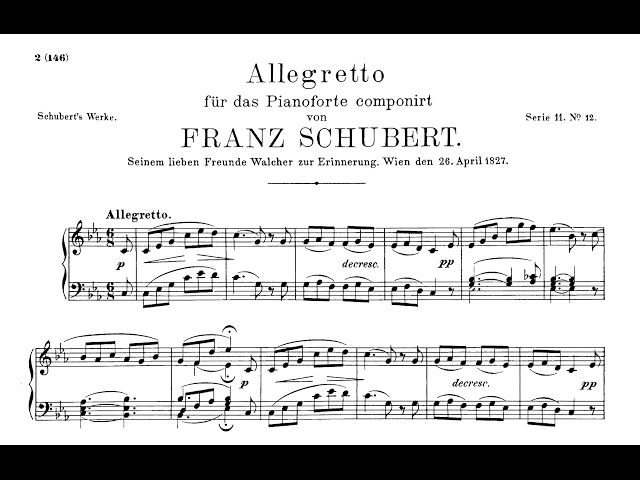
Let me introduce a short piece by Franz Schubert, known as a standard-bearer of the Romantic era.
Written on the occasion of a friend’s departure, this work is filled with the emotions of farewell and profound poignancy.
It is cast in ternary form, and the delicate balance between the main section in C minor and the middle section in A-flat major is striking.
The melody bears traces of Beethoven’s influence, while its sonorities foreshadow Schumann and Brahms—another part of its appeal.
Composed in April 1827, the piece may also reflect an elegiac tribute to Beethoven.
Even beginners at the piano can approach it: the hands often move in parallel, and the passages that shift out of sync can be mastered with slow practice.
A highly recommended piece for anyone wishing to step into Schubert’s world.
Franz Schubert Popular Songs Ranking [2026] (61–70)
Ellen’s Song No. 3, Op. 52-6, D.839 (Ave Maria)Franz Schubert61rank/position

This is one of Schubert’s very late songs, composed in 1825.
It is beloved as one of the world’s three great Ave Maria pieces and is also known as “Schubert’s Ave Maria.” Among Schubert’s songs, it is one of the most popular works.
Because the lyrics include the words “Ave Maria,” it is often mistaken for a religious piece; however, it was originally set to the German translation of Walter Scott’s poem The Lady of the Lake and is one of the songs from the song cycle of the same name.
Ellen’s Song No. 3Franz Schubert62rank/position

This piece is about Takasugi-kun, played by Ryunosuke Kamiki, taking on the challenge of presenting the new iPhone.
While skillfully involving those around him, he speaks powerfully about how well the iPhone pairs with au’s plans.
His confident expression also conveys that the new iPhone is something exceptional.
The piece concludes with the song “Eren’s Song No.
3.” Its composition evokes a grand atmosphere and imparts a bright, uplifting feeling, as if a path is opening ahead.

Schubert’s Lullaby (from “I Can Play the Piano! Junior 3”)Franz Schubert63rank/position

“Piano Hikeruyo! Junior: Play More and More with Songs You Know” features famous pieces everyone has heard at least once, included just as they are as practice pieces.
Across its three volumes, it’s packed with classics like Franz Schubert’s Lullaby, Bumblebee, and Mary Had a Little Lamb.
In addition to the main text, there are also a workbook, a repertoire collection, and technique materials, making it easy to use as a complete series.
It’s the perfect text for children who want to enjoy playing the piano with songs they already know!