


Do you ever find it hard to put your positive, upbeat feelings into words? Four-character idioms are full of expressions that convey encouragement and hope.
Especially for elementary school students, it’s a great chance to learn the meanings of tricky kanji while finding idioms that can boost your own spirits and those of your friends.
In this article, we’ll introduce positive four-character idioms that elementary schoolers can use in everyday life, along with easy-to-understand example sentences.
We hope you find words that truly resonate with your heart!
- Easy for elementary school students to remember! A four-character idiom that expresses the feeling of trying your best
- Learn the meanings too! Cool four-character idioms that elementary school students will want to remember
- [For Elementary School Students] Four-character idioms you can use in sports! Words that are helpful for cheering and goal setting
- Four-character idioms that wish for happiness! Words that will warm the hearts of elementary school children
- Interesting four-character idioms for elementary schoolers! Words you'll want to use once you understand their meanings
- Four-character idioms that help elementary schoolers not give up: words that spark the power to keep trying
- [For Elementary School Students] Inspiring Four-Character Idioms for Shaping the Future at a Glance! Words that Spark Courage
- For Elementary School Students: Four-Character Idioms You Can Use for New Year’s Resolutions — How to Set Cool Goals!
- Recommended for elementary school class goals! A collection of impactful ideas using four-character idioms
- Perfect for elementary school slogans! A collection of four-character idiom ideas you'll want to use
- Popular even among elementary school students! Stylish and easy-to-remember four-character idioms
- Strive toward your goals! Four-character idiom ideas that resonate with elementary school students
- [Elementary School Students] Perfect for Kakizome! A Collection of Four-Character Idiom Ideas
Easy-to-remember, positive four-character idioms for elementary students! Words that brighten the heart (1–10)
with all one’s might
This is a phrase that expresses giving your all.
“Isshō” refers to one’s lifetime, and “kenmei” means to tackle something so seriously that you’d stake your life on it.
In other words, it means to devote yourself wholeheartedly, using all your strength.
For example, you can say, “I studied really hard to get a good score on the test,” or “I worked very hard at my job.” When you give your best effort, you’ll be able to do things you couldn’t before and gain confidence.
Even if you fail, continuing without giving up will make your heart stronger and brighter.
When you take on a challenge, try approaching it with all your might.
If you do, each day will become more enjoyable and you’ll feel more excited!

Fall down seven times, get up eight.
It’s a phrase that means standing up without giving up, no matter how many times you fall.
For example, when practicing riding a bicycle, even if you fall over and over, the spirit of saying “Let’s try one more time!” is shichiten-hakki (literally, “fall seven times, stand up eight”).
Since it means “fall seven times, stand up eight,” it’s an encouraging saying that tells you, “It’s okay to fail.
If you don’t give up, you’ll surely succeed!” Professional athletes and inventors have also failed many times.
Even so, because they didn’t give up, they were able to achieve amazing things.
Even when things are tough, it’s important to remember shichiten-hakki and keep facing forward as you move ahead.
Stay true to your original intention.
It means to carry through the goal and intention you first decided on without giving up until the end.
For example, if you decide, “During summer vacation I’ll learn three kanji every day,” then no matter what kind of day it is, you keep at it steadily and finish it all—that’s shoshi-kantetsu (carrying out one’s original intention).
Even if you start out motivated, there are times when you’ll feel like slacking off.
Still, if you stick with what you decided to do until the end, it becomes a big source of confidence and you start to feel, “If I try, I can do it!” Shoshi-kantetsu is a phrase that powerfully encourages people who are working toward their dreams and goals.
When you feel like giving up, remember this four-character idiom and try taking one more step forward!
A fresh start

It means to refresh your mindset and make a positive new start.
For example, when you don’t get a good score on a test or you end up arguing with a friend, deciding to “try again!” and taking action with a renewed attitude is shinki-itten.
You can also use it like this: “I was lazy over summer vacation, but in the second term I’ll make a fresh start—go to bed early, get up early, and work hard on my studies.” Even when you face hardships or failures, thinking “shinki-itten” helps you move forward with energy again.
It’s an important phrase even when you become an adult, so be sure to remember it!
steady progress day by day; making rapid strides
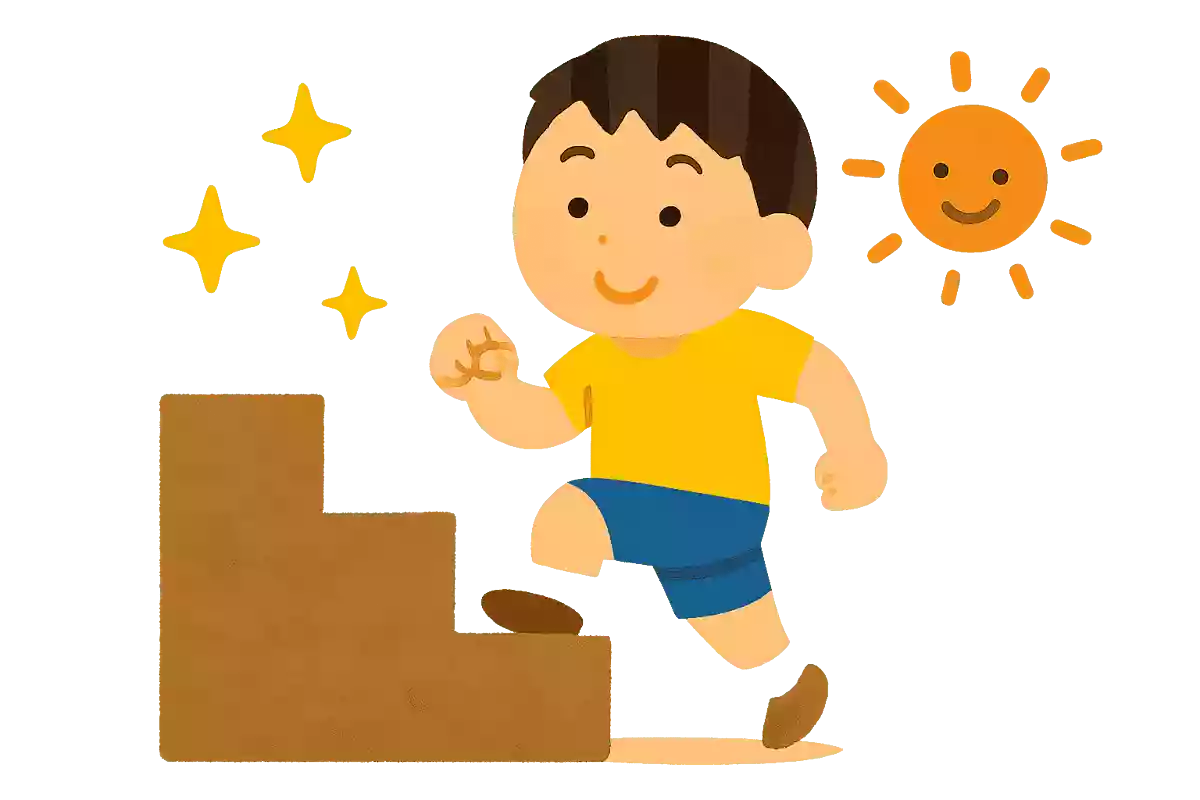
It’s a four-character idiom that means steadily making progress day by day and continually improving.
For example, when you practice the piano every day, even if you can’t play well at first, you gradually get better, right? That’s “Nisshin Geppo” (daily progress, monthly advance).
The same goes for studying and sports—if you move forward little by little, from today to tomorrow, and from tomorrow to the day after, it leads to big growth.
Even if you have days when things don’t go well, if you can think, “I did a little better than yesterday,” that’s enough.
Your small efforts each day will make your future self shine! “Nisshin Geppo” is an encouraging phrase that gives a boost to people who believe in themselves and keep moving forward.
Say what you mean, do what you say.

It’s a four-character idiom meaning “to firmly carry out what you say.” For example, if you say, “I’ll study every day starting tomorrow!” then actually continuing to study every day is yūgen-jikkō (literally, ‘spoken words, carried out’).
Instead of stopping at just talk, seeing things through once you decide to do them builds your confidence.
For instance, if you tell everyone before a soccer match, “I’m going to score a goal!” and you really do score, that’s super cool and feels great, right? Even with small things, if you start with what you can do and act responsibly according to your words, people around you will trust you more.
Starting today, try aiming for ‘yūgen-jikkō’!
Future-oriented
It means “thinking positively about what lies ahead and aiming for a better future.” For example, even if you make mistakes on a test, thinking “I’ll do my best next time!” is future-oriented thinking.
Instead of dwelling on past failures or unpleasant experiences, it’s important to ask yourself, “How can I make things better?” The feeling of “I can’t swim yet, but if I practice every day, I’ll be able to someday!” is also future-oriented.
When both adults and children adopt a future-oriented mindset, their spirits lift and their actions become more positive.
The future is something we create from now on.
That’s why it’s important to focus on what you can do and what you want to do, and enjoy each and every day!