

Easy-to-remember, positive four-character idioms for elementary school kids! Words that brighten the heart

Do you ever find it hard to put your positive, upbeat feelings into words? Four-character idioms are full of expressions that convey encouragement and hope.
Especially for elementary school students, it’s a great chance to learn the meanings of tricky kanji while finding idioms that can boost your own spirits and those of your friends.
In this article, we’ll introduce positive four-character idioms that elementary schoolers can use in everyday life, along with easy-to-understand example sentences.
We hope you find words that truly resonate with your heart!
- Easy for elementary school students to remember! A four-character idiom that expresses the feeling of trying your best
- Learn the meanings too! Cool four-character idioms that elementary school students will want to remember
- [For Elementary School Students] Four-character idioms you can use in sports! Words that are helpful for cheering and goal setting
- Interesting four-character idioms for elementary schoolers! Words you'll want to use once you understand their meanings
- Four-character idioms that help elementary schoolers not give up: words that spark the power to keep trying
- Four-character idioms that wish for happiness! Words that will warm the hearts of elementary school children
- [For Elementary School Students] Inspiring Four-Character Idioms for Shaping the Future at a Glance! Words that Spark Courage
- For Elementary School Students: Four-Character Idioms You Can Use for New Year’s Resolutions — How to Set Cool Goals!
- Recommended for elementary school class goals! A collection of impactful ideas using four-character idioms
- Perfect for elementary school slogans! A collection of four-character idiom ideas you'll want to use
- Popular even among elementary school students! Stylish and easy-to-remember four-character idioms
- Strive toward your goals! Four-character idiom ideas that resonate with elementary school students
- [Elementary School Students] Perfect for Kakizome! A Collection of Four-Character Idiom Ideas
Positive four-character idioms that are easy for elementary school students to remember! Uplifting words (11–20)
A sudden resolve; making a firm decision (to start afresh).

It means starting something with a strong resolve, like saying, “This is it!” For example, when you’ve long been unable to do something, you decide, “Alright, I’ll give it a try!” and commit yourself to working hard.
This phrase carries the ideas of a positive mindset and the courage to persevere.
For instance: “Taro wasn’t good at sports and always gave up.
But one day, he made up his mind, saying, ‘I want to run faster!’ He began practicing a little every day, and gradually he became able to run faster.” His heart grew lighter, and he gained confidence.
If you feel like taking on a challenge, try mustering ichinen-hokki—firm resolve.
With strong determination, you’ll surely get closer to your dreams!

One good deed a day
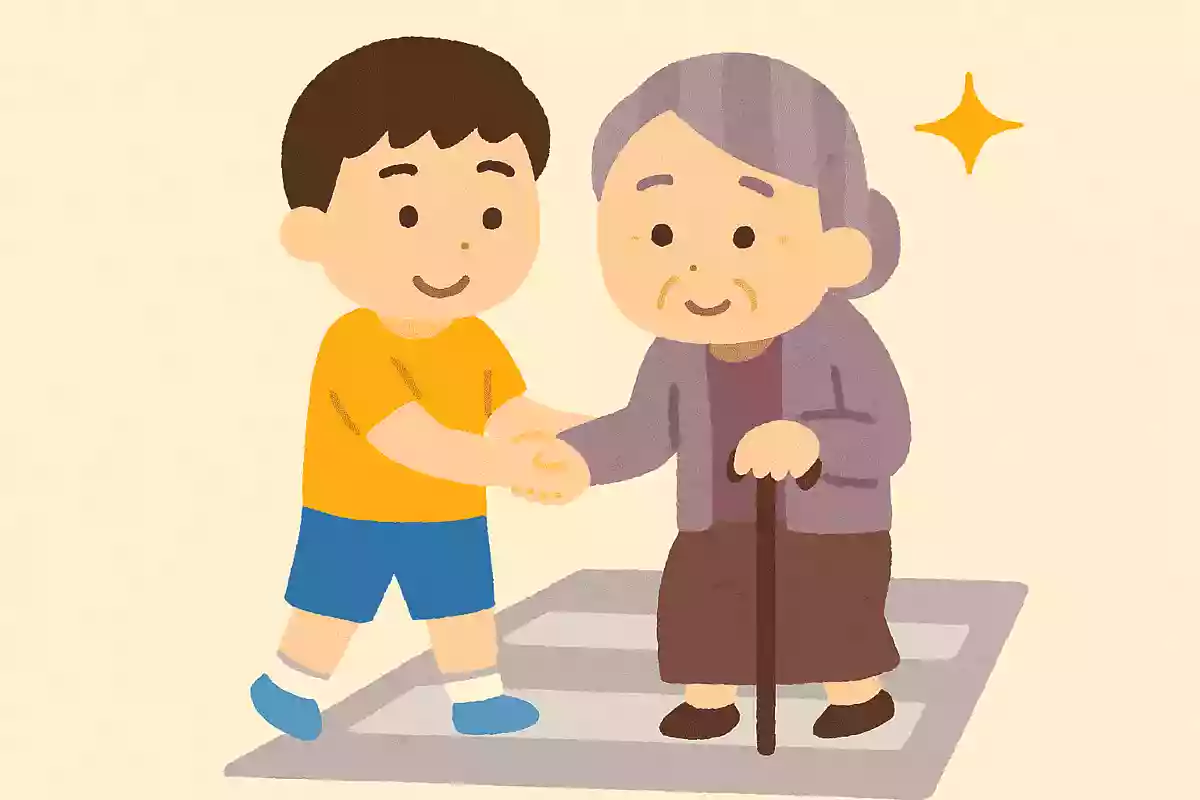
It’s a phrase that means “Do one good deed a day.” It can be something small.
For example, saying “thank you” to a friend or helping someone who’s having trouble on the street are both good deeds.
By doing even one good thing each day, you and the people around you will feel happier.
Your heart feels lighter, and you feel more energized.
If someone at school is struggling and you think, “I’ll help!”, that’s also “one good deed a day.” As you build up small acts of kindness every day, the world becomes more joyful and happy.
Keep “one good deed a day” in your heart, and spend each day with a smile.
Once-in-a-lifetime encounter
This is a four-character idiom that means “cherish a once-in-a-lifetime encounter.” The time you spend playing with friends or laughing with family will never be exactly the same again.
That’s why it carries the feeling of treasuring the present moment.
For example, at a sports day, the friend standing next to you cheered, “You can do it!” That single phrase gave you strength and remains a precious memory even now.
Even a moment like that is ichigo ichie—“one time, one meeting.” Every encounter and every moment is a treasured gift.
Spend each day with a smile, and cherish your connections with others.
Today’s ichigo ichie will become tomorrow’s fond memory.
giving it your all

This is a four-character idiom that means to give it everything you’ve got.
It originally comes from baseball, referring to a pitcher throwing the ball with all their strength.
Nowadays, it’s used to express the attitude of tackling anything with full effort.
For example: “I gave it my all in the relay at the sports day right to the very end,” or “I put my all into my summer vacation independent project, so I’m confident!” No matter how small the task, putting your heart into giving it your all can become a great source of strength for you.
It’s okay to fail.
The experience of trying your best will surely make you stronger!
sincerity

It means “to work with all your heart, sincerely and earnestly.” For example, when a friend is in trouble, helping them honestly and wholeheartedly is an act of ‘seishin seii.’ Remembering this phrase can brighten your mood, because when you are sincere, the people around you smile and trust grows.
If you study for a test with ‘seishin seii,’ you’ll gain confidence and feel happy.
Both children and adults should cherish this phrase and spend each day energetically and joyfully!
Cherry blossoms in full, resplendent bloom
@jeripicho “桜花爛漫” is a Japanese expression meaning “a riot of cherry blossoms.” The idiom “Oka Ranman” refers to the beauty of cherry blossoms and cherry trees in full bloom in Japan, and it also evokes a sense of beauty and tradition. Spring is the season of renewal, growth, and new beginnings. It is the time when the world awakens from its winter slumber and nature comes alive with color, sound, and energy. From the first bloom of a flower to the return of migratory birds, spring is a season of beauty and wonder. Sakura symbolizes both life and death, beauty and violence. Just as the arrival of spring promises new life, the blooming of cherry blossoms brings a sense of vitality and vibrancy. At the same time, their brief lifespan reminds us that life is fleeting.#CherryBlossom Spring #nihongo
♬ snow dream – lmnl
Ouka-ranman is a four-character idiom that describes cherry blossoms bursting into full bloom in a bright, beautiful display.
It’s easy to grasp the meaning if you picture schoolyards and routes to school in spring washed in pink by cherry blossoms.
The sight of blossoms at their peak also conveys the idea that hard work has borne fruit and the feeling of sharing joy together.
In essays or reflections, using it for spring events or scenes like entrance and graduation ceremonies makes your expression much richer.
It’s a word worth remembering that teaches us both the beauty of nature and the brightness of the heart.

Limit Break

When you’re working hard at something and hit a wall, you become aware of your limits, don’t you? If you can’t break through with your current ability, the only option is to take a bigger leap and challenge it again.
That’s what it means to surpass your limits.
Put simply, it’s about not setting a finish line for your own strength and aiming to become even stronger and cooler! If you like games, you might think of it as leveling up.
All of you elementary school students are still growing and full of potential.
When you hit a wall, think of it as a chance and bring out your abilities and charm to the fullest!

A single smile is worth a thousand gold pieces.
Isshou Senkin is a beautiful four-character idiom meaning “a single smile or laugh is worth a thousand pieces of gold.” It teaches us that a heartfelt smile makes people happier than expensive things or money.
A smile that cheers up a friend, or a small laugh that soothes a family, has the power to brighten the atmosphere around us.
Valuing smiles in everyday life also helps us build good relationships with many people.
It’s easy to remember and conveys the importance of feelings.
It’s one of the four-character idioms I especially recommend for families with elementary school children.
cherry, plum, peach, and apricot (each flower/thing has its own unique beauty)
@hiroaki946 Oubaitōri Shorts Short video Mini video Set phrase Four-character idioms Proverbs Japanese Meaning of words Wordplay Learning Education Trivia Japanese culture Time-killer Study Knowledge Trivia Everyday life Power of words VOICEVOX: Shikoku Metan A four-character idiom that recognizes differences: “Oubaitōri” Do you know what it means? First, an example sentence: With the arrival of spring, the cherry, plum, peach, and apricot (sour plum) blossoms in the garden were in full bloom, coloring the yard. As the children looked at each flower, they said things like, “I like the pale pink of the cherry blossoms,” “The fragrance of the plum is the best,” “Peach petals are so cute,” and “The white blossoms of the apricot are lovely too.” By noticing the charm each flower possesses and learning the spirit of oubaitōri, the children began to feel that they should also cherish their own individuality. Meaning: Oubaitōri (桜梅桃李) comes from the idea that cherry, plum, peach, and apricot blossoms each have their own unique beauty. It teaches the importance of each person having their own individuality and talents, and expressing their own beauty without comparing themselves to others. It also implies that when people recognize and make use of their strengths and characteristics without comparison, overall harmony can be achieved. That is all.
Original song – hiroaki946 – hiroaki946
This four-character idiom means that just as cherry blossoms, plum blossoms, peach blossoms, and apricot blossoms each bloom with their own unique beauty, it’s okay for every person to be different, too.
It’s easy for elementary school students to understand and carries a message close to “Everyone is different, and that’s okay,” so it’s a good phrase to use in class activities or moral education.
It encourages children to value their own strengths and personalities as they are and to feel positive about themselves.
Beyond memorizing it as study, it can also be a starting point for recognizing differences among friends.
The sound of the phrase is beautiful, and it’s an idiom that lets students enjoy learning while imagining seasonal flowers.

pure breeze and bright moon
It depicts a serene, composed scene in nature—clear wind and a bright moon.
Free of anything superfluous, it conveys a purity that seems to lighten the heart.
Thinking of the refreshing breeze on a summer night or a round moon floating in the sky brings peace of mind.
You could say this phrase also carries the message: “Keep your heart calm and face things with honesty.” Even on irritating days, recalling these words can help your feelings settle.
It reminds us not to forget to take time to clear our minds amid our busy daily lives.
It is a four-character idiom that teaches the importance of that mindfulness.