

Easy-to-remember, positive four-character idioms for elementary school kids! Words that brighten the heart

Do you ever find it hard to put your positive, upbeat feelings into words? Four-character idioms are full of expressions that convey encouragement and hope.
Especially for elementary school students, it’s a great chance to learn the meanings of tricky kanji while finding idioms that can boost your own spirits and those of your friends.
In this article, we’ll introduce positive four-character idioms that elementary schoolers can use in everyday life, along with easy-to-understand example sentences.
We hope you find words that truly resonate with your heart!
- Easy for elementary school students to remember! A four-character idiom that expresses the feeling of trying your best
- Learn the meanings too! Cool four-character idioms that elementary school students will want to remember
- [For Elementary School Students] Four-character idioms you can use in sports! Words that are helpful for cheering and goal setting
- Interesting four-character idioms for elementary schoolers! Words you'll want to use once you understand their meanings
- Four-character idioms that help elementary schoolers not give up: words that spark the power to keep trying
- Four-character idioms that wish for happiness! Words that will warm the hearts of elementary school children
- [For Elementary School Students] Inspiring Four-Character Idioms for Shaping the Future at a Glance! Words that Spark Courage
- For Elementary School Students: Four-Character Idioms You Can Use for New Year’s Resolutions — How to Set Cool Goals!
- Recommended for elementary school class goals! A collection of impactful ideas using four-character idioms
- Perfect for elementary school slogans! A collection of four-character idiom ideas you'll want to use
- Popular even among elementary school students! Stylish and easy-to-remember four-character idioms
- Strive toward your goals! Four-character idiom ideas that resonate with elementary school students
- [Elementary School Students] Perfect for Kakizome! A Collection of Four-Character Idiom Ideas
Easy-to-remember positive four-character idioms for elementary schoolers! Uplifting words (21–30)
Snow, Moon, Wind, and Flowers
@hjc.aki [Setsugetsufūka] Snow, moon, wind, and flowers—an expression that collectively refers to the beautiful scenery of nature. A phrase that evokes beautiful winter landscapes. It’s a word I like, though I’m not good with the cold lol.Snow, Moon, Wind, FlowersWinterCalligrapherCalligraphyTranslation
♬ Kaede – Ryuta Shibuya
These words—snow, moon, wind, and flower—evoke the beautiful scenery of the four seasons.
They embody a distinctly Japanese sensibility that delights in the passage of nature and appreciates the unique charm of each season.
Gently falling snow, the moon hanging in the night sky, a pleasantly blowing breeze, and flowers blooming in spring—this expression reminds us of the importance of pausing to savor the world around us, even amid busy days.
For example, simply noticing the cherry blossoms on your way to school or the hues of the evening sky can bring a moment of calm.
As we attune ourselves to landscapes that change with the seasons, we also bring our hearts into balance.
It is a refined and beautiful four-character idiom that calls to mind such intentional, graceful moments.

The highest goodness is like water.

It is a saying that means “The highest good is like water.” Just as water changes its shape to fit the vessel, it teaches the importance of living gently and flexibly.
Water, without asserting itself forcefully, has the power to wear down stone little by little.
And like water flowing from high to low, it also conveys a natural, unpretentious way of being.
Someone who cherishes their own thoughts while being attuned to the feelings of others may have a “heart like water.” Even when facing difficulties, they don’t become rigid, but move forward positively, adapting to the situation.
That attitude can be said to lead to true strength.
To each their own.

It’s a phrase that means “if there are ten people, there are ten different ways of thinking and ten different personalities.” Even if you spend time in the same class, the things you like, what you’re good at, and how you think all differ little by little.
That’s exactly what “jūnin toiro” (ten people, ten colors) expresses.
This saying teaches us that “it’s natural for everyone to be different.” Sometimes we feel down when we compare ourselves with others, but from another perspective, those differences are precious individuality.
If we cherish our own color while respecting others’ colors, the world will become a more comfortable place.
When a friend’s way of thinking differs from yours, try to remember “jūnin toiro.”
Gentle face, loving words

It’s a term that means “a gentle smile” and “kind, considerate words.” It’s an expression that teaches the importance of facing others with a warm smile and speaking to them with heartfelt words.
For example, asking a friend who’s in trouble, “Are you okay?” or quietly offering words of encouragement to someone who’s feeling down after a failure are perfect examples of ‘wagō aigo.’ One of the appealing aspects of this concept is that you don’t need to do anything grand; it can be practiced in small, everyday moments.
Even simply greeting someone with a smile can lighten their mood a little and warm their heart.
You could say that the accumulation of such small acts of kindness softens the atmosphere around us.
innocent and pure

It’s a word that describes being natural and free-spirited, just as your heart dictates.
If you picture a small child laughing innocently or being completely absorbed in something they love, that is exactly “tenshinranman.” The word also carries the nuance that being sincere and straightforward is very appealing.
As we grow older, we become more conscious of others’ eyes and more likely to hide our true feelings.
Remembering this four-character idiom at such times reminds us of the importance of living while cherishing our own hearts.
It is a beautiful and positive idiom that expresses the radiance of a sincere and pure heart.
triumphant; elated; full of high spirits
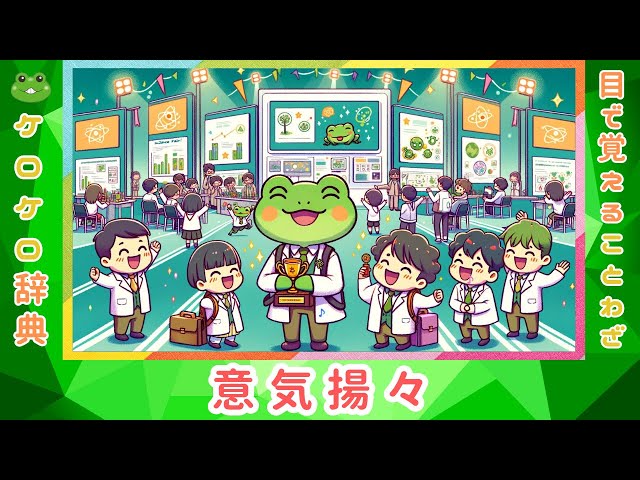
This four-character idiom is often used in positive situations where someone’s expression is radiant because things are going well.
It’s commonly used when someone feels proud after achieving a goal or returns victorious from a competition.
“Iki” refers to one’s frame of mind, while “yōyō” conveys a sense of pride or triumph.
Try using it in moments filled with joy and confidence, such as: “He won the contest and came back in high spirits,” “He was brimming with confidence after being entrusted with a new job,” or “She won the lottery and returned in a triumphant mood.”

a clear and serene mind

It’s not a phrase you hear often in everyday life, but it’s used at decisive moments—whether in a crucial contest or when making a major life decision.
Pronounced “meikyō shisui,” 明鏡 (meikyō) means a “polished mirror without a speck of cloudiness,” and 止水 (shisui) means “still, unmoving water.” For example: “Even against a strong team, his mind was as clear as meikyō shisui,” or “After long deliberation, I’ve made my decision, and my mind is meikyō shisui.” Try using it in situations involving important decisions or pivotal challenges.
The return of the sun; the turning of the tide toward good fortune (often used to mean a revival or a new beginning after adversity).
@hjc.aki Ichi-yō rai-fuku: Winter will surely end and spring will come; tough times will surely end and happiness will arrive.The return of the sun (symbolizing the turning of misfortune to good fortune)translationCalligrapherCalligraphyTranslation
♬ Soranji – Mrs. GREEN APPLE
Like the end of a cold winter and the gentle return of spring, the four-character idiom “Ichiyō Raifuku” means that good fortune comes after a spell of misfortune.
On days when you fail at studying or sports, or when something sad happens, you may worry that things will stay this way forever.
Even so, time moves forward little by little, and a new light begins to shine into your heart.
Even if school life doesn’t go smoothly, by continuing to move forward—even if only in small steps—the situation will surely change.
It is a four-character idiom that gives you the courage to keep hope in your heart.

Long life in good health

Sokusai-enmei expresses the wish for robust health and a long life.
Even without any special events, the everyday routine of waking up, going to school, talking with friends, eating meals, and sleeping is a very precious time.
When the body is healthy, the mind becomes positive, and the energy to take on new challenges wells up.
Valuing your own body and caring about the health of your family and those around you leads to a sense of security.
This four-character idiom reminds us of the importance of the ordinary days we spend—on the way to and from school, during recess, and with friends and family.
smooth sailing

Like a ship cheerfully sailing with a tailwind, this phrase describes when things go smoothly.
In school life, there are times when studying or sports feel enjoyable and when friendships go well.
That is proof that your past efforts and your kindness toward others are giving you strength.
Precisely when things are going well, it’s important not to forget gratitude and to prepare for the next challenge.
There will be days when failure makes it feel as if the wind has died, but if you keep going without giving up, a new tailwind will surely rise.
It’s a bright, hope-filled four-character idiom that gives you the courage to keep moving forward with a positive mindset.