

Recommended for elementary school students! Science fair topics & craft ideas


Speaking of summer vacation, choosing a topic for the independent research project can often be tough.
Science experiments and crafts are both fun! If your child is good at crafts, we recommend crafts because they can enjoy the process as they go.
When they get absorbed in it, they might even finish in just a few days.
Here, we’ll introduce a variety of ideas for independent research and crafts! If you’re struggling to pick a theme, please use these as a reference.
To create fun summer memories, make a one-of-a-kind project of your own!
- For summer vacation homework! Simple and amazing crafts for elementary school students that you’ll want to make after seeing them
- Simple yet amazing crafts: craft ideas that elementary school students will want to make
- Elementary School Students: Simple One-Day Science Project and Craft Ideas
- DIY science projects that elementary school boys will love: ideas you can make with everyday materials
- [For Upper Elementary Students] Simple but Awesome! A Collection of Summer Vacation Craft Ideas
- For upper-grade boys! Simple yet awesome craft project [Don’t call it lazy]
- Fun crafts using straws
- Recommended for lower elementary school students! A collection of plastic bottle craft ideas made with everyday materials.
- Simple and cute summer project crafts! A collection of ideas for girls that will make you want to create
- [Middle School Students] Easy One-Day Science Projects and Crafts Ideas
- Toys you can make from cardboard crafts! Authentic ideas you can build and play with
- Simple but awesome! Craft ideas for upper-grade girls
- Crafts parents and kids can enjoy together. Recommended craft ideas to keep children entertained.
For upper grades (141–150)
Handmade Happy Noodles
@n.annlee321 A pretty surprising way to make noodles 🤣 The packaging turned out so cute 🥹💓#DesignedWithCanva#CanvaPartner
♬ Electro Swing with retro cool brass & piano(1088312) – Ponetto
Looks just like the real thing! Let’s handcraft some happy noodles.
Flatten a cotton ball made from yellow embroidery thread to form a lump of noodles.
Also, wrap another embroidery thread around chopsticks and soak it in water mixed with liquid starch.
Once it dries and you remove it, it will turn into curly noodles, so make some of those too.
Use a small paper cup as the container and attach a package label you designed with a design app.
Put in the noodles and a packet of toppings, then stick on the lid to finish! You might even be able to use it as a keychain if you add some parts.

Easy Spinning Top Made from a Milk Carton
@silk_haru3mama Simple spinning top made from a milk cartonSummer Vacation CraftSummer Vacation Craft#HandmadeToys#HandmadeEducationalToy#Milk Carton Crafts#Milk carton#AtHomePlayworkSimple craftEducational toy#Summer Vacation
Fuzzy Navel – Conton Candy
Here’s an idea for making a spinning top you blow on using a milk carton.
First, cut the carton about 1.5 cm up from the bottom, then make slits at the four corners and open it up.
Next, rotating the carton in a consistent direction from each corner, cut along the edges of the bottom.
Leave about 1 cm uncut at the ends.
Bend the sections you just cut inward so they gather toward the center, and decorate with masking tape or stickers to finish.
If you blow straight down from above, it will spin around and around.
Cute mysterious bottle

A mysterious bottle where two liquids won’t mix even when tilted.
It’s a fun idea that works great as interior decor or a small gift.
First, fill the bottle about halfway with baby oil.
Next, add colored water tinted with food coloring.
Put in glitter or holograms as you like, cap it, and decorate the bottle to make it cute—and you’re done! The method is very simple, so even younger elementary school children can enjoy making it.
Along with the craft, try summarizing both your own ideas and the correct explanation for why baby oil and water don’t mix.
Puru-Koro Soap
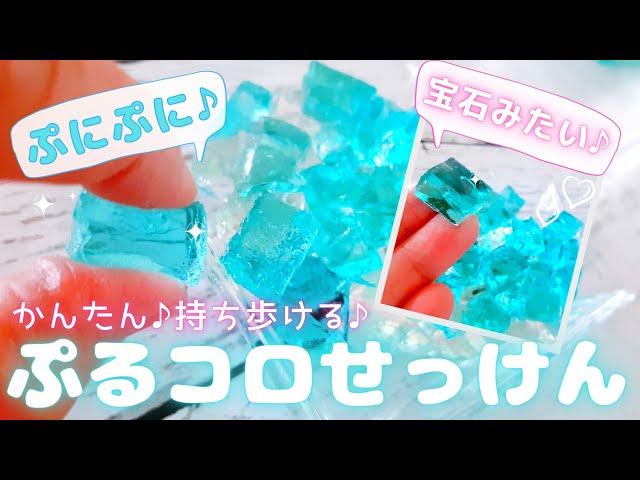
It’s like a jewel! Let me show you how to make cute, jiggly soap.
You’ll need liquid hand soap, gelatin, hot water, and food coloring.
Dissolve the gelatin in hot water, then mix in the liquid hand soap.
The trick is to stir slowly so it doesn’t foam.
Add food coloring, pour into a flat container, and chill in the refrigerator for 1–2 hours.
Then just cut it into your favorite shapes and you’re done! It looks adorable and might make handwashing more fun.
Just be careful to prevent small children from accidentally swallowing it.
Sparkling Kaleidoscope

If you’re unsure what to make for your summer vacation craft project, why not try a sparkling kaleidoscope? You can make this kaleidoscope with recycled materials and items from the 100-yen shop.
Cut a hard plastic case and form it into a triangular prism, then place beads in the bottom and secure them.
On the opposite end, attach a piece of black construction paper with a peephole.
Glue a milk carton—lined on the inside with black construction paper—around the triangular prism, and decorate it as you like to finish.
While kaleidoscopes typically use mirrors, in this idea the hard plastic case serves that role.
Sparkling hourglass

Let’s make a cute, sparkly hourglass that doubles as interior decor.
Prepare two small bottles, glitter to use as sand, a clear plastic file sheet, and decorative parts.
Cut the clear file slightly larger than the bottle opening and make a hole in the center for the glitter to pass through.
Attach tape and half-cover the hole, then glue it to the bottle.
Add the glitter and glue on the other bottle.
Finish it off cutely with decorative parts.
After adding the glitter, be careful not to turn it over until the adhesive has dried.
lampshade

Here’s a lampshade idea that also works as room decor.
Brush glue mixed with water onto an inflated balloon, then stick on small torn pieces of washi paper.
For sturdiness, layer the washi several times until the balloon’s color isn’t very visible.
Be sure to leave an opening where the light will go.
Since washi is white, use tissue paper if you want to add color.
Once it’s completely dry, pop the balloon and remove it, then secure a wire along the inside edge of the opening for the light to finish it off.