


Take on the Hyakunin Isshu quiz! Guess the lower verse from the upper verse!

Even if you want to memorize the Ogura Hyakunin Isshu and try competitive karuta or play casual karuta, many people probably feel it seems too difficult.
So in this article, we’re introducing a Hyakunin Isshu quiz perfect for anyone who wants to give karuta a try.
It’s a quiz where you hear the first half of a poem and guess the second half, letting you enjoy Japan’s traditional culture while having fun.
Why not imagine the scenes of the poems and enjoy the world of waka with friends or family? If the quiz helps you learn the Hyakunin Isshu, be sure to try competitive karuta too!
Take on the Hyakunin Isshu quiz! Guess the second verse from the first! (1–10)
What is the concluding verse that follows “Kore ya kono / yuku mo kaeru mo / wakarete wa”?

- I will never allow passage at the Barrier of Osaka in this world.
- Whether they know me or not, at the Barrier of Ōsaka (Ōsaka no Seki).
- People, it seems, call this world ‘Uji Mountain.’
See the answer
Whether they know me or not, at the Barrier of Ōsaka (Ōsaka no Seki).
This is a poem by Semimaru, a poet of the early Heian period. Set at the Barrier of Ōsaka, it portrays the passing of people—those who go and those who return—saying, “Both travelers setting out and those coming back all part ways here.” The place name Ōsaka also resonates with the verb “to meet” (au). The scene conveys the atmosphere of the checkpoint while also evoking the impermanence of life, with its repeated meetings and farewells.

What is the concluding lower phrase that follows “Koisute fu waga na wa madaki tachinikerI”?
- It was in secret that I first fell in love.
- I fear I may bring ruin upon myself.
- The path of love, whose way to go I do not know.
See the answer
It was in secret that I first fell in love.
There are times when even the moments spent thinking about an unrequited crush can feel enjoyable. Even if you think you’re hiding it, rumors like “You know, So-and-so is always looking at that person” may start to spread. Hearing people talk about your feelings like that can make you feel embarrassed. This is a waka poem that sings of someone in love in just such a state. Imagining the world of waka, it even comes across like a romantic comedy.

What is the last line that follows “Though I try to hide it, my love has shown in my face”?
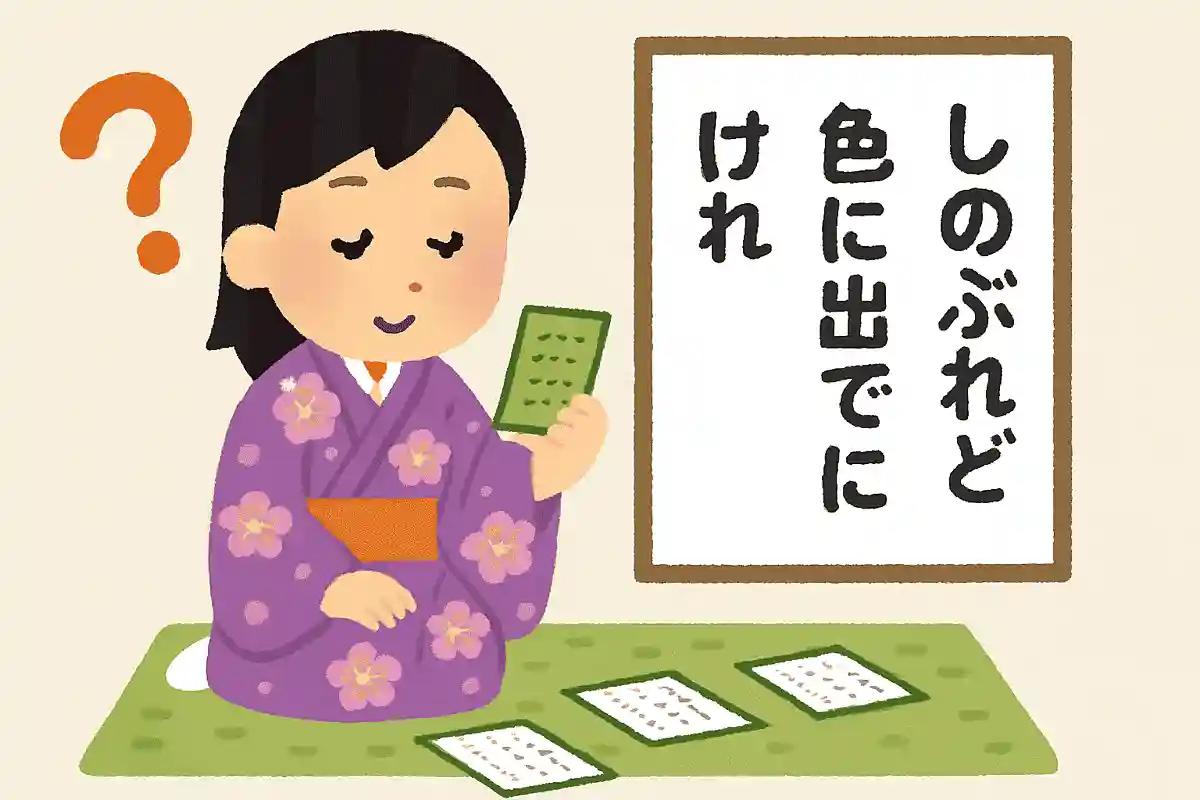
- When one is lost in thought, even others begin to ask
- The path of love, whose way to go I do not know.
- It was in secret that I first fell in love.
See the answer
When one is lost in thought, even others begin to ask
In everyday life, there are times when we meet someone wonderful and fall in love. Some people talk about their feelings of love with those around them or seek advice, while others keep their feelings hidden from everyone. Even if you think you’re keeping it a secret, it seems that people around you may surprisingly notice. Perhaps the joy and delight you feel when you think of the person you like naturally comes across to others. You can sense that same happy feeling of longing for someone in waka poetry as well.
What is the concluding verse that follows “Heavenly wind, close off the pathway through the clouds”?
- Let me keep the maiden’s figure for a moment longer.
- Do you mean to bid me pass quickly through this fleeting world in frolic?
- It is not that I began to be disordered (in love) of my own accord.
See the answer
Let me keep the maiden’s figure for a moment longer.
This poem was composed by the monk Henjō, one of the Six Poetic Immortals and the Thirty-Six Immortals of Poetry of the Heian period. It is among the most fantastical in the Hyakunin Isshu, conjuring a dreamlike scene. It carries the wish, “I want the road back to heaven to be closed, so I can gaze longer upon the celestial maiden.” In this verse, a dancing maiden is likened to a heavenly nymph, and its beautiful imagery merges seamlessly with human emotion.
What is the second half (shimo-no-ku) that follows “Haru sugite natsu ki ni kerashi shirotae no”?
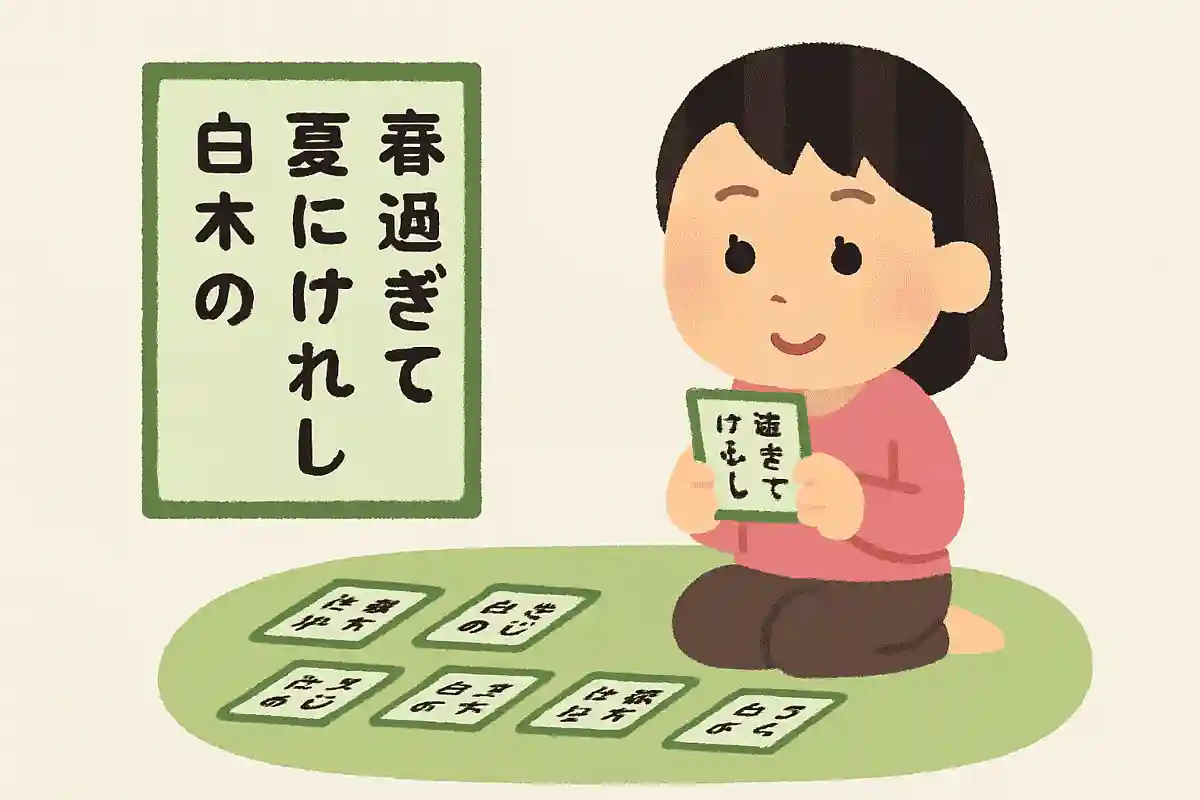
- They say garments are hung to dry on heavenly Mount Kaguyama.
- Are the flowers scattering without a tranquil heart?
- Has today already begun to scent with Kokonoe’s fragrance?
See the answer
They say garments are hung to dry on heavenly Mount Kaguyama.
It is said that the Kagu-yama mentioned in the song is located in Nara Prefecture. There’s a legend that this mountain descended from the heavens, which is why it’s prefixed with “Ama” (heavenly). At Kagu-yama, white garments are hung out to dry in the summer. The sight of brilliant white against the lush green must have been very beautiful. Beyond the landscape itself, it seems that in those days the smooth transition of the seasons from spring to summer was also regarded as proof that the country was being governed well.
What is the latter verse that follows: “Since the rapids are swift, the torrent is hemmed by rocks”?
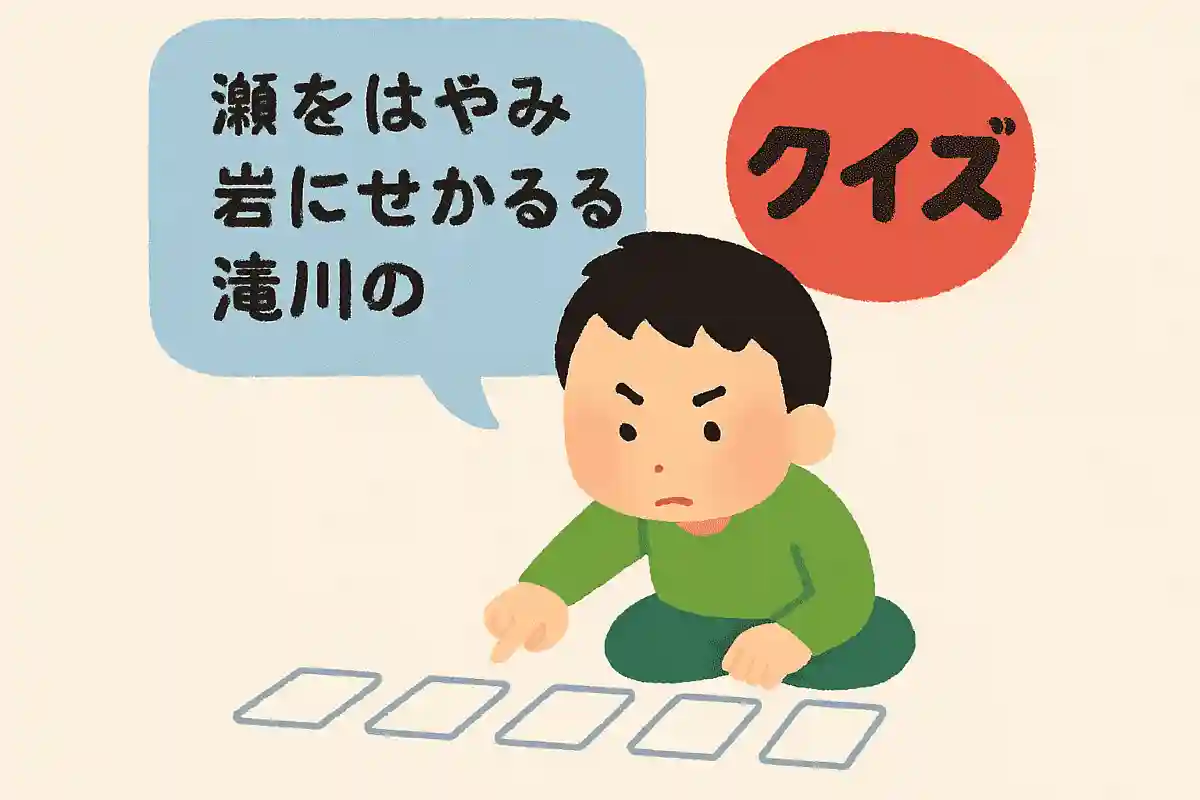
- That in deep crimson, water is bound together
- Even if we are parted now, I believe we shall meet at last.
- When is it, I wonder, that I feel so longing?
See the answer
Even if we are parted now, I believe we shall meet at last.
Parting from a beloved is always sorrowful, isn’t it? This waka conveys a forward-looking feeling that says, “We will surely meet again,” instead of brooding endlessly over the separation. Even when a swift current is split in two by a rock, it joins together once more—this imagery also lets us sense a strong resolve.
What is the concluding verse that follows “Hototogisu nakitsuru kata o nagamureba”?
- It seems I have gone out to wait for the waning moon of dawn.
- There is nothing as melancholy as the dawn.
- Only the moon over Ariake remains
See the answer
Only the moon over Ariake remains
This song is a work by Fujiwara no Sanekata, the former Minister of the Left at the Tōkudaiji. He is one of the Thirty-Six Poetry Immortals and was said to excel not only in waka, but also in gagaku, Chinese poetry, and imayō—so he was something of a modern-day multi-talent. In the Hyakunin Isshu, it’s known as a “one-character decision” poem: once the syllable ho is read, there’s no other possible choice, which makes it one of the easier poems to remember.
