

J.S. Bach | Introducing Famous and Representative Works
The songs that are popular today—across not only classical music but also pop and jazz—are deeply influenced by past composers.
Among them, classical music is often called the foundation of music, and it’s no exaggeration to say that Johann Sebastian Bach, known as the “Father of Music,” was one of the figures who laid that very groundwork.
Bach’s music, while carrying a religious hue, is characterized by philosophical depth and intricately refined structure down to the finest details, with melodies of exceptional beauty.
Please take a look into the world of Johann Sebastian Bach, one of the greatest composers in history.
- J.S. Bach | Introducing Famous and Representative Works
- J.S. Bach Popular Songs Ranking [2026]
- [Masterpiece Classics] A special showcase of gem-like masterpieces so beautiful they’ll move you to tears
- Handel’s Masterpieces | A Comprehensive Introduction to His Popular Works
- [Baroque Music] A Curated Selection of Timeless Masterpieces and Famous Works
- Vivaldi’s masterpiece. Popular classical music.
- Today's Classics: Recommended classical music and great performances to listen to today
- Mozart: An Introduction to His Signature and Popular Works
- Popular classical piano pieces. A collection of masterful performances by Japanese pianists.
- Cool classical masterpieces. Recommended classical music.
- [Quartet] Masterpieces and Popular Pieces for String Quartet
- François Couperin Popular Songs Ranking [2026]
- Masterpieces of Ballet Music: Introducing Classic Favorites
J.S. Bach | Introducing Masterpieces and Signature Works (141–150)
Polonaise in G minorJ.S.Bach

Many pieces that beginners can play are arranged at a relaxed tempo that doesn’t demand fast finger work.
As a result, pieces in major keys tend to end up sounding drawn-out.
Perhaps many beginners feel the same way.
For those people, I recommend this piece: Polonaise in G minor.
It’s a famous work by Johann Sebastian Bach, and although short, its memorable G minor structure is very appealing.
Try playing it while savoring the noble atmosphere of Baroque music.

MusetteJ.S.Bach

It’s attributed to Bach, but there’s a theory that he didn’t actually compose it, and some say it should be listed as composer unknown.
From the way it sounds, though, it’s full of Bach’s atmosphere.
Playing it as written in the score isn’t all that difficult.
Minuet in G majorJ.S.Bach

For many years, the Minuet in G major was believed to be a work by J.
S.
Bach, often called the father of music.
It is included in the Notebook for Anna Magdalena Bach, a collection associated with Johann Sebastian Bach, but research has revealed that it is actually a piece by his contemporary, Christian Petzold.
Nevertheless, because it was long cherished as Bach’s composition, most people today are still unaware of its true composer.
Regardless of who wrote it, it remains an unforgettable piece with an elegant and noble character once you hear it.

Minuet in G major, BWV Anh. 114J.S.Bach

It’s a composition by Bach.
Even people who don’t play the piano or aren’t interested in classical music have probably heard it somewhere.
It’s a very beautiful piece, but simply playing it as written in the score isn’t particularly difficult.
Minuet No. 3J.S.Bach
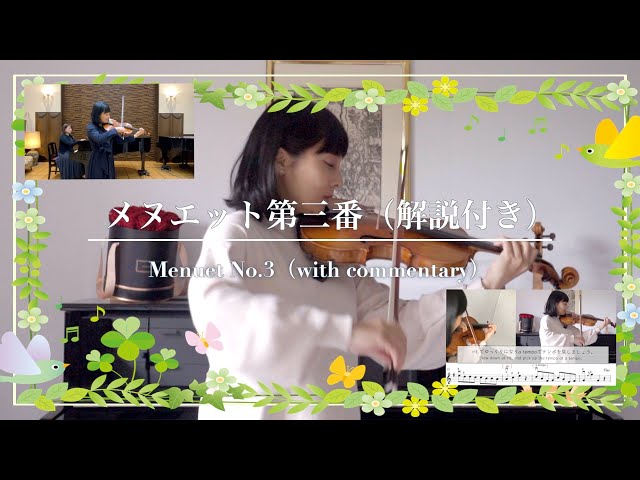
Bach’s music continues to be loved by many to this day because of its universal appeal.
This piece is known as part of the French Suites, which Bach composed between 1722 and 1725.
It features a relaxed rhythm and a calm melody, and conveys the elegance of the minuet, a dance in triple meter.
It is ideal for practicing violin performance, and since it consists of short phrases, it’s perfect for building a foundation in reading music.
While appreciating the charm of classical music, you can cultivate nuanced expression and a sense of rhythm.
Why not experience the depth of Baroque music through Bach’s works?
Violin Partita No. 2 in D minor, BWV 1004: I. AllemandeJ.S.Bach

Johann Sebastian Bach is an indispensable composer when discussing Baroque music.
He is said to have laid the foundation of Western music, and in Japan, he is honored as the “Father of Music” for his great achievements.
This piece, Violin Partita No.
2 in D minor, BWV 1004: I.
Allemande, is one of his famous violin works and consists of five movements.
Today, it has also been arranged for instruments other than the violin.
It might be interesting to compare those arrangements as well.
Prelude and Fugue in A minor, BWV 543J.S.Bach

A German composer active from the 17th to the 18th century.
Appointed as a court organist and a cantor, he upheld the traditions of Protestant music while leaving over 1,000 works.
While grounded in polyphony and incorporating music from various regions, he elevated musical counterpoint to its utmost, earning the epithet “the Father of Music.” The prelude of this piece is filled with passionate moods, sharp tension, and dissonance, featuring rapid motion over sustained pedal tones.
The subject of the fugue, while related to that of the prelude, possesses a calm expressiveness in contrast to the prelude.
