

Enrich your heart with beautiful four-character idioms! A collection of expressions you'll want to use in everyday life.

Among the four-character idioms that have blended into everyday life—such as “ōka ranman” (cherry blossoms in full splendor) and “kachō fūgetsu” (the beauties of nature)—there are many whose beauty can move you deeply.
These are not mere strings of words; they distill Japanese aesthetics, wisdom, and even life philosophy.
In this article, we introduce accessible four-character idioms chosen for their beautiful meanings and captivating sound.
You’re sure to encounter charming expressions that resonate with your heart.
Try using your favorite idioms in various situations!
- Become positive with four-character idioms that resonate with the heart! Common yet deeply meaningful words.
- [Four-Character Idioms] Impressive and Cool Sound! A Collection of Famous Quotes Worth Knowing as General Knowledge
- Intellectual beauty that shines! Stylish four-character idioms you can use in everyday situations
- Amusing four-character idioms you’ll want to use right away! A collection of expressions to remember as general knowledge.
- [For Elementary Students] A Collection of Beautiful Four-Character Idioms to Know
- General: Four-character idioms that encourage determination—powerful, heart-stirring words
- Four-character idioms wishing happiness: a collection of heartwarming expressions for everyday use
- Four-character idioms of love that touch the heart: expressing deep affection in everyday words
- [Kakizome] Four-character idioms fit for the New Year: Introducing words that resonate with the heart and their meanings
- Learn the meanings too! Cool four-character idioms that elementary school students will want to remember
- Four-character idioms that help you achieve goals! Phrases you can use in everyday situations
- Four-character idioms that convey grandeur: words expressing the vastness of nature, the breadth of thought, and the greatness of a person's character
- Interesting four-character idioms for elementary schoolers! Words you'll want to use once you understand their meanings
Enrich your heart with beautiful four-character idioms! A collection of expressions you'll want to use in daily life (1–10)
A hundred flowers in full bloom
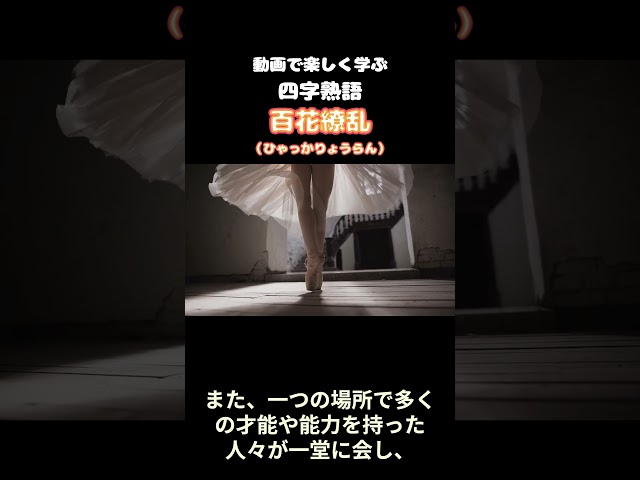
This is a four-character idiom that describes the sight of many different flowers blooming in full splendor all at once.
The scene is dazzling to the eye and symbolizes abundance and brilliance.
It is also used to depict a moment when diverse people and talents appear together, competing and shining alongside one another.
In history and the arts, eras in which many distinct personalities blossom are called “hyakka ryōran,” a term cherished for expressing cultural vibrancy and flourishing.
Beyond inspiring joy and exhilaration, it teaches the beauty of embracing diversity.
It is a dynamic expression that conceals strength within its splendor.

Flower in the mirror, moon on the water

It is a four-character idiom that likens things to flowers reflected in a mirror or the moon reflected on the water—beautiful yet without substance.
It refers to entities visible to the eye but impossible to grasp, symbolizing the transience and depth of art and thought.
In Japan, it has been used in poetry and painting, evoking a sense of dreamlike beauty.
In everyday life, it is also overlaid onto the pursuit of dreams and ideals, gaining value in contrast to reality.
It teaches us that there is beauty that shines precisely because it cannot be possessed and that lingers in the heart.
It is a refined expression that makes one feel ephemerality and beauty as one.
scenic
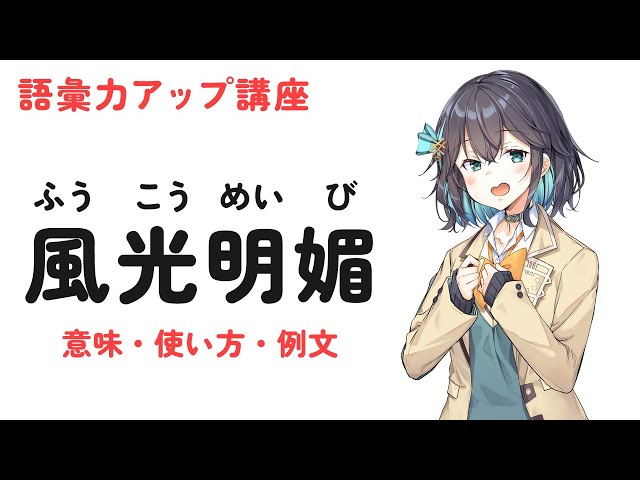
It is a four-character idiom that refers to beautiful natural scenery that soothes the heart.
The distinctive landscapes of a place—mountains, rivers, seas, and forests—blend in harmony and captivate visitors.
Used to describe tourist spots and famous scenic sites, this term conveys not only beauty but also a power to enrich the spirit.
For many people, the experience of touching nature clears the mind and brings emotional balance.
Places that show different faces with the changing seasons have long been cherished as travel destinations and havens of healing.
It is a Japanese expression that conveys the charm and beauty of nature.
Enrich your heart with beautiful four-character idioms! Expressions you'll want to use in daily life (11–20)
a thousand purples and ten thousand reds (i.e., a profusion of brilliantly colored flowers; a riot of colors)
@senshibankouchan What does 'senshibankō' mean?A thousand purples and ten thousand redsFour-character idiomsJujutsu Kaisen#Yuji ItadoriNobara KugisakiShoko IeiriFrozenTranslationNendoroid#NendoroidDoll
♬ Sweet Venom – ENHYPEN
This four-character idiom describes a scene where countless purple and crimson flowers bloom all at once.
It is a phrase that conveys the rich colors of the natural world and evokes a glamorous, vibrant image.
It is also used to depict a mix of diverse elements, each showing its individuality while thriving.
Symbolizing the exchange of diverse cultures and people, as well as the liveliness and bustle of society, it leaves a bright impression, like many flowers blooming.
Combining beauty and momentum, it is a powerful expression that brings hope and joy.
Ephemeral as a bubble; an illusion like a dream

This is a four-character idiom that expresses the fleeting, ever-changing nature of all things in this world.
Conveyed through words that evoke fragile images like dreams, illusions, bubbles, and shadows, it also appears in Buddhist scriptures.
It is regarded as a symbolic phrase for realizing the impermanence of life.
No matter how dazzling something seems, with time it disappears and cannot be preserved forever.
Yet it is not mere pessimism; precisely because we know its transience, it urges us to cherish the present.
Within our limited time, it teaches the importance of valuing encounters with people and nature and of savoring the beauty of each moment—a phrase rich with depth.
pure breeze and bright moon

This is a four-character idiom that depicts a beautiful natural scene of clear wind and a bright, shining moon—imagery that purifies the heart.
Stepping away from daily life, gazing up at the night sky and feeling the gentle breeze restores a sense of nature’s vastness and inner calm.
It portrays the refined atmosphere of an autumn evening and also refers to elegant, sophisticated pastimes.
The phrase conveys values that prize spiritual peace and harmony over material wealth.
In Japan, it has been cherished in many poems and essays and has been regarded as a symbol of a pure, dignified way of life.
It is a word with a beautiful ring that gently guides the mind to tranquility.
Scattered blossoms and falling leaves

It is a four-character idiom that expresses the changing of the seasons and the transience of nature, like flowers scattering in spring or fallen leaves dancing in autumn.
In the image of blossoms and leaves drifting through the air, there is a sense of life’s finitude and the poignancy of time’s passage.
This term has been used not only for its beautiful scenic description, but also as a metaphor for the fragility of life’s most splendid periods, which, though they arrive in brilliance, eventually come to an end.
At the same time, it evokes the cycles and renewal of nature, nurturing a sensibility that discovers beauty within wistfulness.
It is a word that conjures the beauty of Japanese landscapes, finding profound emotion in impermanence.