

Enrich your heart with beautiful four-character idioms! A collection of expressions you'll want to use in everyday life.

Among the four-character idioms that have blended into everyday life—such as “ōka ranman” (cherry blossoms in full splendor) and “kachō fūgetsu” (the beauties of nature)—there are many whose beauty can move you deeply.
These are not mere strings of words; they distill Japanese aesthetics, wisdom, and even life philosophy.
In this article, we introduce accessible four-character idioms chosen for their beautiful meanings and captivating sound.
You’re sure to encounter charming expressions that resonate with your heart.
Try using your favorite idioms in various situations!
- Become positive with four-character idioms that resonate with the heart! Common yet deeply meaningful words.
- [Four-Character Idioms] Impressive and Cool Sound! A Collection of Famous Quotes Worth Knowing as General Knowledge
- Intellectual beauty that shines! Stylish four-character idioms you can use in everyday situations
- Amusing four-character idioms you’ll want to use right away! A collection of expressions to remember as general knowledge.
- [For Elementary Students] A Collection of Beautiful Four-Character Idioms to Know
- General: Four-character idioms that encourage determination—powerful, heart-stirring words
- Four-character idioms wishing happiness: a collection of heartwarming expressions for everyday use
- Four-character idioms of love that touch the heart: expressing deep affection in everyday words
- [Kakizome] Four-character idioms fit for the New Year: Introducing words that resonate with the heart and their meanings
- Learn the meanings too! Cool four-character idioms that elementary school students will want to remember
- Four-character idioms that help you achieve goals! Phrases you can use in everyday situations
- Four-character idioms that convey grandeur: words expressing the vastness of nature, the breadth of thought, and the greatness of a person's character
- Interesting four-character idioms for elementary schoolers! Words you'll want to use once you understand their meanings
Enrich Your Heart with Beautiful Four-Character Idioms! A Collection of Expressions You’ll Want to Use in Daily Life (51–60)
Say what you mean, do what you say.

This is a four-character idiom that means taking responsibility for your words by putting them into action.
It serves as a guideline not only for making promises but for cultivating the attitude to keep them.
Even small things like “doing your homework” or “being on time” build trust when you follow through.
If the whole class embraces this phrase, everyone becomes more mindful about keeping promises, the atmosphere tightens, and a cooperative environment emerges.
It also fosters the strength to keep challenging yourself toward goals you set, bringing the joy of seeing things through.
It’s a phrase that teaches the importance of aligning words and actions.

fair and square

This four-character idiom expresses the attitude of taking on challenges the right way, without resorting to unfair methods.
By adopting it as a class goal, students cultivate a sense of fairness in various situations such as tests, sports days, and presentations.
A key point is that it fosters an atmosphere that values effort and process over results, rather than focusing only on winning or losing.
Respecting others and engaging earnestly builds trust across the class and creates a spirit of cheering each other on.
Experiences that let students hold their heads high even after failure will nourish them for the future.
It is a phrase that teaches the value of following the rules and facing challenges head-on.
Learning new things by revisiting the old
This is a four-character idiom that means learning from the past to gain new ideas and wisdom.
Used as a classroom goal for elementary school students, it can foster an attitude of learning from history and past experiences.
Students can reflect on the previous year to build a better class, and recall school events they shared—like sports days or field trips—to inspire new challenges.
By not only looking back at the past but also applying it to the future, growth accelerates.
It is a phrase that deepens learning and helps children feel the joy of gaining knowledge and the fun of continuing to learn.
consistent throughout

This is a four-character idiom that means remaining unwavering and consistent from beginning to end.
When facing difficulties, hesitating or changing course along the way can render the efforts you’ve built up meaningless.
However, by keeping this phrase in mind, you can stay steady against doubts and temptations that arise on the path to your goal and make steady progress.
In any challenge, maintaining an unshakable attitude and conviction leads to results.
Consistent actions also make it easier to earn the trust of those around you, which becomes a powerful asset in gaining their cooperation.
When you want to keep challenging yourself without giving up, this phrase will serve as a guiding support for your heart.

Enrich your heart with beautiful four-character idioms! A collection of expressions you'll want to use in daily life (61–70)
sincerity

This four-character idiom expresses facing things with a straightforward heart, without lies or deception.
If set as a class goal, it can help students value an honest and sincere attitude toward friends and teachers.
Daily actions will become more thoughtful—such as apologizing frankly when making a mistake and sincerely helping those in need.
By treating everyone with sincerity, the classroom atmosphere will become calmer and trust will deepen.
It’s a heartwarming phrase that offers hints for being considerate of others’ feelings and taking responsibility for your own words and actions.
a miraculous comeback
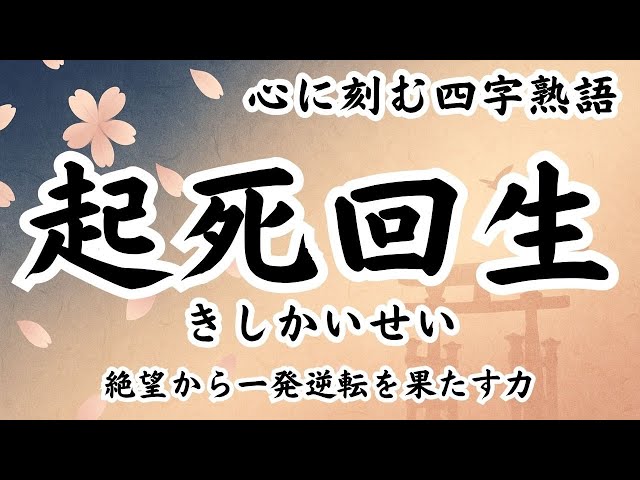
It’s a phrase that means recovering from a situation that seems hopeless and brilliantly turning the tide.
In life, there are inevitably moments when failures and setbacks make us feel like giving up.
But this phrase instills the strong resolve of “I can still do it—this is where it begins.” Whether it’s a come-from-behind victory in sports, a comeback at work, or a renewed challenge in studies, persistent effort without giving up can produce results that seem almost miraculous.
It is precisely in the face of difficulty that such a mindset becomes our support and draws out the courage to try again.
This empowering four-character idiom embodies the hope that we can rise again from any situation.
balmy spring breeze; a tranquil and genial spring atmosphere (calm, carefree mood in spring)
@yojijyukugo.seizan Four-character idioms #working adult #learning #study
Original Song – Four-character Idioms/Holy Mountain – Four-character Idioms/Holy Mountain
This four-character idiom is used to describe people with a calm, gentle personality or peaceful, laid-back scenes.
A place embraced by nature where you can relax in both body and mind can be described as “shunpu taitō” (literally, “spring breeze, untroubled and easy”).
It’s a tender expression also used when you meet someone who may not be flashy but has a composed air or a warm character.
When someone is easily irritated, quick to anger, or short on patience, gifting them this phrase might help them regain a sense of calm and create mental space, encouraging a more positive outlook.

In conclusion
Beautiful four-character idioms truly embody the heart of the Japanese language. The beauty contained in each phrase gracefully colors the hearts of people living today. By becoming familiar with these idioms, you can savor the depth of language as well as the rich expressiveness that Japanese possesses. Please continue to cherish encounters with words that resonate in your heart.