

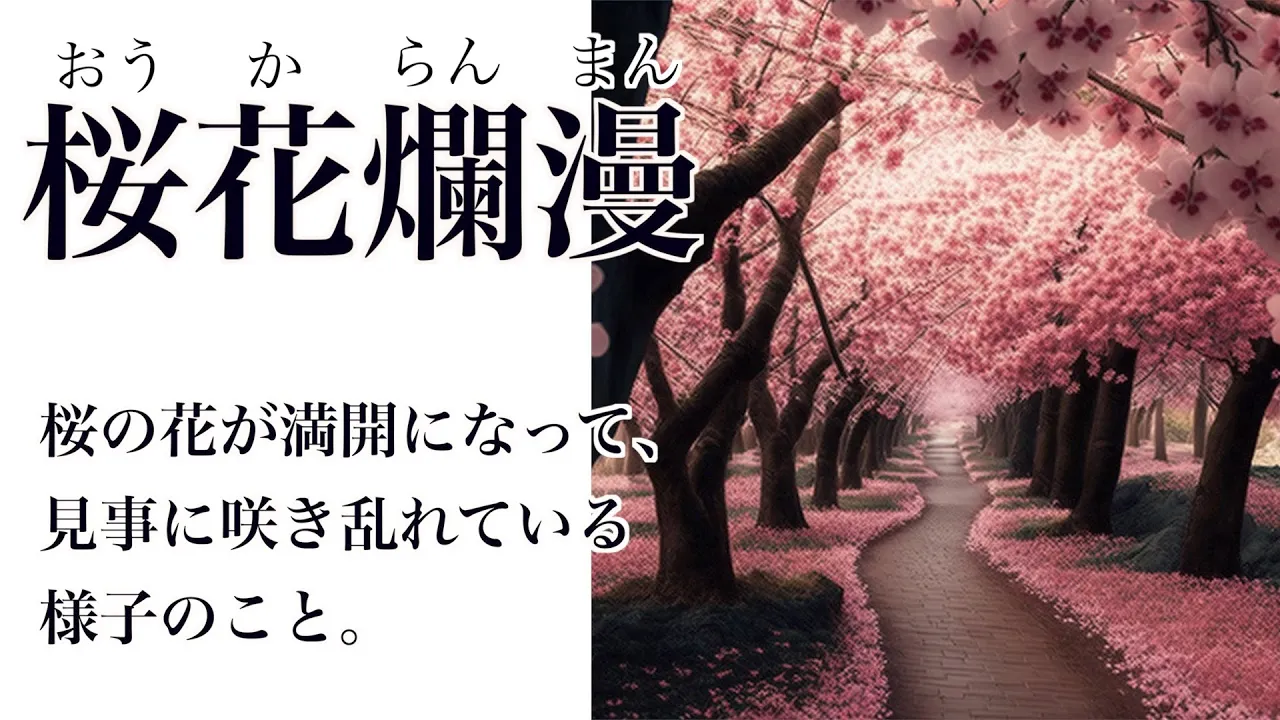

Among the four-character idioms that have blended into everyday life—such as “ōka ranman” (cherry blossoms in full splendor) and “kachō fūgetsu” (the beauties of nature)—there are many whose beauty can move you deeply.
These are not mere strings of words; they distill Japanese aesthetics, wisdom, and even life philosophy.
In this article, we introduce accessible four-character idioms chosen for their beautiful meanings and captivating sound.
You’re sure to encounter charming expressions that resonate with your heart.
Try using your favorite idioms in various situations!
- Become positive with four-character idioms that resonate with the heart! Common yet deeply meaningful words.
- [Four-Character Idioms] Impressive and Cool Sound! A Collection of Famous Quotes Worth Knowing as General Knowledge
- Intellectual beauty that shines! Stylish four-character idioms you can use in everyday situations
- Amusing four-character idioms you’ll want to use right away! A collection of expressions to remember as general knowledge.
- [For Elementary Students] A Collection of Beautiful Four-Character Idioms to Know
- General: Four-character idioms that encourage determination—powerful, heart-stirring words
- Four-character idioms wishing happiness: a collection of heartwarming expressions for everyday use
- Four-character idioms of love that touch the heart: expressing deep affection in everyday words
- [Kakizome] Four-character idioms fit for the New Year: Introducing words that resonate with the heart and their meanings
- Learn the meanings too! Cool four-character idioms that elementary school students will want to remember
- Four-character idioms that help you achieve goals! Phrases you can use in everyday situations
- Four-character idioms that convey grandeur: words expressing the vastness of nature, the breadth of thought, and the greatness of a person's character
- Interesting four-character idioms for elementary schoolers! Words you'll want to use once you understand their meanings
Enrich your heart with beautiful four-character idioms! A collection of expressions you'll want to use in daily life (1–10)
Cherry blossoms in full, resplendent bloom

This is a four-character idiom that depicts cherry blossoms in full bloom, vividly coloring the spring scenery.
Though the sight is a fleeting beauty, it has the power to leave a deep imprint on people’s hearts.
Japanese people often feel transience and poignancy in cherry blossoms and have long enjoyed them through the tradition of hanami.
From the expression “ōka ranman” (cherry blossoms in glorious profusion), one can sense the richness of nature and the cycle of life.
Feeling the changing seasons with our own bodies gives today’s busy people a moment to pause, reminding them of peace of mind and gratitude.
It is an indispensable Japanese word when speaking of spring.

A land of picturesque mountains and clear waters
@hiroaki946 Yamazaki-suimei (beautiful mountains and clear waters), Shorts, short videos, mini videos, idioms, four-character compounds, proverbs, Japanese language, meanings of words, wordplay, learning, education, trivia, Japanese culture, time-killing, study, knowledge, trivia, everyday lifeThe Power of WordsVOICEVOX: Shikoku Metan Four-character idiom that evokes a beautiful landscape: “Sanshi-suimei” Do you know what it means? First, an example sentence: During a summer holiday, I visited my hometown mountain village. As the sun rose, the mountains were tinged a pale purple, and a truly “sanshi-suimei” scene spread out before me. The river water was so clear that I could see the pebbles resting on the bottom. Accompanied by birdsong, the sound of trees swaying in the wind was soothing, and being surrounded by nature eased the fatigue of daily life. I felt a strong desire to keep protecting this beautiful scenery. Meaning: “山紫水明 (sanshi-suimei)” is a phrase that describes beautiful natural scenery. This four-character idiom refers to landscapes where the mountains and waters are especially beautiful and crystal clear. Specifically, it is used to depict mountains tinged with purple hues and pure, bright waters. The expression emphasizes the beauty of nature and the clarity of the scenery. That is all.
Original song – hiroaki946 – hiroaki946
It is a four-character idiom that refers to a scene where mountains are veiled in purple haze and waters flow clear and beautiful.
This expression captures the purity and beauty of nature, and in Japan it has long been used in waka and classical Chinese poetry.
Beyond merely describing a landscape, the phrase also carries the meaning of symbolizing harmony between nature and the human heart.
Stepping away from everyday life to encounter the beauty of mountains and rivers offers an experience that purifies body and mind—a timeless message and a value of lasting importance.
"Sanshi-suimei" (山紫水明) is a profound term that evokes the serenity and nobility of the natural world.
boundless; vast and unbroken as far as the eye can see

It is a four-character idiom that describes looking out over an endlessly expanding view.
When faced with a horizon or the open sea, it expresses the feeling that no boundary is visible and that the vista stretches on infinitely.
This word not only conveys the grandeur of nature, but also symbolizes boundless possibilities and an expansive future.
When everyday life feels stagnant, recalling the term “ichibō-mugin” (boundless as far as the eye can see) can help broaden your perspective.
It is a powerful phrase that evokes the majesty of nature and the possibilities of life.
cherry, plum, peach, and apricot (each flower/thing has its own unique beauty)
@sisqoxrw0sq What are cherry, plum, peach, and apricot? The Zen phrase “Oubaitori.”
♪ Original Song – Eiichiro – Eiichiro
This four-character idiom expresses that just as cherry blossoms, plum blossoms, peaches, and Japanese apricots each bloom with their own beauty, every person has unique qualities and inherent value that need not be compared.
Even when appearances or abilities differ, each individual’s character enriches society.
Rather than competing, acknowledging one another’s differences is a vital foundation for harmony in relationships and in society as a whole.
Using flowers as a metaphor, it warmly points to a way of living together that honors diversity—the beauty of lives in which everyone blooms with their own distinct petals.
The beauties of nature — flowers, birds, wind, and the moon (a poetic expression appreciating nature’s elegance)
@mitsu_is Kachou Fuugetsu: A word of traditional Japanese beauty that middle and high schoolers and adults can enjoy. History-loving Yayoi-chan and her grandpa, a former IT engineer, give a fun, pop-style explanation! AI-generated voices: VOICEVOX: Kotouta Nia, VOICEVOX: Chibishiki-jii. 🕊️ Contents: • What does “Kachou Fuugetsu” mean? • Is the origin from the Tang poet Li Bai!? • How to enjoy “Kachou Fuugetsu” in everyday life. ▶︎ Dive deeper on the blog ‘Little Stories of Life and History’.https://webizist.com/Kachōfūgetsu; four-character idioms; Japanese aesthetics; history lover; Yayoi and Grandpa; little stories of life and history; short lessons; Japanese culture; understandable for middle schoolers
♬ Original song – mitsu_is – mitsu_is
This four-character idiom expresses a sensitivity that loves the beauty of nature and reflects its emotions in the heart.
Through the four elements—flowers’ colors, birds’ songs, the freshness of the wind, and the radiance of the moon—it conveys a rich cultural background in which nature and the human heart are connected.
From this word, one senses not only the depiction of scenery but also an attitude of enjoying the seasonal changes and feeling the joy of living within nature.
Even in a busy daily life, by being mindful of kachō-fūgetsu, you can calm your mind and refine your sensibility.
It is a word of deep flavor that nurtures a heartfelt appreciation for nature.
Blue sky beyond the clouds
@mitsu_is [Un-Gai-So-Ten] Beyond the clouds, the blue sky awaits! ✨ This time’s theme is the four-character idiom “雲外蒼天” (ungai sōten)! It means “If you overcome hardships, hope will open up.” It comes from the Chinese classic Book of the Later Han and is still used today as a positive expression.🌤 A similar phrase is “雨過天晴” (uka tensei), meaning “After the rain, the sky clears.” In what situations would you like to use “雲外蒼天”?AI-generatedStructure/Script: ChatGPTImage generation prompt: ChatGPTCaptions and sound effects: VrewImage generation: Vheer, ImageFXVideo generation: Vheer, Veo 2Video editing: CanvaNarrationVOICEVOX: Kotouta NiaVOICEVOX: Chibishiki-jii📌 If there are other four-character idioms you’d like explained, tell us in the comments!👉 For a detailed explanation, see the blog “Everyday Life and Little Histories”! 🔗https://webizist.com/Four-character idiom: “After the clouds, a blue sky” (Ungai Sōten). History enthusiast. Study account. Positive mindset. Trivia. Yayoi and her grandfather. Short explainer. Vignettes of life and history.
♬ Original song – mitsu_is – mitsu_is
It is a four-character idiom that signifies that clear blue skies spread beyond the dark clouds, teaching that a bright future awaits once you overcome hardships.
In the midst of adversity, the path ahead can seem uncertain and frightening, but this phrase encourages us to believe that the situation will surely improve and gives us the courage to move forward.
Even if you experience doubt or seemingly unbearable suffering in the process of persistent effort, a sense of accomplishment and hope will await you beyond it.
It is a word that conveys encouragement in life and serves as a powerful support for those who continue to take on challenges.
Three Houses

This is a four-character idiom that expresses an appreciation for flowers dancing in the wind, the clear moon, and the beauty of snow.
It reflects a distinctly Japanese sensibility that loves natural landscapes and finds emotion and subtle charm within them.
In Japan, where there are four seasons, the idiom is used in poetry and painting, and it is characterized by a cultural background that enriches the heart, extending beyond mere descriptions of nature.
Enjoying the seasonal sights in daily life brings nourishment to the spirit.
It is a phrase that values the crystalline beauty of landscapes and a sensibility of living in harmony with nature, serving as an important guide for discovering beauty in everyday life.