

Brahms's masterpieces. Popular classical music.

Here are some recommended works from the many masterpieces left by the German composer Johannes Brahms.
If you get to know Brahms—hailed as one of the “Three Bs” of German music alongside Bach and Beethoven—you’ll be well on your way to becoming a classical music connoisseur.
His Symphony No.
1, composed with deep respect for Beethoven, was so strongly influenced by him that the conductor of its premiere, Hans von Bülow, famously called it “Beethoven’s Tenth Symphony.”
Please enjoy the world of Brahms, which continues to be cherished by classical music fans today.
- [Masterpiece Classics] A special showcase of gem-like masterpieces so beautiful they’ll move you to tears
- Johannes Brahms Popular Songs Ranking [2026]
- [Violin] A curated selection of beloved classic masterpieces and popular pieces that continue to be cherished across eras
- Robert Schumann | Introduction to his famous and representative works
- Cello Masterpieces: A comprehensive introduction to exquisite classical works that let you savor its profound timbre
- Masterpieces for Harp: A curated selection of distinguished works featuring noble and delicate tones
- Masterpieces of classical piano that are too beautiful for words. A gathering of delicate tones that cleanse the soul.
- Mozart: An Introduction to His Signature and Popular Works
- Gabriel Fauré | Introduction to His Famous and Representative Works
- [Quartet] Masterpieces and Popular Pieces for String Quartet
- Timelessly beautiful classical masterpieces. Recommended classical music.
- Mendelssohn’s Masterpieces | Popular Classical Music
- Today's Classics: Recommended classical music and great performances to listen to today
Brahms's Masterpieces: Popular Classical Music (31–40)
Six Pieces for Piano, Op. 118 No. 3 “Ballade”Johannes Brahms

Johannes Brahms, one of Germany’s greatest composers.
Brahms wrote many pieces at an intermediate level, but among them I especially recommend “Six Pieces for Piano, Op.
118 No.
3: Ballade.” It’s a piece marked by the weighty, powerful melodies that are quintessential Brahms.
In terms of difficulty, it’s roughly equivalent to Czerny Nos.
40–50.
Although this work is said to be challenging at the beginning and end, the middle section requires legato technique in double notes, so rather than treating it like a piece with relentless, flashy passages, pay careful attention to the details as you perform it.

Waltz No. 15, Op. 39-15Johannes Brahms

This is the 15th piece from the 16 Waltzes, Op.
39, originally written for piano four hands and later arranged for solo piano.
The work was dedicated to the aesthetician and music critic Eduard Hanslick, who reportedly was surprised that Brahms—a champion of absolute music—had composed waltzes, which were considered entertainment music at the time.
Brahms, impressed by the popular waltzes of Johann Strauss then in vogue, composed this set.
Rather than an optimistic, merry waltz, the piece reflects Brahms’s temperament with a certain solemn and weighty character.

Waltz No. 15 in A-flat major, Op. 39Johannes Brahms

Johannes Brahms, a great composer known for his meticulous and elegant style.
Because many of his pieces are calm, his works frequently appear on YouTube playlists for sleeping to classical music.
Among Brahms’s works, the one I especially recommend is the Waltz No.
15 in A-flat major, Op.
39.
Originally composed for piano four hands, it was later arranged for solo performance and has been played by many performers up to the present day.
This otherworldly Brahmsian waltz, bearing the imprint of Schumann, conveys a depth of artistry not found in other waltzes.
Waltz No. 15 in A-flat major, Op. 39 “Waltz of Love”Johannes Brahms
Johannes Brahms, the German composer known for his dense and weighty style.
Because many of his pieces have a calm character, his works often appear in YouTube playlists for sleep-oriented classical music.
Among Brahms’s works, one I especially recommend is the Waltz No.
15 in A-flat major, Op.
39.
Originally composed for four-hand piano duet, it was later arranged for solo piano and has been performed by many pianists up to the present day.
Why not savor a waltz of depth and substance, distinct from the typical light and airy waltz?
Lullaby, Op. 49 No. 4Johannes Brahms
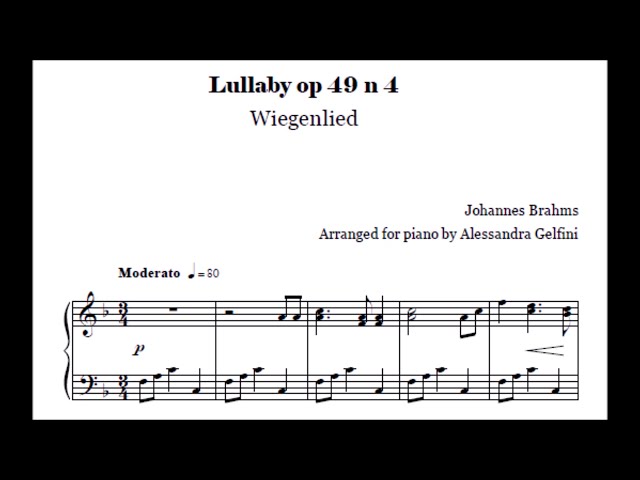
Among classical works, there are several pieces that bear the title “Lullaby.” Among them, alongside those by Schubert and Mozart, one of the most famous is Johannes Brahms’s “Lullaby, Op.
49 No.
4,” widely known as “Brahms’s Lullaby.” Its gentle, sparsely noted melody—typical of lullabies that lull children to sleep—is easy to play on the piano, making it perfect for beginners.
However, precisely because it is simple, the beauty of tone and flow becomes crucial.
Let’s aim for a soothing performance that helps listeners feel at ease and drift off to sleep.

Brahms’s Masterpieces: Popular Classical Music (41–50)
Waltz No. 15 “Waltz of Love”Johannes Brahms
Brahms’s Waltz No.
15, the “Waltz of Love.” It’s well known from children’s collections, too.
With its friendly, adorable melody, it’s often performed on piano and violin.
A simple, short tune is repeated with variations, which makes it easy to listen to and very appealing.
It’s a gentle waltz that can be enjoyed by both children and adults.

Intermezzo, Op. 118 No. 2Johannes Brahms

A piece whose gentle, graceful melody seeps into the heart.
Like waves that ebb and flow, its unhurried lines carry deep emotion and quiet reflection.
Written in 1893, it is characterized by a singing right-hand melody supported by soft left-hand chords.
In the middle section, it unfolds with passion, yet returns to the calm theme, evoking the rises and falls of life.
Expressing the stillness of an autumn dusk and feelings held within, this work is ideal for those who wish to experience the piano’s profound allure or refine delicate expressive skills.
Rather than technical bravura, it calls for attention to color and emotional nuance—an invitation to take it on with care and sensitivity.