

[For Seniors] Enjoyment at Day Care: A Roundup of Games and Recreational Activities


We’ve put together a collection of games and recreational activities that can be enjoyed at day care.
We introduce plenty of options, including simple games you can play while seated, brain-training games, and activities that help with hand and finger rehabilitation—so please use them as a reference.
Some activities require props, but they’re simple to make using recycled materials or items from 100-yen shops, making them easy for older adults to recreate.
Give them a try with everyone during recreation time or in small breaks.
- [For Seniors] Simple Recreational Activities You Can Enjoy While Seated
- For Seniors: Effective Recreation for Preventing Care Needs—Have Fun While Staying Healthy
- [For Seniors] Simple Tabletop Games: Fun and Engaging Recreational Activities
- [For Seniors] Easy and fun seated activities you can do in your room
- [For Seniors] Today’s Recommended Activity: Fun and Engaging
- [Elderly Day Service] Let’s all have fun! Games and recreational activities
- [For Seniors] Fun! Games and Ideas to Boost Memory
- [For Seniors] Have Fun! A Collection of Group Game Recreation Ideas
- Hand games that liven things up for seniors—also great brain training
- [For Seniors] Easy to try. Fun, crowd-pleasing recreation
- [For Seniors] Fun Small-Group Recreation
- [For Seniors] Recreational Activities Enjoyable in Large Groups
- [For Seniors] Enjoyable Indoor Activities! Recreations and Games That Engage the Mind and Body
[For Seniors] Enjoy at Daycare: Compilation of Games and Recreational Activities (261–270)
Let’s look for some fish and try catching them!

The fish-finding game played as a recreation activity for older adults is always a big hit.
It’s easy to enjoy not only for those who love fishing, but also for complete beginners.
The game involves placing various fish on a table and catching them with a rod.
A staff member calls out the name of a fish on the table, and the older adults look for it.
Because it requires split-second decisions, it helps develop their powers of observation.
Through this game, older adults can learn fish names, and it also serves as brain training, so it’s highly recommended.

fishing

While enjoying a game of “fishing,” let’s train the brain as well as the hands and arms.
It’s a great game for busy staff, and you can prepare it easily with paper cups, newspaper, and disposable chopsticks.
Draw fish, octopuses, and other sea creatures on several paper cups—the more cups you have, the more fun it becomes.
Steps like tearing newspaper and making a fishing rod with chopsticks use your fingertips, right? Since many nerves connected to the brain are concentrated in the hands, they’re sometimes called the “second brain.” Using your hands and fingers stimulates and activates the brain.
Reeling in catches also provides exercise for the hands and arms.
Be sure to try fishing with your non-dominant hand as well!

“Hello, Little Turtle” hand game

A hand and finger play that you can enjoy to the tune of “Moshi Moshi Kame yo, Kame-san yo” is introduced.
In this finger play, when you raise the right thumb, you raise the left pinky; if the right hand shows the pinky, the left hand shows the thumb.
It’s a hand play where you alternately open and close the hands left-right.
Doing it face-to-face with a partner also encourages interaction.
Beanbag Toss Game
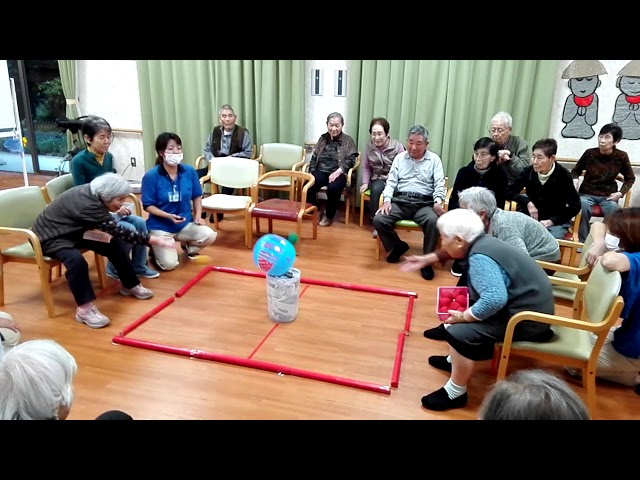
With a time limit set, the “Ojami Toss Game” challenges players to drive a beach ball into the opponent’s territory.
“Ojami” refers to beanbags used for traditional juggling.
Beanbags are familiar items for many older adults, and their moderate weight and pleasant texture make them a perfect match for this game.
The key is adjusting how hard you toss the beanbags to strike the beach ball and push it into the opponent’s side.
This game can help improve hand and arm strength as well as cognitive function in older adults, so why not actively incorporate this easy-to-play activity?

Shiritori Cards

We’ll play a shiritori game using cards with various words written on them, connecting words one after another.
It’s easier to read the words in hiragana, but writing them in kanji also adds the element of recalling their readings.
Start with a simple shiritori to get going, and once everyone gets used to it, it’s recommended to add conditions to the words.
By adding variations—such as searching for words with a specified number of characters—the game becomes more complex and really trains thinking skills.
If you proceed as a team and cooperate, you can also incorporate a communication element, which is highly recommended.
