

Summary of exercises for seniors: introducing preventative care movements by body part.

To stay healthy in both body and mind for as long as possible, preventive care is essential.
Whole-body training is effective for preventive care.
In this article, we introduce exercises for older adults, organized by body part.
Since there are exercises that work the entire body from the neck to the toes, we recommend doing different body parts on different days.
Be careful not to try doing everything at once, as it may tire you out.
Use this article to help maintain the health of older adults.
- [For Seniors] Easy and Fun Core Training
- [For Seniors] Fun Exercises You Can Do While Seated
- [For Seniors] Recommended Easy Strength Training
- For seniors: Enjoyable exercises done while seated, accessible for wheelchair users.
- For Seniors: Fun and Lively Exercise Recreation
- Energetic and Lively! Sing-and-Exercise Program for Seniors
- [Seated] Fun Health Exercises for Older Adults and Seniors
- [Recommended for seniors] Rejuvenating Rock-Paper-Scissors Exercise
- Let's extend our healthy lifespan! Care exercises to stay active and energetic forever
- [Today's Recommendation] Gentle Health Exercises for Seniors
- [For Seniors] Hand and finger play roundup: Finger exercises that lead to brain training
- [For Seniors] Recreational activities and games that let you have fun while strengthening your legs
- [For Seniors] Have Fun and Relieve Stress! Introducing Dances Everyone Can Enjoy Together
Summary of exercises for seniors: Introducing preventative care exercises by body area (41–50)
Sit-to-stand exercise using a chairNEW!

This is a training exercise using chairs that strengthens your legs and glutes.
It directly helps you perform the standing motion with less strain, so give it a try.
First, sit on a chair.
Place another chair facing the same direction in front of you, at a distance where you can touch its backrest with your arms extended.
Grab the front chair with your hands and lean your upper body firmly forward.
Then slowly lift your hips and stand up.
If you stand up with your torso upright, it puts strain on your legs and lower back, so be sure to lean forward well.

Pelvic floor exercises you can do lying down for 5 minutes every dayNEW!
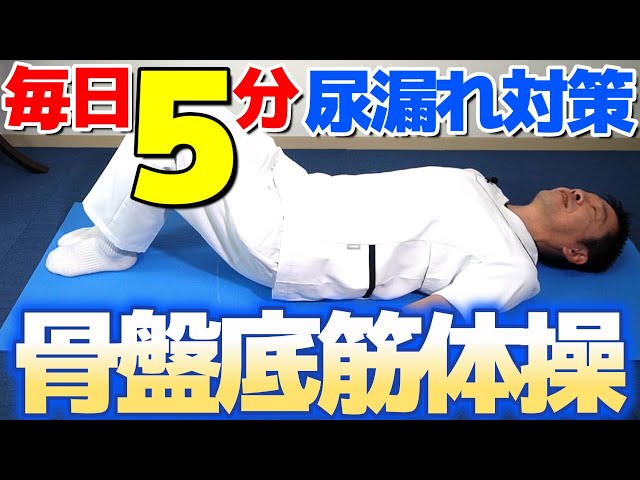
This is a low-impact workout that’s easy to start.
First, lie on your back, bend both knees, and keep them together.
Tighten your anal muscles firmly and hold for 10 seconds.
After 10 seconds, spread your feet to shoulder width, lift your hips, and hold steadily for 5 seconds.
Then, as you inhale, slowly relax and return to the starting position.
Training on your back helps your body relax and makes it easier to understand how to engage your muscles, so you can easily keep it up for short sessions before bed or right after you wake up.
There’s also a method on all fours introduced here, so try incorporating it at your own pace without overexerting yourself.

A simple pelvic floor exercise you can do while sitting for 5 minutes every dayNEW!

This is an easy exercise you can do every day while seated.
Sit in a chair, press your palms together, and hold them between your knees.
Keeping them squeezed, lift your heels and, as you exhale, gently tighten your anal area and lower abdomen; you’ll start to feel your pelvic floor muscles engage.
Hold for 10 seconds, then relax as you inhale.
Repeat this 10 times to help you get a better sense of consciously moving your pelvic floor muscles.
Finish with a deep breath to relax.
Because it can be done sitting down, you can keep it up even while watching TV, so why not make it a habit?
Grip strength training with a water-filled plastic bottleNEW!

Fill an empty plastic bottle with water and use it as a dumbbell.
First, while seated, place the hand holding the bottle on a desk and move only your wrist as if curling the bottle upward.
Keep your elbow from lifting by holding it down with your other hand.
Do the same with the opposite hand.
Next, stand up and, in the same way, raise the bottle using only your wrist.
Again, it helps to hold your elbow in place with your other hand so it doesn’t move unnecessarily.
Of course, repeat on the other side as well.
Do each for 30 seconds.
If the bottle feels too heavy, it’s fine to reduce the amount of water inside.

Simple exercises to make standing up easierNEW!

When standing up from a chair, lifting your hips is essential.
But that’s the moment that puts the most strain on your legs and lower back.
So let’s use this exercise to train yourself to raise your hips more easily.
First, clasp your hands and extend your arms in front of your body.
Then take both feet slightly back, and as you extend your arms diagonally upward, lift your hips off the seat.
Repeat this movement, and when you’re done, actually stand up.
The key is to tilt your pelvis upright and keep your back straight so it doesn’t round.
Inner thigh exercises needed for standing upNEW!

When you learn to properly engage your inner thigh muscles, everyday movements become smoother and your whole body feels more stable.
First, sit on a chair with your back straight and consciously bring your knees together.
While sensing the inside of your thighs, slowly repeat the motion of opening and closing your knees to activate the inner thigh muscles.
Do about 10 repetitions.
As you continue, the supporting strength of your legs will increase, making it easier to build the power used when standing up.
Since this helps daily movements become smoother and contributes to overall stability, try incorporating it gradually at your own pace.
Exercises to improve standing up movementsNEW!

This exercise focuses on becoming aware of which parts of your body move when you stand up, and gradually improving each movement.
Start by improving ankle mobility: while seated in a chair, alternately lift your toes and heels to engage the area from your ankles to your calves.
As you thoroughly loosen your ankles and increase the range of motion of your toes and heels, your movements when standing up will also become larger and safer.
It’s important to amplify each movement, and when doing the exercises, use a chair for support to help maintain balance.
