

[For Seniors] Recommended Brain Training! A Fun Collection of Math Quizzes

In senior and welfare facilities, various brain-training activities are practiced.
The “math quiz” we’re introducing this time is one of those brain-training activities.
Working with numbers is expected to help activate the brain.
We’ve prepared a variety of problems, including the four basic operations like addition and division, as well as puzzles where the operation symbols in the equations are hidden!
There are also word-based math quizzes, so why not take your time and try solving them?
You can write them on a whiteboard or on paper and enjoy working through them with a few seniors.
Of course, you can also focus and solve them on your own.
Let’s have fun training our brains with this “math quiz”!
- Calculation problems that train the brain for seniors
- [For Dementia Prevention!] Brain-Training Math Quiz for Seniors
- [For Seniors] Fun Brain Training! A Collection of Tricky Quizzes You’ll Definitely Get Stumped By
- A math quiz for adults. Can you solve it?
- [For Seniors] Brain Training with a Whiteboard! Fill-in-the-Blank Exercises & Quizzes
- [For Seniors] Brain Training! Recall Quiz Collection!
- [For Seniors] Fun Brain Training! Lively Mind Exercises
- [For Seniors] Today’s recommended quiz. Daily brain-training quiz!
- Hand games that liven things up for seniors—also great brain training
- [Interesting] Collection of Math Quiz Problems
- [For Seniors] Recommended for Brain Training! Ultra-Difficult Quizzes and Riddles
- [For Seniors] Fun and Engaging Brain-Training Recreation
- [For Seniors] Boost Your Knowledge! Fun Trivia Quiz
[For Seniors] Recommended Brain Training! Fun Math Quiz Collection (11–20)
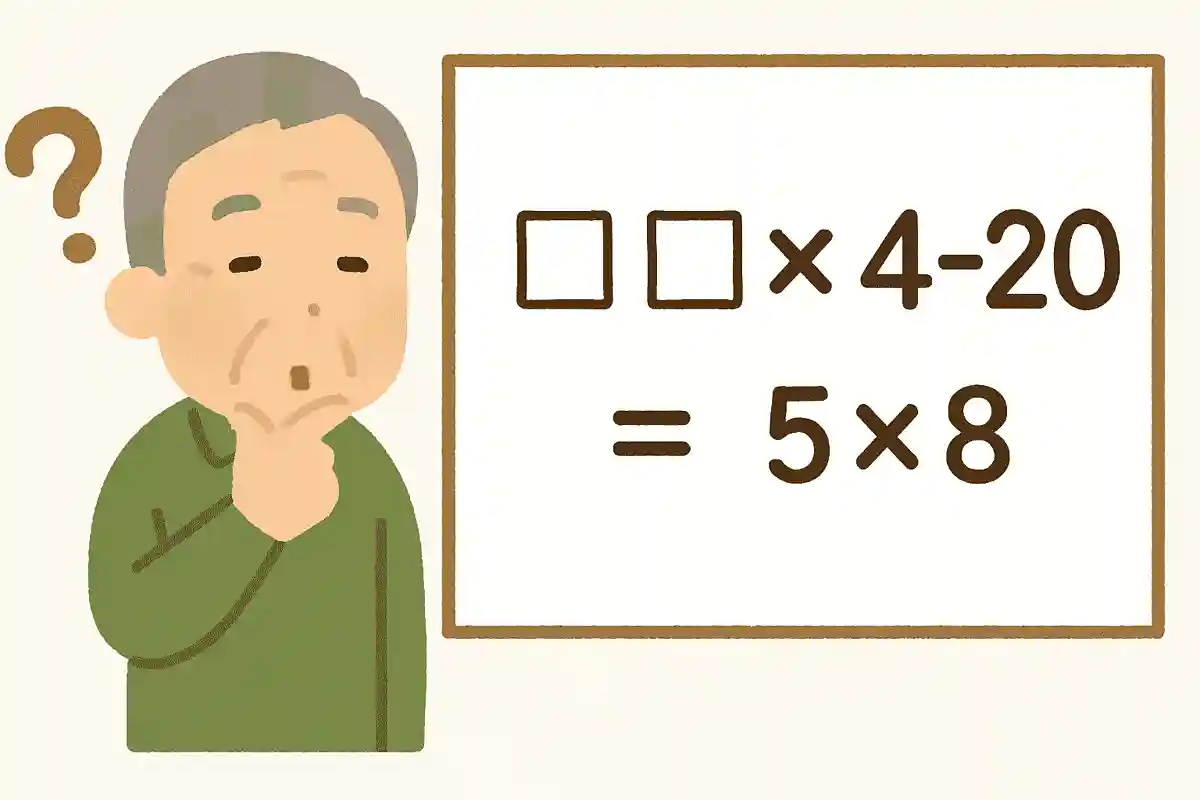
Let’s figure out the number that goes in the blank in ○○ × 4 − 20 = 5 × 8.
See the answer
15
When there is multiplication on both the left and right sides of an equation, it can feel difficult, right? But once you learn how to solve it, one of the fun parts of arithmetic and calculation problems is that you’ll feel like trying different kinds of problems. By getting creative—like working out the answers with staff members or other older adults—even tough problems may become easier to tackle.

small change calculation

Let me introduce a brain-training exercise that uses counting coins: the Coin Calculation game.
Coins will appear on the screen—memorize them within the time limit and calculate the total amount.
The double task of taking a quick look, memorizing, and then calculating greatly activates your brain.
Calculating and paying money are essential activities for living in society.
In fact, it has been reported that in the early stages of dementia, counting coins becomes difficult, leading people to rely more on bills.
If you’ve had fewer chances to shop in your daily life, please give this a try.

Number Shape Quiz

It’s a puzzle where numbers are written in a 3×3 grid, and you have to figure out which number goes in the center.
The time limit is one minute.
There’s a hint, but it doesn’t reveal which number it is, so you need to prove which number belongs there.
Focus on the sequences of numbers horizontally and vertically; you’ll need both the creative idea of “what if?” and the logical reasoning to calculate and verify.
If you stay calm, you should be able to reach the answer.
In senior care facilities, writing it on a whiteboard and solving it with a group can make it enjoyable for everyone.
It’s also recommended as a way to help prevent cognitive decline.
In conclusion
Did you have fun with the various calculation problems? I think they’re perfect for exercising your brain, from solving the presented formulas to working through problems that require careful reading and calculation. It’s also important to feel that brain training is “fun”! Try providing hints and support to suit older adults as they work through the tasks.