

Hand games that liven things up for seniors—also great brain training
Hand-based activities are a fun and effective way for older adults to stimulate the brain.
Even simple hand games can stimulate the brain by moving the fingertips, helping to maintain or improve cognitive function.
In addition, doing them to music or together with others naturally brings more smiles and increases opportunities for communication.
In this article, we introduce hand games that are easy for seniors to enjoy without strain and also work as brain training.
Incorporate easy activities into your routine to maintain your health while having fun!
- [For Seniors] Hand and finger play roundup: Finger exercises that lead to brain training
- [For Seniors] Extremely Effective Brain Training! A Fun Collection of Hand Games
- [For Seniors] Fun and Engaging Brain-Training Recreation
- [Brain Training for Seniors] Recommended Hand-Play Recreation for Dementia Prevention
- [For Seniors] Recommended Muscle Training Gear. Simple and Easy
- Fun Brain Training! Memory Games for Seniors
- [For Seniors] Fun! Games and Ideas to Boost Memory
- [For Seniors] Easy to try. Fun, crowd-pleasing recreation
- [For Seniors] Let’s Have Fun While Training the Brain! Handmade Card Game Ideas
- [For Seniors] Enjoy Easily! Hand Play 'Shimoshika Meyo' (If If, Tortoise)
- [For Seniors] Popular Hand-Play Songs: Fun Brain-Training Ideas
- [For Seniors] Recommended Handmade Activities! Simple Ideas
- [For Seniors] Winter Haiku: Introducing Beautiful Masterpieces by Famous Haiku Poets
[For Seniors] Lively Hand Games That Get Everyone Involved. Also Great for Brain Training (171–180)
finger exercises

You may have heard that doing finger exercises can activate the brain and may help prevent dementia.
It’s said that many nerves are concentrated in the fingertips.
Because of this, moving the hands and fingers can stimulate the brain.
Another appeal of finger exercises is that anyone who can move their hands can do them easily, anytime and anywhere.
Try bending your fingers one by one while counting, or make a fist and an open hand with each hand and alternate pushing them forward.
Since these can be done while seated, they can also encourage interaction with those around you and help promote communication.

ball toss (traditional Japanese beanbag/ball-throwing game)

Tamaire, the ball-toss game often seen at school sports festivals.
Some older adults may have taken part in sports days and played tamaire in the past.
Here’s a perfect tamaire activity for a warm April day to get the body moving.
Because it’s a familiar game, it can help older adults refresh their mood and relieve stress.
Have participants sit in chairs and place a basket in the center.
Prepare red, white, and other colored balls, and have the participants throw them into the basket.
The person who gets the most balls in the basket wins.
Throwing with the arms and shoulders also provides upper-body exercise.
Listening hand game

There are expressive ways of describing things like flowers and insects, right? For example, for dandelion fluff you might say “fluffy,” and for butterflies you might say “fluttering.” Try using words like these, and when a prompt is given, add hand movements as you answer.
It can be a word game as well as a hand-play activity.
You could also play music and do it to the rhythm.
Like eurhythmics, it’s said to promote mental and physical well-being and even offer brain-training benefits.
If you choose seasonally themed prompts, it may help older adults sense the seasons and the passage of time.
Brain-training finger play

Here’s a no-prep recreation activity: a finger-play brain exercise.
It’s simple to do! First, hold your hands up with your palms facing you and make fists.
Open only the thumb on your right hand and only the pinky on your left hand.
Next, switch: open the pinky on your right hand and the thumb on your left hand.
Keep repeating this.
It sounds easy, but it’s surprisingly hard.
Try doing it to a rhythm—one, two, one, two—and you might find yourself laughing at how tricky it is.
But don’t worry.
The goal isn’t to do it perfectly; performing two different movements at the same time stimulates your brain, so just trying it provides a brain-training effect.
With practice, you’ll get the hang of it and feel a sense of achievement.
Give it a try!

Paraphrase Rock-Paper-Scissors
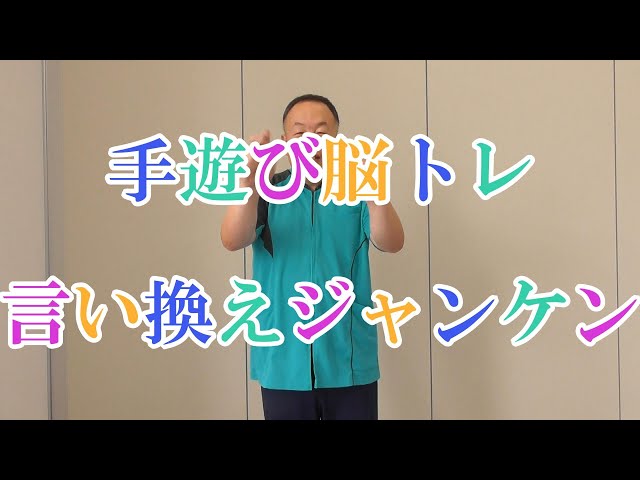
When you think of rock-paper-scissors, you think of rock, scissors, and paper.
But let’s try some exercises by using different expressions based on the hand shapes.
For example, you can call rock a punch or a stone.
You can also use numbers, like 5 for paper and 2 for scissors.
Rewording it can serve as brain training, and speaking the words can also help improve oral function.
It would be fun for everyone to rename the rock-paper-scissors hands and either make the same hand movements together or actually play while saying the new words.
[For Seniors] Lively Hand-Play Games. Also Great for Brain Training (181–190)
Good evening

Let’s make shapes with our hands and fingers to match the words.
For example, for “konbanwa,” move your hands and fingers so that “kon” is a fox, “ban” is a gun, and “wa” is a ring.
Although the ending is written as “ha” in Japanese, it’s okay to change the character to match the pronunciation.
Start at a slow pace, and once you get used to it, try saying the words faster.
You can also raise the difficulty by changing the order to “kon,” “ban,” and “wa.” Even if it gets harder or older adults make mistakes, it’s important to keep a relaxed, supportive atmosphere.
Try moving your hands and fingers with various words.
The Apple Song

Let’s move our hands in sign language to the lyrics of “Ringo no Uta” (“The Apple Song”).
“Ringo no Uta” is one of the emblematic songs of the Showa era, and many older adults have probably heard it at least once.
Because the signs follow the lyrics, you’ll need to learn different hand movements.
Until you get used to the motions, it might be good to practice the signs at a slow tempo.
Of course, enjoying yourself is important too, so don’t be overly concerned about making mistakes in your signing.
Besides “Ringo no Uta,” try using other songs that are familiar to older adults.
In conclusion
Finger-play activities are a perfect way to stimulate the brain while having fun and to maintain mental and physical health. Moving your fingertips helps activate the brain, and it can also serve as a catalyst for deepening interactions with those around you. Please enjoy doing them with your family and friends, and continue at a comfortable pace without overexerting yourself.