

Conversations Made Easy! A Collection of Topics That Elderly People Enjoy


Some caregiving staff may find it difficult to hold conversations with older adults.
You might think, “I don’t know what to talk about, so the conversation doesn’t continue,” or “I don’t have any funny, laugh-worthy stories.” The key to communicating with older adults is attentive listening—taking a genuine interest and carefully listening to what they say.
Try shifting your approach from “talking yourself” to “listening to the other person.” In this article, we’ll introduce conversation topics that older adults tend to enjoy and that help keep the conversation flowing.
If you know in advance some easy, enjoyable themes that older adults can talk about comfortably, you’ll be able to chat with more confidence.
Please use this as a reference for communicating with older adults.
- [For Seniors] Perfect Brain Training! Fun Trivia
- [For Seniors] Hilarious! A Collection of Funny Questions
- Fun, engaging topics for conversations with older adults!
- [For Seniors] Uplifting Words That Comfort the Heart
- [For Seniors] Today’s Recommended Activity: Fun and Engaging
- For seniors: Fun shiritori—enjoyable and easy to play
- [For Seniors] Fun and Lively! Recommended Quiz Questions
- Words useful for conversations with elderly people. Words that were used in the past.
- [For Seniors] Brain Training! Recall Quiz Collection!
- [For Seniors] Fun and Informative! Health Trivia Quiz
- [For seniors] Dice talk: engaging prompts
- Introducing words that will delight elderly people
- [For Staff at Elderly Care Facilities] Simple Performances to Liven Up a Year-End Party
Never run out of things to say! A roundup of conversation topics that resonate with seniors (21–30)
A conversation that uses a three-part punchline

We’d like to introduce a conversation technique you can use during recreation time that incorporates the “three-part punchline” (sandangochi).
This means that over the course of three statements, the last one delivers a humorous twist.
For example, you say, “I brought XX today,” but in the first and second statements you cut it off as “I didn’t.” On the third try, you complete it as “I brought XX today,” which gets a laugh.
The idea is to make people think, “The third time will be the same as the second,” and then switch it up, making it fun.
Older adults who enjoy comedy shows will likely get into it.
If the third statement sharply contradicts the first two, you can get a big laugh.

Memories of summer vacations from long ago
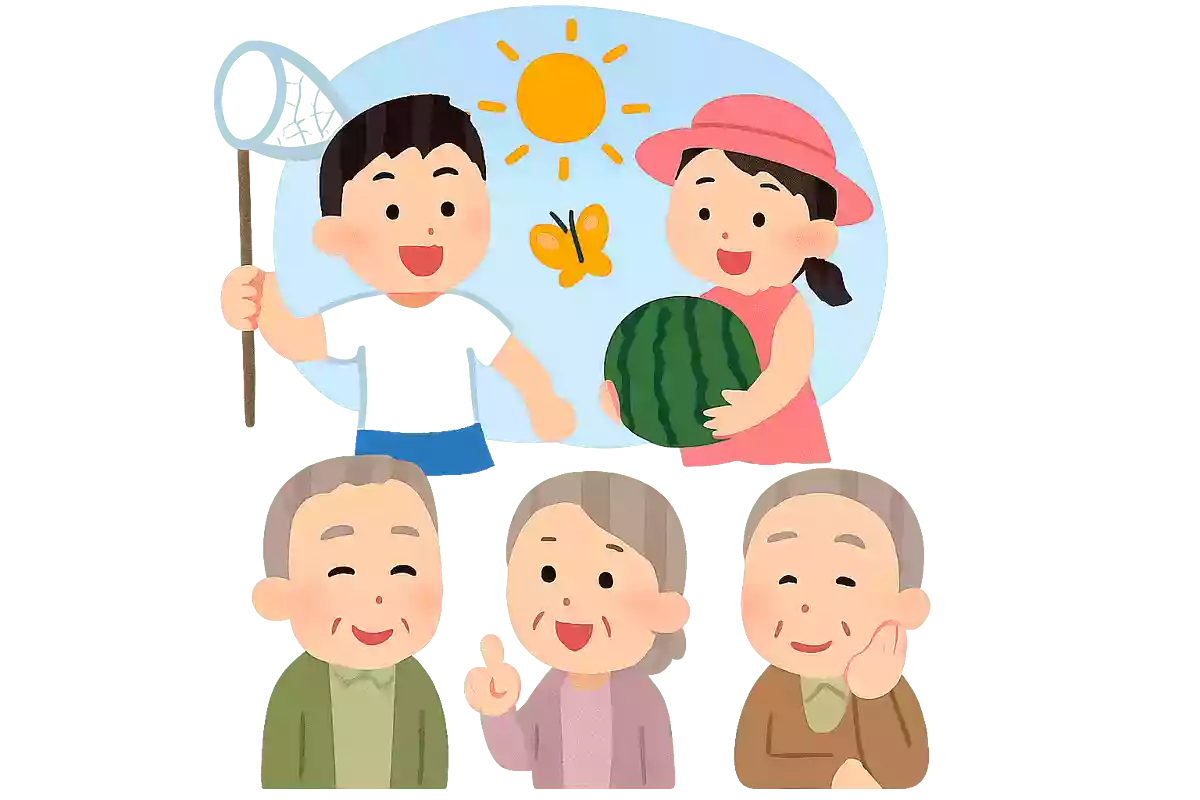
Summer vacation has always been one of the things children look forward to most, both now and in the past.
This time, as a conversation theme with older adults, we’d like to introduce “Memories of Summer Vacation in the Old Days.” Mornings started with radio calisthenics, followed by school pool time, catching insects and fishing—fun memories of playing in nature and with friends.
At the same time, some children helped with the family business, looked after younger siblings, and supported the household as valuable helping hands.
There’s much to learn from the experiences of older generations, so take this opportunity to ask them about their stories!

Topic about your favorite celebrity
Some older adults may enjoy TV and movies.
For those people, talking about their favorite celebrities is a great topic.
If they can’t remember the celebrity’s name, try asking questions like, “What shows were they on?” or “What movies did they appear in?” You could also look them up on a smartphone and show a picture to ask, “Is it this person?” or play a YouTube clip—this could be fun as well.
You might learn about their preferences, and the conversation may become easier and more engaging.

A story about sumo

It seems that many older adults like sumo.
Some may even go to watch matches at the Kokugikan in person.
When today’s seniors were children, the sports that were frequently broadcast on TV and elsewhere were sumo and baseball.
Because of that background, there’s a view that many seniors are sumo fans.
Anyone is happy when a favorite topic comes up, and conversations tend to get lively.
Try checking sumo news beforehand and prompting seniors to talk about sumo.
From there, the conversation may branch out in many directions.
Today’s topic of the day

Japan has many commemorative days.
If you search, you’ll find so many that it’s almost as if there isn’t a single day that isn’t a commemorative day.
You can explain what today’s commemorative day is, and from there expand the conversation by asking questions like “When is your wedding anniversary?” or “When was your child born?” Even just having someone share stories related to those events can be enjoyable.
In addition, recalling details such as what things were like at the time can help trace various memories, which also contributes to brain training.
Work talk

Over the course of a long life, how about asking what kinds of jobs each person has done and how they approached their work? Someone who has held a variety of jobs will likely have a wealth of accumulated experience, such as differences by role or workplace location.
And for those who have stayed in a single job for a long time, there may be insights they’ve gained through building up experience.
They could probably share stories from many angles—about jobs that were good, jobs that were bad, and everything in between.

Health practices

Many people likely have their own unique methods they practice to live healthily day to day.
How about developing a conversation around the health practices everyone knows, as well as popular ones that are trending? Questions about when they learned the method and what effects it has are likely to liven things up.
Encouraging each older adult to share what they want to highlight can also help boost a positive feeling of expressing their own thoughts.
Depending on the type of health practice, trying it out on the spot and experiencing its effects could be a great springboard for further discussion.