

[For Seniors] Finger Rehabilitation Tools: Easy DIY Ideas


Illnesses or disabilities can make it difficult to move the fingers or can cause unintended movements.
When these symptoms affect the fingers, they can lead to various difficulties in daily life, such as being unable to use chopsticks or a pen properly, struggling to get dressed, or lacking strength and falling.
In this article, we introduce DIY rehabilitation tools to help improve finger mobility.
All of them are easy to make, so consider creating them in senior care facilities to support rehabilitation for older adults!
- [For Seniors] DIY Hand Rehabilitation Tools to Strengthen Fingertips: A Collection of Handmade Ideas
- [For Seniors] DIY Rehabilitation Aids: A Collection of Easy-to-Make Ideas
- [For Seniors] Simple Handicrafts Recommended for Finger Exercise
- [For Seniors] Ideal for Finger Rehabilitation: A Collection of Simple Ideas Made with Yarn
- [For Seniors] Recommended Handmade Activities! Simple Ideas
- [For Seniors] A roundup of games using disposable chopsticks: Chopstick activities that also support rehabilitation
- [For Seniors] Easy Craft Activity Using Straws
- [For Seniors] Recommended Muscle Training Gear. Simple and Easy
- [For Seniors] Get Started Easily: Simple Handicraft Kit Ideas
- [For Seniors] Hand and finger play roundup: Finger exercises that lead to brain training
- [For Seniors] For Men! Easy Craft Kit
- [Handmade Assistive Devices] DIY assistive tools made from 100-yen shop materials. Packed with simple ideas.
- [For Seniors] Easy and Fun! Tsumami Zaiku Craft Ideas
[For Seniors] Finger Rehabilitation Goods: Introducing Simple DIY Ideas (11–20)
A teamwork training gadget made with pins and rubber bands

This is a coordination training tool that not only exercises the fingers but also trains you to carefully observe objects with your eyes while using your hands.
Prepare a small, thin wooden board about 10 cm on a side.
Evenly insert pushpins with handles around the edges of the board, and the tool is ready to use.
The way to use this rehab tool is to take rubber bands with chopsticks and fit them onto the pins to create various shapes.
Prepare sample patterns of the shapes you want the user to make.
By closely observing the sample with their eyes and using chopsticks with their fingers to place the rubber bands, they can perform rehabilitation.

Let’s pay the money.
@user8492253312849 Independent Project Work Log 70. Let's Pay MoneyTranslationHandmade teaching materialsSpecial Needs Education#AutismNeurodevelopmental disorder#After-school Day ServicesTokachi# developmental support (ryōiku)
♬ A heartwarming cute song for everyday scenes(840142) – Sumochi
When you go shopping, you pay money and think about the prices of items, right? Let’s turn those actions—using your hands to take out and put away money, and calculating item prices—into a training activity.
Place the appropriate amount of money on cards that show products and their prices.
Checkout-style practice is effective for finger dexterity and brain training.
It’s also useful for older adults who want to try going shopping in real life.
Many seniors say they want to go shopping, but if someone hasn’t shopped for several years, it can be hard to do it smoothly right away.
Why not gradually get used to shopping and paying by practicing handling money?

Pegboard made from an empty egg carton
@funotactivities DIY Fine motor pegboard using egg carton with crayons! #occupationaltherapy#schoolot#activitiesforkids#crayola#rainbow#ot#kidscraft#fun#diy
♬ Dynamite – BTS
A pegboard is a wooden board with holes into which you insert pegs—wooden pins that vary in color, shape, and size.
Because it involves grasping the pegs and inserting or removing them from holes, it’s used for upper-limb training.
Commercial versions can range from around a thousand yen to several tens of thousands of yen.
Here’s a more affordable, homemade alternative: a pegboard made from an empty egg carton.
Paint the rounded egg-holder sections of a paper egg carton and make holes in them.
Use crayons as the pegs.
Insert each crayon into the hole with the matching color on the egg carton.
You’ll have an inexpensive and easy-to-make rehabilitation tool ready to use.
Insert the back closure into the hole.

If your training tools are simple and portable, it’s easy to do the exercises anytime.
Also, the key to training is to keep at it every day.
Being able to do it casually makes it easier to keep going.
This time, I’ll introduce tools that use a bag closure clip and an empty instant noodle cup.
A bag closure clip is the light blue or white plastic piece that comes on a loaf of bread.
Make a hole in the bottom of the instant noodle cup and put the bag closure clips inside.
Pinching the small, thin clips can be expected to help train the fingertips.
Competing for time or turning it into a team match could make it enjoyable for older adults as well.
rehabilitation chopsticks

Let me introduce rehab chopsticks that are perfect for practicing the act of using chopsticks itself! Prepare one pair of disposable chopsticks, two rubber bands, and a clothespin.
Split the disposable chopsticks and attach the clothespin to the end you hold.
Position the opening side of the clothespin at the end of the chopsticks, clamp it with the chopsticks, and secure each side with a rubber band.
And that’s it—your rehab chopsticks are complete! When you grip the chopsticks with your fingers, the clothespin mechanism moves, making the chopsticks open and close so you can pick up food.
If you find chopsticks hard to use because you can’t move your fingers well, try rehabilitating with these chopsticks!
Shape matching

Let me introduce “Shape Matching,” an activity that trains the brain while moving your fingers.
You draw simple shapes on transparent sheets and layer them to recreate a reference figure.
You can adjust the difficulty to suit the person playing—for example, by making the same shapes in different sizes, or by combining not just two shapes but three or four.
Completing the specified figure gives a sense of accomplishment, and it also sounds fun to set a time limit or compete with others to see who can finish the fastest.

[For Seniors] Finger Rehabilitation Goods: Easy Handmade Ideas (21–30)
Bottle opening and closing training tool
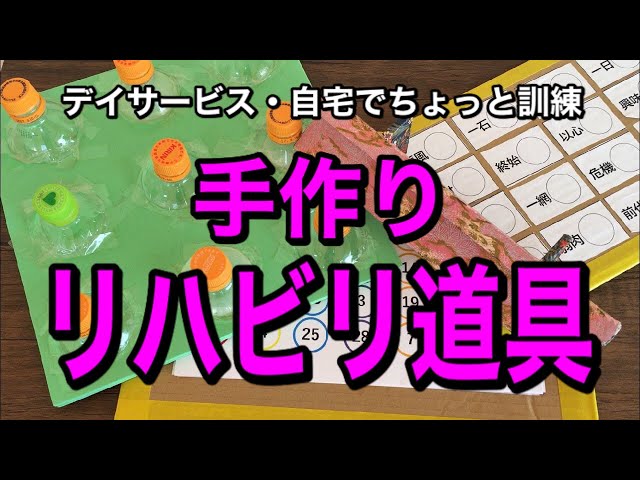
There are times when you can’t get a good grip and it’s hard to open a plastic bottle cap, right? Let’s train with this tool so you can open caps on your own! Prepare several plastic bottles by cutting off the bottom two-thirds and leaving only the area near the mouth.
Firmly attach these to a single sheet of drawing paper or thick cardstock to fix them in place, and you’re done! The person training should practice twisting with the whole hand to open and close the caps, and then increase the difficulty by opening and closing the caps using just the fingertips.
This tool lets you move the hands, fingers, and wrists thoroughly, so definitely give it a try!