

[For Seniors] Finger Rehabilitation Tools: Easy DIY Ideas


Illnesses or disabilities can make it difficult to move the fingers or can cause unintended movements.
When these symptoms affect the fingers, they can lead to various difficulties in daily life, such as being unable to use chopsticks or a pen properly, struggling to get dressed, or lacking strength and falling.
In this article, we introduce DIY rehabilitation tools to help improve finger mobility.
All of them are easy to make, so consider creating them in senior care facilities to support rehabilitation for older adults!
- [For Seniors] DIY Hand Rehabilitation Tools to Strengthen Fingertips: A Collection of Handmade Ideas
- [For Seniors] DIY Rehabilitation Aids: A Collection of Easy-to-Make Ideas
- [For Seniors] Simple Handicrafts Recommended for Finger Exercise
- [For Seniors] Ideal for Finger Rehabilitation: A Collection of Simple Ideas Made with Yarn
- [For Seniors] Recommended Handmade Activities! Simple Ideas
- [For Seniors] A roundup of games using disposable chopsticks: Chopstick activities that also support rehabilitation
- [For Seniors] Easy Craft Activity Using Straws
- [For Seniors] Recommended Muscle Training Gear. Simple and Easy
- [For Seniors] Get Started Easily: Simple Handicraft Kit Ideas
- [For Seniors] Hand and finger play roundup: Finger exercises that lead to brain training
- [For Seniors] For Men! Easy Craft Kit
- [Handmade Assistive Devices] DIY assistive tools made from 100-yen shop materials. Packed with simple ideas.
- [For Seniors] Easy and Fun! Tsumami Zaiku Craft Ideas
[For Seniors] Finger Rehabilitation Goods: Easy Handmade Ideas (21–30)
Button fastener training aid
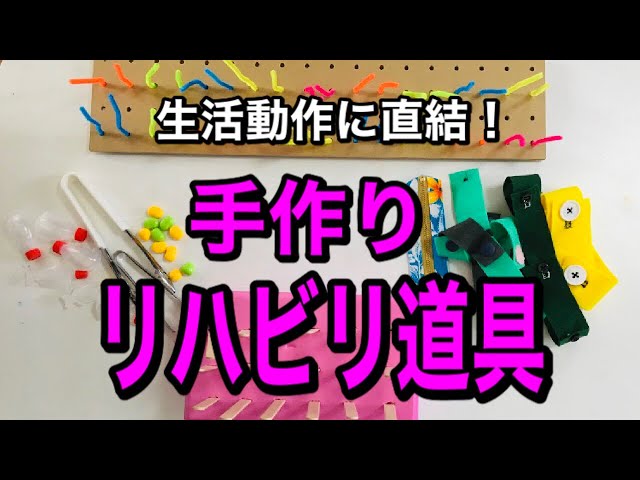
When it becomes difficult to move your fingers, putting on and taking off clothes can be challenging.
One of the hardest tasks is fastening and unfastening buttons.
This item helps you practice exactly that.
Attach a button to one end of a fabric scrap and make a buttonhole on the other end—then you’re ready to go! The person training uses this tool to practice fastening and unfastening the button.
To allow continuous practice, it’s a good idea to prepare several identical pieces.
To keep things interesting and prevent boredom, we also recommend varying the patterns of the fabric scraps and buttons.

Concentration using your fingertips
This is a handmade concentration (matching) game that also helps with finger dexterity and brain training.
You can make it using sponge blocks and popsicle sticks sold at 100-yen shops.
The basic idea is to pull out popsicle sticks stuck into a sponge block, but let’s add a twist.
By putting colored stickers on the popsicle sticks, it becomes a brain-training matching game.
Of course, you can also use stickers with animals or fruits instead of colors.
Choose two sticks from the sponge block; if both sticks have the same sticker, remove them.
If they’re different, put the sticks back in the same spots.
It’s a game that’s exciting for both individuals and groups, letting you enjoy finger exercises and brain training at the same time.
It’s also great for recreational activities.

Training aids for fingers and wrists made with pipe cleaners
This is a training tool for fingers and wrists using chenille stems (pipe cleaners).
Prepare a pegboard with many small round holes—often used for hanging hooks—and some pipe cleaners.
If you don’t have a pegboard, you can use a thin wooden board with holes large enough for the pipe cleaners to pass through.
Insert one pipe cleaner into each hole, and you’re ready to go.
The person training will twist neighboring pipe cleaners together and then untwist them to separate.
You can do this with both hands or just one.
The more repetitions you do, the more you’ll feel the load, making it a great exercise for the fingers and wrists!
beanbags

By feeling the texture of the beans inside with your fingers and performing actions like gripping, throwing, and grasping, beanbags can be used for hand and finger rehabilitation.
First, make a small pouch with fabric you like, then fill it with adzuki beans or similar.
Besides adzuki beans, we recommend using prayer beads, dried corn kernels, or seashells.
Close it up, and you’re done! You can also use it to play with your grandchildren, making hand and finger rehab fun.
Try games like stacking the beanbags or tossing them into a basket.
Finger exercise gadget made from a milk carton

Introducing an easy rehab tool you can make with milk cartons! First, prepare lots of milk cartons cut into thin, ring-shaped slices.
If you’re using cartons that have been opened flat, shape them into rings after cutting.
Once you have plenty of milk carton rings like those used for ring toss, you’re ready to go! The trainee will pick them up one by one with their fingers and stack them like a tower.
If they use chopsticks to pick up the rings, it also becomes chopstick training! It’s also fun to add a game element, like competing to see who can build the tallest stack within a set time.
Finger exercises with plastic bottle caps

Here’s a recreational activity you can make using the many plastic bottle caps that tend to pile up.
Place the caps on a base sheet, matching each cap with the same kanji written on the sheet, making sure not to make mistakes.
Kanji sets that are hard to distinguish—like the fish or tree radicals series—are recommended.
Because players identify the characters while pinching the caps with their fingers, it trains both the brain and fine motor skills.
Give it a try—make it and play with it! You could also turn it into a game by pairing addition problems with their answers.

color clip fastener
@user8492253312849 Independent Project Production Log 75. Color Clip FastenerTranslationHandmade teaching materialsSpecial Needs Education#AutismNeurodevelopmental disorder#After-school Day ServicesTokachi
♬ A walk with the puppies Relaxing pops – spiraea
“Color Clip Match” is an activity where you prepare colorful sheets of paper and clip on paper clips of the same color, making use of the paper’s original colors.
There’s no need to color the paper, so preparation is simple.
Pinching the clips with your fingertips and attaching them to the matching color spot is perfect for training fine motor movements and grip strength.
Distinguishing colors and placing the clip in the correct spot also stimulates the brain.
The materials are easy to find at 100-yen shops and similar stores, making it simple to get started.
It’s a fun, game-like rehab method that’s highly recommended for older adults.
