

![[For Seniors] Finger Rehabilitation Tools: Easy DIY Ideas](https://i.ytimg.com/vi_webp/7UqtPLtlg7U/maxresdefault.webp)
[For Seniors] Finger Rehabilitation Tools: Easy DIY Ideas


Illnesses or disabilities can make it difficult to move the fingers or can cause unintended movements.
When these symptoms affect the fingers, they can lead to various difficulties in daily life, such as being unable to use chopsticks or a pen properly, struggling to get dressed, or lacking strength and falling.
In this article, we introduce DIY rehabilitation tools to help improve finger mobility.
All of them are easy to make, so consider creating them in senior care facilities to support rehabilitation for older adults!
[For Seniors] Finger Rehabilitation Goods: Easy DIY Ideas (1–10)
Finger training using magnets

A pegboard is designed to improve fine motor skills by having you pinch several cylindrical blocks—such as red, green, and yellow ones—and move them into a box.
It’s often used for training the upper limbs and fingers after a stroke.
While the price can be fairly high, it turns out you can substitute it using only items from a 100-yen shop.
Prepare a whiteboard, four colors of magnets, a permanent marker, and a ruler.
On the whiteboard, use the permanent marker to plan and adjust a magnet layout in a 2-centimeter grid both vertically and horizontally; this process helps activate the brain.
Pinching the magnets is also said to be effective as finger exercise.
It’s nice that you can do the training while seated, too.

Finger training with a pegboard

A key point with rehabilitation and training is to keep them going.
There are many kinds of rehab tools, but if they’re expensive or hard to carry around, it becomes difficult to stick with them.
So, here’s a fingertip training tool you can make using items from a 100-yen shop.
Prepare a plastic perforated board with evenly spaced holes and a shoelace.
A regular string works fine, too.
Thread the shoelace through the holes in the perforated board.
This trains finger movements and is effective for actions like lacing shoes, sewing and other crafts, and even using chopsticks.
Try it with your non-dominant hand as well.
Shoelace tying

Let’s use familiar items to improve the ability to skillfully use your hands and fingertips for precise, detailed tasks.
This time, we’ll use a shoe insole and a lace.
Make holes in the insole similar to those in a shoe so you can thread the lace through.
By lacing it like a shoelace, you can train dexterity—the ability to perform fine motor tasks accurately.
Dexterity is an important physical function directly connected to daily life, such as carrying objects, writing, and opening bottle caps.
With easy shoelace tying, it seems like you could keep up with the training every day.
Button sewing
Let’s try making training tools using scrap materials or items from a 100-yen shop.
Leftover felt pieces and buttons from a craft activity can be transformed into rehabilitation tools.
If you don’t have them, make use of items sold at 100-yen shops.
Cut the felt into squares of about 3 centimeters and make a buttonhole in the center.
Thread the button with string and tie it, then pass it through the felt’s buttonhole.
It may be difficult to pass the button through at first, but with repeated practice you’ll get the hang of it.
Since it’s portable, one of the appealing points is that you can train anytime, anywhere.
Triangle Puzzle
Here’s an introduction to a triangle puzzle made with thick paper.
Create triangular puzzle pieces from thick paper, and also prepare several pieces colored red using a red pen.
Using the triangle pieces, you will recreate shapes that match the sample in both form and color.
Pinching and moving the thick paper pieces with your fingertips provides good training.
In addition, making and thinking about shapes that match the sample stimulates the brain and helps activate it.
It can also train spatial awareness and memory, which may help prevent dementia.
Because it’s a rehabilitation tool that can be done seated at a table, many older adults can participate.
Zipper open/close
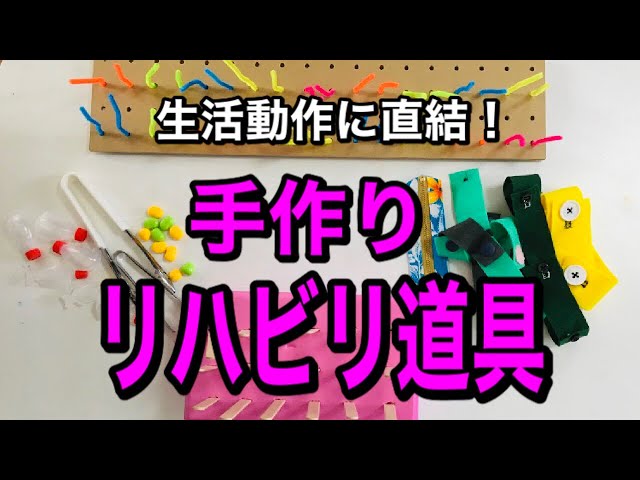
What kinds of everyday items use zippers? There are pants and jackets, bags, and fabric pencil cases, for example.
Zippers can be difficult to operate if the pull tab is small or your hand movement is limited.
Also, since you open and close zippers by moving your wrist, they’re said to be effective for exercising your fingertips and wrists.
You can use zippers on items you already use in daily life, or on something you make yourself.
Try making a pencil case with a zipper or a small pouch.
It’s also recommended as a craft activity to do with older adults.
Change the zipper’s orientation between horizontal and vertical, and practice.
Imagining real situations where you actually use zippers—like on bags or shoes—while you train is said to be the key.
Möbius tie
We want seniors to enjoy doing rehabilitation, right? So here’s a fun finger-movement training using chenille stems (pipe cleaners).
Thread the pipe cleaners through a pegboard with evenly spaced holes in advance.
Then have the seniors twist the pipe cleaners using their fingertips.
Twist each pair of pipe cleaners five times.
People tend to feel the effort level when twisting between 5 and 20 pairs.
It’s effective for training finger dexterity and wrist movement.
Pipe cleaners and pegboards are sold at 100-yen shops’ craft sections, so preparation should be easy.
Please use this as a reference and give it a try!