

[For Seniors] Recommended Brain Training! Classic Riddles

Riddles (nazokake) are also very popular among older adults.
They’re a traditional Japanese wordplay, familiar to many through rakugo performances and comedy segments like ogiri.
As a brain-training activity, many facilities enjoy turning the “sono kokoro wa?” part of nazokake into a quiz.
However, it can be difficult to find nazokake topics that suit older adults.
So this time, we’ll introduce nazokake prompts that older adults will find relatable.
Thinking them through helps with brain training and strengthens creativity, vocabulary, and language manipulation skills.
Even those who find it difficult to stand or move their bodies can participate, so everyone, please give nazokake a try together!
- [For Seniors] Fun and Lively! Recommended Quiz Questions
- [For Seniors] Guaranteed to Liven Things Up! A Collection of Brain Training Activities That Will Spark Laughter
- [Brain Training] Lively Word Quiz for Seniors
- [For Seniors] Brain Training Recommended for Dementia Prevention
- [For Seniors] Laugh-Out-Loud, Crowd-Pleasing! Fun Quiz
- [For Seniors] Find daily brain training. Today’s recommended brain workout.
- [For Seniors] Fun Riddles That Stimulate the Brain
- [For Seniors] Today’s recommended quiz. Daily brain-training quiz!
- [For Seniors] Fun! Let’s Get Excited with Japan’s Number One Quiz
- [For Seniors] Brain Training! Recall Quiz Collection!
- [For Seniors] Fun Brain Training! Lively Mind Exercises
- [Challenging and Fun!] Quizzes & Riddles for Adults
- [For Seniors] Challenging but Exciting! Kanji Quiz
[For Seniors] Recommended Brain Training! Classic Riddles (1–10)
A riddle: “What do sushi and the board game sugoroku have in common? The punchline: In both, you ‘finish’ at the end—since in sushi you say ‘agari’ (tea served at the end), and in sugoroku you ‘agari’ (reach the goal).”
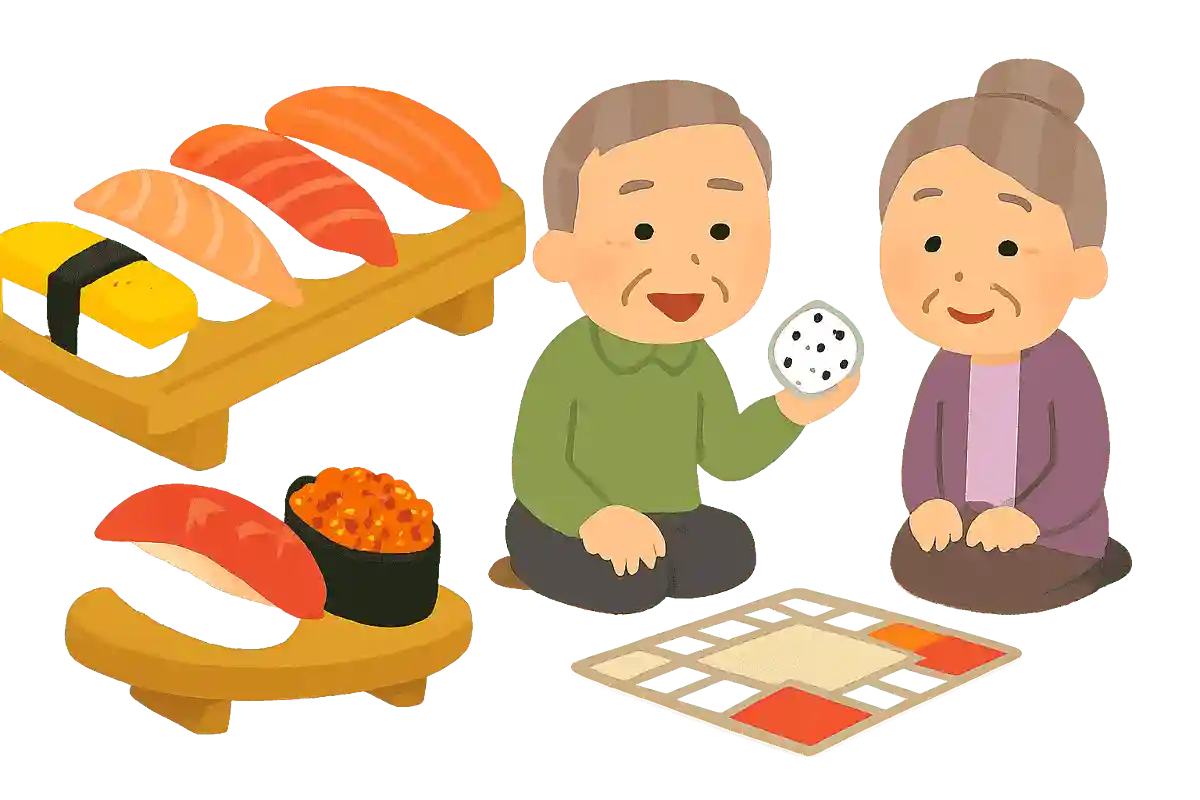
This is a riddle that looks for a common point between sushi and sugoroku (a Japanese board game).
To find commonalities between seemingly unrelated categories like food and games, it might help to think about tools used only in that setting or unique terms used only in that field.
At a sushi restaurant, tea is called “agari,” and you finish the meal with that tea.
In sugoroku, reaching the goal is also called “agari.” Thus, the shared keyword that comes to mind is that “it ends with agari.”

A riddle: What do cars and nurses have in common? The heart of it is that both need skill in parking (injection).

This is a riddle that asks you to find what cars—being vehicles—and nurses—being a profession—have in common.
At first glance, objects and people may seem unrelated, but by thinking about what’s important when handling them and what the job entails, you can find the answer.
When driving a car, it’s not just about moving forward; parking skills are also important.
For nurses, it’s vital to watch over patients and to have reliable injection skills.
The shared keyword that emerges is chūsha: in cars, parking (chūsha), and for nurses, injections (chūsha).
In both cases, skill with “chūsha” is essential.
I pose a riddle: What do mandarins and rural scenery have in common? In both, kawa is essential—peel for the mandarin and river for the landscape.

This is a riddle with a relaxed vibe that asks you to consider what tangerines and countryside scenery have in common.
You might picture someone leisurely eating a tangerine in a rural setting, but here we look at tangerines and the countryside separately and think about the essential elements of each.
To eat a tangerine, you need to peel its skin.
When you think of a peaceful rural landscape, the babbling of a river often comes to mind.
In both cases, there’s a kawa—peel (kawa) for the tangerine and river (kawa) for the countryside.
That shared “kawa” is the common point highlighted by this riddle.
[For Seniors] Recommended Brain Training! Classic Riddles (11–20)
A riddle: What do you call table tennis and a correct answer? The punchline: both go “ping-pong” (a pun on the “ping” of table tennis and the “ping” sound for a correct answer).
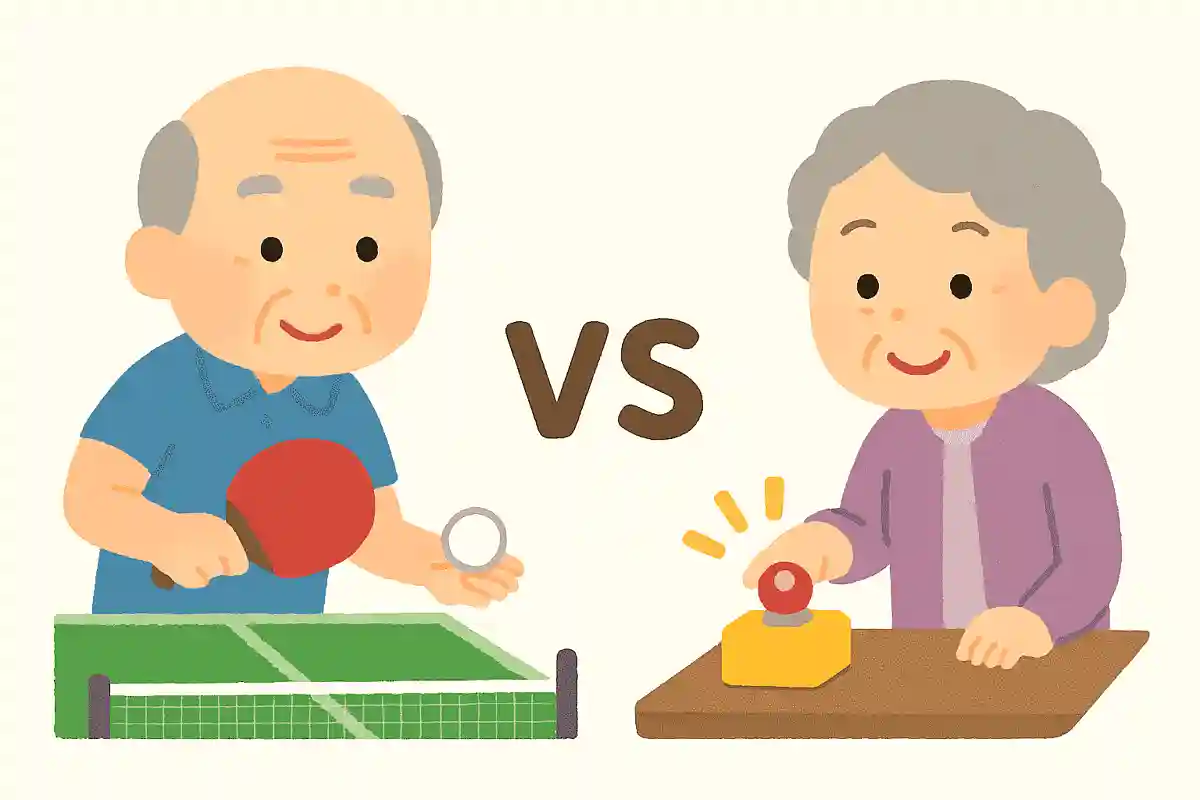
This is a riddle that asks you to find the common point between the sport name “table tennis” and the phenomenon of getting an answer “correct.” By thinking about the sounds the words evoke and possible paraphrases, you can arrive at a simple answer.
The sport of table tennis is also called “ping-pong,” a name derived from sound.
On quiz shows and the like, when someone answers a question correctly, a sound effect that goes “ping-pong” is often played.
So the word and sound “ping-pong” emerge as the common element in this puzzle.
A riddle: What do scissors and a frugal person have in common? The answer: both go ‘chokin’—the scissors go snip-snip (chokin), and the frugal person saves money (chokin/cho-kin).

This is a riddle that asks you to think of common points and related words between the tool “scissors” and the trait of being “thrifty.” By clearly imagining the situations in which each is used and what is being done, you can get closer to the answer.
Since there are many ways to save money and the scope is broad, it may be easier to approach the answer from scissors.
When using scissors, when cutting something, you hear the sound ‘chokin’ (snip).
By being frugal and spending less money, it becomes possible to save money—‘chokin’ also means ‘savings’ in Japanese.
So the shared word that emerges in this riddle is ‘chokin,’ which is both the cutting sound and the word for saving money.
A riddle: What do hay fever and a ferocious dog have in common? The answer: both are a handful with a runny nose (and when let loose).

This is a riddle that looks for a common point between hay fever—a major concern as spring approaches—and a ferocious dog you don’t want to get near.
A key to solving it is thinking about what hay fever is like, but that can be hard for people who haven’t experienced it.
Another important element is considering how the impression changes when it’s not just any dog, but specifically a “ferocious” one.
The main symptom of hay fever is the misery of a runny nose.
As for a ferocious dog, you feel safe because it’s kept on a leash; if it’s let loose, anything could happen.
In other words, the common point is that in both cases, when they’re “let loose,” it becomes a big problem—whether it’s a nose being ‘let loose’ (a runny nose) or a dog being set loose—so the answer hinges on that shared idea.
A riddle: What do a festival and dried sardines have in common? The answer: Both make dashi—parade floats (山車, pronounced “dashi”) at a festival, and soup stock (出汁, also pronounced “dashi”) from dried sardines.
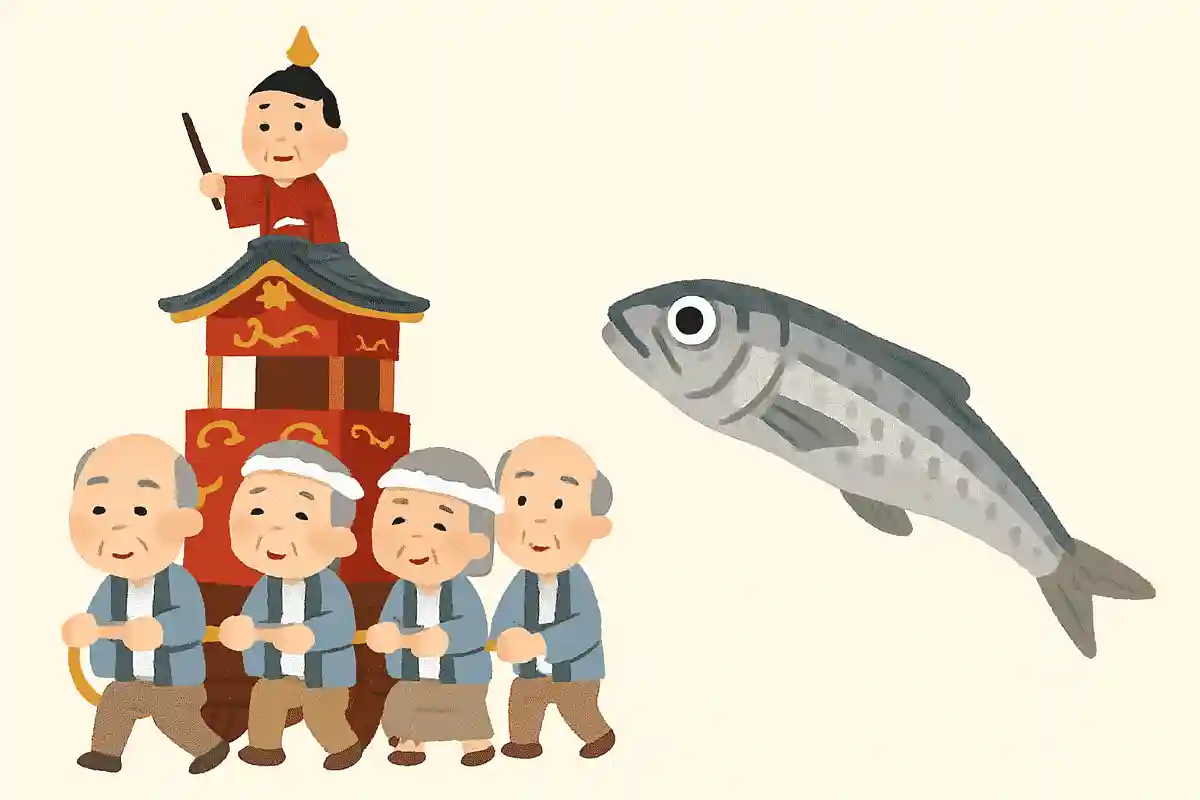
It’s a riddle that asks you to think about what festivals and dried sardines have in common, evoking a vague image of something traditionally Japanese.
If you picture a big, lively festival scene and consider the situations in which dried sardines are used, you’ll likely arrive at the answer.
Since festivals have various regional characteristics, it may be clearer to narrow things down starting from the dried sardines.
Along with the portable shrine, another essential element for celebrating festivals is the festival float (dashi).
When you soak or simmer dried sardines in water, you get dashi—a broth into which umami components dissolve.
In this way, the key word that comes to mind, connecting both, is “dashi.”