

[Intermediate Level] A curated selection of piano masterpieces featuring strikingly brilliant melodies!


When you think of brilliant, showy piano pieces, what comes to mind?
The piano can play melody and accompaniment simultaneously, not only connecting lines smoothly but also creating bold, percussive rhythms—it’s even said to be an instrument capable of recreating an orchestra all on its own.
Piano timbre has many facets—beauty, poignancy, fragility—but this time we’ve selected intermediate-level works that let you fully savor its bright, powerful, and dazzling side!
Even if you prefer gentle or wistful pieces, we hope this will be a chance to discover a new charm of the piano and inspire you to give these works a try.
- [Intermediate Level] Cool Piano Pieces You Can Play [Great for Recitals Too]
- [For Intermediate Players] Challenge Yourself! Recommended Masterpieces That Shine at Piano Recitals
- [For Adults] Recommended for Piano Recitals! A Curated Selection of Impressively Sounding Masterpieces
- Piano Masterpieces: Surprisingly Easy Despite Sounding Difficult!? A Curated Selection Perfect for Recitals
- [Piano Recital] Perfect Pieces for Middle Schoolers! A Curated Selection of Impressive, Audience-Pleasing Works
- [Intermediate] Recommended Piano Duets | A Curated Selection of Cool and Dazzling Pieces
- [Latest] Piano Solo Intermediate | Picked Recommended & Popular Sheet Music
- For Advanced Players: Showstopping Classics to Play at a Piano Recital
- Masterpieces of classical piano that are too beautiful for words. A gathering of delicate tones that cleanse the soul.
- [For Elementary School Students] Brilliant, Showy Masterpieces That Sound Impressive at Piano Recitals
- It’s so cool if you can play these on the piano! A selection of irresistibly charming masterpieces.
- [For Piano Recitals] Simple yet Cool Classical Pieces
- [Classical Music] All pieces under 3 minutes! A collection of short and cool piano pieces
[Intermediate Level] A curated selection of famous piano pieces with strikingly brilliant melodies! (51–60)
Carnival, Op. 9Robert Alexandet Schumann

A collection of piano pieces composed between 1834 and 1835 by Robert Schumann, a leading composer of the German Romantic school.
Consisting of 21 short movements, it portrays participants at a masked ball, friends, and characters from the Italian commedia dell’arte.
Each movement has its own character and theme, expressing both Schumann’s introspective and passionate sides.
Distinctive harmonies and inventive rhythms are evident, richly embodying the spirit of Romantic music.
The work reflects Schumann’s feelings for his fiancée and his literary tastes, embedding cryptic messages in note sequences such as “A-S-C-H” and “S-C-H-A.” In 1910, it was also adapted into a ballet, influencing other artistic fields.
Noble and Sentimental Waltzes: No. 1, Modéré (Moderato), G majorMaurice Ravel
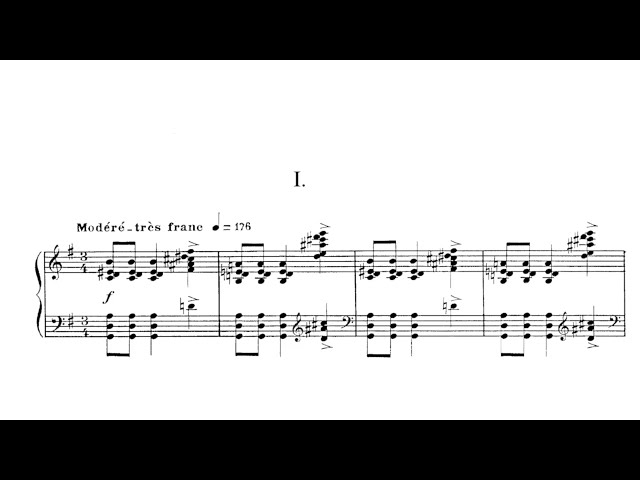
The suite Valses nobles et sentimentales fuses traditional waltz forms with Maurice Ravel’s characteristically modern sonorities.
Its opening piece is graceful yet tinged with melancholy, evoking a curious, elusive mood.
At its premiere in May 1911, the composer’s name was withheld, and the work astonished audiences with its originality.
One can almost picture a glittering ballroom where, amid the dancing, a secret, fleeting thought crosses the heart.
The work is also known in its ballet incarnation as Adélaïde, ou le langage des fleurs.
It’s perfect for those who want to experience the intriguing rhythms and harmonies that overturn conventional images of the waltz.
Aim for a rounded, gentle tone to convey the wistfulness that lies beneath the brilliance.
Fantasia, Op. 28Alexander Scriabin

A solo piano piece composed in 1900 by the Russian composer Alexander Scriabin.
Written in a single-movement sonata form, it demands advanced virtuosity.
It opens in B minor, after which a beautiful melody in D major appears.
The middle section features an intense contrapuntal development, with striking arpeggios in both hands.
The finale culminates in a powerful closing section in B major, reaching a climax that suggests Wagner’s influence.
The work is characterized by complex textures and rich emotional expression.
It holds significant importance as a mid-period work by Scriabin, serving as a bridge to his later, more abstract compositions.
Recommended for those seeking a piano piece that combines brilliance with power.
Three Military Marches, D.733 Op.51 No. 1Franz Schubert

Franz Schubert’s masterpiece Three Military Marches, frequently performed by orchestras and wind ensembles, is a collection notable for its dazzling, RPG-like melodies accompanied by fanfare figures.
Among them, the especially recommended piece is the first of the Three Military Marches.
As the opening work of the set, it is in 2/4 time and D major, and its brilliant melody exudes a sense of uplift, evoking the beginning of an adventure or journey.

Etude Op. 25, No. 11 “Winter Wind”Frederic Chopin

Composed in 1836 by Frédéric Chopin, a leading Romantic composer of the 19th century, this piece is No.
11 from his Études, Op.
25.
It is characterized by torrents of intense sound and leaping figures in the left hand, evoking the impression of a winter storm in music.
While the A minor theme recurs, it occasionally modulates to C major, creating an emotional contrast.
The performer must possess advanced technique and stamina, yet this is not merely a technical study; it is a work imbued with profound musical expression.
Combining the emotional depth and technical refinement emblematic of Romantic music, it is recommended for those seeking to discover new facets of the piano.
It also appears near the end of the film Green Book, in a scene where the protagonist pianist performs it.