

Recommended for middle school students! A collection of quick science project ideas you can do in a short time.


Are you struggling to choose a topic for your middle school independent research project? In fact, with a small twist, you can easily do interesting experiments using everyday items like smartphones, mouthwash, and even bread! In this article, we’ll share tips for independent research—from original ideas to classic experiments—that will make everyone say “Wow!” All of these experiments let you experience the wonders of science, such as programming and chromatography.
Through your summer vacation project, you’re sure to make exciting new discoveries!
- Stand out with your junior high school independent research! A collection of fun experiment and craft ideas
- [Middle School Students] Easy One-Day Science Projects and Crafts Ideas
- Recommended for high school students! A collection of easy one-day science project ideas
- Recommended for middle school students! A collection of quick science project ideas you can do in a short time.
- For 6th Graders: Unique and Fun Ideas for Independent Research Projects
- [For Middle Grades] Simple Magic Tricks for Elementary School Students: Fun Magic Everyone Will Love!
- [For Middle School Students] Recommended Ways to Spend Your Free Time
- For summer vacation homework! Simple and amazing crafts for elementary school students that you’ll want to make after seeing them
- Amazing discoveries with everyday materials! Fun summer vacation independent research ideas
- Recommended for elementary school students' independent research! Experiment and observation ideas using everyday materials
- [For Upper Elementary Students] Simple but Awesome! A Collection of Summer Vacation Craft Ideas
- Elementary School Students: Simple One-Day Science Project and Craft Ideas
- [I don't want to be like everyone else!] Recommended independent research topics for high school students
Recommended for junior high school students! A collection of quick science project ideas (71–80)
Boosting bass using a balloon

Instruments with hollow bodies, like acoustic guitars and snare drums, produce sound with their strings or drumheads, and the sound becomes louder as it resonates and bounces around inside the hollow box.
Using that principle, let’s make a simple smartphone speaker with a balloon! A toilet paper roll is perfect because it’s hollow.
And above all, the king of hollows—the balloon—matches this experiment wonderfully! We’ll make the speaker—the sound outlet—in the shape of a trumpet using a cup.
By creating this setup, the sound from your smartphone’s external speaker becomes dramatically louder.
Give it a try!

The Irritation Stick made with 100-yen store items
@rollercoaster002 #Summer VacationIndependent ResearchInvention and ingenuityworkSimple craft#100-yen-shop100-yen shop craftsElementary school craftJunior high school student crafts#IrritationStickElectrical work
Original Song – Craft Team STARSS – Craft Team STARSS
Let’s make a steady-hand game using materials from a 100-yen shop and learn about electricity! The materials are: a foam brick, a personal safety alarm, aluminum wire, copper wire, and vinyl tape.
Remove the switch from the circuit board inside the safety alarm and insert and solder the copper wire.
Wrap the copper wire with vinyl tape to cover it.
Shape the aluminum wire however you like, insert it into the foam brick, and connect one end of the copper wire to it.
Now your steady-hand game is complete! When you touch the remaining copper wire to the aluminum wire, the safety alarm will sound.
If the alarm doesn’t sound, it means the electrical circuit from positive to negative isn’t connected.
Check it again.

Shiny 10-yen coin experiment
Even though a 10-yen coin is just 10 yen, a brand-new, shiny one somehow feels special, doesn’t it? It shouldn’t be worth more than 10 yen, and yet… The human heart really is a mystery.
Let’s try making a 10-yen coin shine.
This is a popular independent study topic for elementary school students, so as a plus, let’s add a middle-school-level perspective.
For example, experiments using strong acids or weak alkaline chemicals that elementary students likely wouldn’t know about.
You could also add originality by using purified water for rinsing, employing a high-pressure washer, and so on—these touches will give your research more credibility.
Recommended for middle schoolers! A collection of quick science project ideas (81–90)
Mold Growth Experiment

Mold is something you see a lot during the rainy season.
It doesn’t just show up in the back of closets or storage spaces—it can also grow on foods like bread and cookies, which can be really unpleasant.
However, some types of mold are actually useful for making vaccines.
And of course, they’re the unsung heroes essential for producing things like cheese and bacon.
Doing an independent study on different kinds of mold is also recommended! Researching types of anti-mold agents and the environments where mold grows easily could even lead to unexpected discoveries.
Just be sure not to forget your mask when studying mold!
Let’s try mixing water and oil

This is an experiment to see what happens when you mix water and oil.
First, make colored water by adding food coloring to a glass of water.
In a separate glass, pour in some oil, then carefully pour the colored water on top.
Strangely, the colored water you added last will settle at the bottom of the glass, and the oil will form a layer on top.
Even if you stir it with a stick, they won’t mix at all.
It’s a fun experiment that overturns the common belief that liquids mix with each other.
Give it a try! The non-mixing liquid you make can also be put into a bottle to create a playful decorative piece.
Experiment to make clear ice
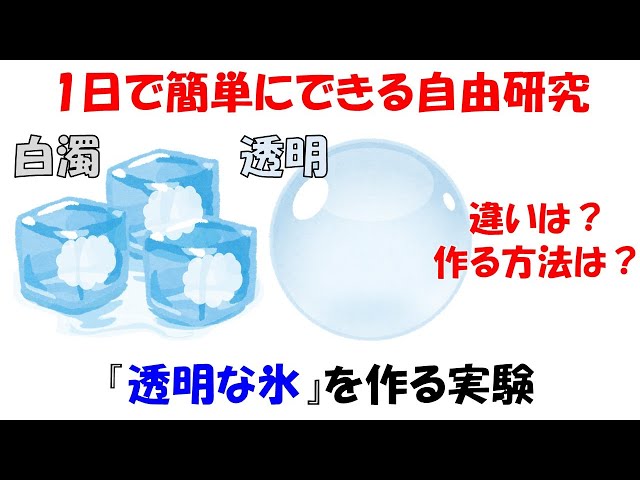
If you take a close look at the ice in drinks served at shops or the ice cubes sold in stores, they’re beautifully clear.
Meanwhile, the ice you make at home often looks cloudy, doesn’t it? That’s because clear ice contains fewer impurities and is frozen slowly over time.
Once you know the trick, it’s nothing special—but turning this mystery into a science project could be fun.
People often say you can make clear ice by wrapping water in bubble wrap (the cushioning material) and chilling it, but it would be great to run comparative experiments on those conditions.
Ultra-clear ice really draws attention!
Baking Soda and Vinegar Experiment

A highly recommended project for anyone looking for a classic, science-focused independent study is the “baking soda and vinegar experiment.” If you’re in middle school, you’ve probably produced various gases in science class.
For example, oxygen is generated by mixing manganese dioxide and hydrogen peroxide.
In the experiment introduced here, mixing baking soda and vinegar produces carbon dioxide.
There are many ways to present it, such as inflating a balloon or a glove with the generated carbon dioxide.
The “baking soda × vinegar” experiment is also a versatile idea that can be adapted into a project like “making different gases using everyday materials.”