

Recommended for middle school students! A collection of quick science project ideas you can do in a short time.


Are you struggling to choose a topic for your middle school independent research project? In fact, with a small twist, you can easily do interesting experiments using everyday items like smartphones, mouthwash, and even bread! In this article, we’ll share tips for independent research—from original ideas to classic experiments—that will make everyone say “Wow!” All of these experiments let you experience the wonders of science, such as programming and chromatography.
Through your summer vacation project, you’re sure to make exciting new discoveries!
- Stand out with your junior high school independent research! A collection of fun experiment and craft ideas
- [Middle School Students] Easy One-Day Science Projects and Crafts Ideas
- Recommended for high school students! A collection of easy one-day science project ideas
- Recommended for middle school students! A collection of quick science project ideas you can do in a short time.
- For 6th Graders: Unique and Fun Ideas for Independent Research Projects
- [For Middle Grades] Simple Magic Tricks for Elementary School Students: Fun Magic Everyone Will Love!
- [For Middle School Students] Recommended Ways to Spend Your Free Time
- For summer vacation homework! Simple and amazing crafts for elementary school students that you’ll want to make after seeing them
- Amazing discoveries with everyday materials! Fun summer vacation independent research ideas
- Recommended for elementary school students' independent research! Experiment and observation ideas using everyday materials
- [For Upper Elementary Students] Simple but Awesome! A Collection of Summer Vacation Craft Ideas
- Elementary School Students: Simple One-Day Science Project and Craft Ideas
- [I don't want to be like everyone else!] Recommended independent research topics for high school students
Recommended for junior high school students! A collection of quick independent research project ideas (21–30)
Homemade compost: making fertilizer from kitchen scraps

Compost is what you get when kitchen scraps and fallen leaves from the home are broken down and fermented using the power of fungi and microorganisms to become fertilizer.
It takes some time to turn into fertilizer, so it’s a perfect theme to work on during a long break like summer vacation.
This experiment, which lets you easily make compost using a cardboard box, is excellent from an ecological standpoint, so it’s great to keep as an ongoing habit even after the experiment.
It’s also recommended to use the finished compost in your home garden.

Water Quality Survey

Water is all around us in our daily lives, but it’s hard to tell which water is clean and which is dirty.
In such cases, using a water quality testing kit makes it easy to see how contaminated the water is.
Try collecting water from as many different places as possible and test their quality.
Even if the results show the water is cleaner than you expected, it’s not recommended to drink it directly, though it might be useful in emergencies.
By the way, it seems that water containing detergent will show up as contaminated.
Make plastic from milk

Did you know you can make plastic using milk? Conventional plastic is a synthetic resin, so it’s not very environmentally friendly.
But plastic made from milk returns to the soil, making it eco-friendly! If you prepare molds you like, you can create original pieces.
Testing whether it truly biodegrades in soil would also make for a good experiment.

An ultraviolet experiment using bananas

We’re all exposed to ultraviolet (UV) rays when we go outside, but many people don’t really know what effects they have.
Try conducting this experiment to find out how UV rays can affect you.
It’s easy to do and highly recommended.
Research materials that can melt ice faster
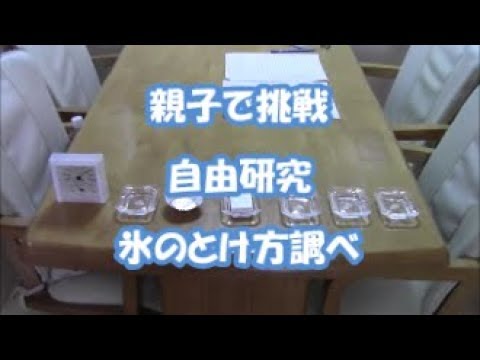
Here’s a science project that investigates how ice melts! For the experiment, use ice made from tap water as well as ice made by mixing in sugar or salt before freezing, and compare how they melt.
Also prepare materials like Styrofoam, aluminum cups, and glass plates to compare how the type of plate affects melting.
To properly record the experiment, use a thermometer and a timer to measure the exact room temperature and time.
Watching ice melt feels refreshing in the hot summer, making this a perfect project for summer vacation.

Make compost from kitchen waste

It’s an easy project you can do in a day, but with a change in angle it could turn into a grand investigation: “Making compost from kitchen scraps.” Basically, you just put soil in a storage bin, mix in food waste, and leave it.
You can add an extra step like pouring in rice-washing water or adding natto, but most of the time it’s just left alone.
If you want to make it a proper study, there are plenty of variables to test: swap rice-washing water for other liquids, replace natto with yogurt, and so on.
Exploring fermentation times also seems quite deep.
It’s a great science project for a passionate middle schooler who doesn’t want to settle for an ordinary summer!
How clean can a 10-yen coin get?

It’s a well-known story that dipping a 10-yen coin in soy sauce makes it shiny, and this is an experiment to seriously try it out.
As you can see in the video, watching a decades-old 10-yen coin gleam like new is quite moving.
