

Recommended for middle school students! A collection of quick science project ideas you can do in a short time.


Are you struggling to choose a topic for your middle school independent research project? In fact, with a small twist, you can easily do interesting experiments using everyday items like smartphones, mouthwash, and even bread! In this article, we’ll share tips for independent research—from original ideas to classic experiments—that will make everyone say “Wow!” All of these experiments let you experience the wonders of science, such as programming and chromatography.
Through your summer vacation project, you’re sure to make exciting new discoveries!
- Stand out with your junior high school independent research! A collection of fun experiment and craft ideas
- [Middle School Students] Easy One-Day Science Projects and Crafts Ideas
- Recommended for high school students! A collection of easy one-day science project ideas
- Recommended for middle school students! A collection of quick science project ideas you can do in a short time.
- For 6th Graders: Unique and Fun Ideas for Independent Research Projects
- [For Middle Grades] Simple Magic Tricks for Elementary School Students: Fun Magic Everyone Will Love!
- [For Middle School Students] Recommended Ways to Spend Your Free Time
- For summer vacation homework! Simple and amazing crafts for elementary school students that you’ll want to make after seeing them
- Amazing discoveries with everyday materials! Fun summer vacation independent research ideas
- Recommended for elementary school students' independent research! Experiment and observation ideas using everyday materials
- [For Upper Elementary Students] Simple but Awesome! A Collection of Summer Vacation Craft Ideas
- Elementary School Students: Simple One-Day Science Project and Craft Ideas
- [I don't want to be like everyone else!] Recommended independent research topics for high school students
Recommended for middle schoolers! A collection of quick science project ideas (81–90)
Electric string telephone production

String telephones are a classic kids’ craft, but they’re a bit too simple for middle schoolers, aren’t they? So this time, I’d like to introduce the idea of an electric string telephone.
It looks just like a regular string telephone, but by using components built into a personal safety alarm, we’ll make a string telephone that carries your voice as an electrical signal.
It’s a simple yet authentic project that uses tools and a soldering iron, so middle school students should have fun building it.
Once the string telephone is complete, please also put together a summary of the steps and an explanation of how the voice transmission works.

Let’s explore the secrets of sound
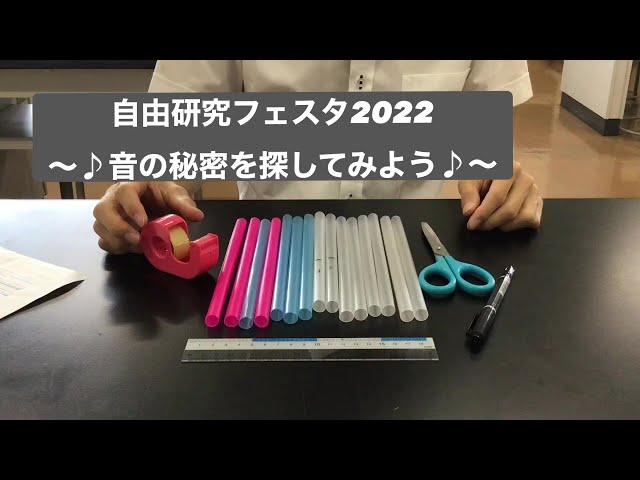
Here’s an idea for a flute you can make just by connecting straws.
Prepare straws that are all the same thickness and length.
You’ll need 8 straws for the mouthpiece, and since you’ll place spacer straws between them, prepare an additional 7, for a total of 15.
Cut the spacer straws to 5 cm.
The straws that become the flute pipes will vary in length depending on the pitch, so be sure to measure their lengths carefully with a ruler.
After cutting, seal one end of each straw with tape to make it a closed pipe.
Once everything is connected and glued together, it’s done.
Try experimenting with different lengths to see what sounds they make.
I tried expressing sound with salt

Have you ever used a tuning fork in a science class? There’s an experiment where you place two tuning forks side by side with a screen between them and strike one of the tuning forks.
The result shows that sound carries vibrations through the air to the other tuning fork, creating resonance.
How about a free research project where you visualize sound vibrations using salt? The patterns in the salt change with pitch, which is quite fascinating, and you could also study factors like room temperature and differences between instruments that produce the sound.
Doing this research might make you more sensitive to the “don-don” sound of drums!
Making a cajón

How about making a cajón, a percussion instrument that produces different sounds depending on where you hit it? You can build one with wooden panels and a part called a snare (snappy).
Once you have the materials, it can be finished in less than half a day.
The tone changes depending on the size of the sound hole you make on the side and the position of the snare.
You can buy snares in the percussion section of a music store, but you can also substitute small bells.
If you use bells, you can even get them at a 100-yen shop.

Straw thermometer

How about making a thermometer using a straw, water, and paint? You can see changes in temperature by the height the water rises inside the straw, so try placing it in different spots like under direct sunlight or in the shade of a tree.
Although it won’t give you exact temperatures, it’s an interesting experiment where you can visually observe temperature changes.
Research brimming with love for Dragon Ball

I think it would be fun to choose Dragon Ball, an anime that’s extremely popular with kids, as the theme for an independent research project! Dragon Ball is loved by a wide range of generations, from children to adults.
You could count the sound effects that appear in the manga, present them with graphs and numbers, and note how many times the same sounds are used.
It might also be enjoyable to think about how powerful the Kamehameha is, or to research how nutritious senzu beans are.
Over the long summer vacation, incorporating something you’re interested in into your independent research could help deepen your knowledge.

Recommended for junior high school students! A collection of quick independent research project ideas (91–100)
Casein plastic

You can actually make plastic from a drink that’s close to all of us: milk.
If you add vinegar to boiled milk and mix, you’ll get a white, clumpy substance.
This is casein, a protein that serves as the base for plastic.
Remove the moisture from the casein, press it into a mold, and heat it in a microwave for one-minute intervals several times until it hardens.
In recent years, the issue of plastic waste has gained attention, and many of us are thinking about how we can reduce it.
This experiment could be a wonderful independent research project that points toward a future rich in nature.