


Tongue twisters used for play and enunciation training.
If you’re going to take on the challenge, you want to enjoy it with uniquely funny phrases that make you laugh, right? In this article, we’ve carefully selected and introduced original tongue twisters created by comedian Kenta Otani.
Each one weaves together a whimsical world that makes you imagine the scene, and a tricky difficulty that skillfully exploits mouth movements.
They’re perfect for a quick bit of fun, so be sure to say them out loud and give them a try with your friends and family!
- Tongue Twisters So Fun and Cute You’ll Want to Say Them Out Loud!
- Challenging tongue twisters: Introducing high-difficulty phrases and sentences!
- Tongue twisters that will make you laugh out loud! Super funny
- Get hyped! Tongue twisters that sound cool if you can say them—wordplay that makes you want to take on the challenge
- Take on the world’s hardest tongue twisters! A roundup of ultra-tough prompts that’ll tie your tongue
- [Recreation] Challenge! A roundup of tongue twisters recommended for elementary school students
- [Diction Training] A Collection of Tongue Twisters to Improve Articulation
- A collection of long tongue twisters. Also recommended for practicing announcements and narration.
- Perfect for pronunciation practice! A collection of English tongue twisters.
- Chinese tongue twisters: A collection of rao kou ling helpful for learning Chinese
- Nagoya dialect tongue twisters are exquisite! A fun collection where your tongue gets tied in knots with regional dialects
- Irresistibly tempting to try! Have fun practicing pronunciation with Korean tongue twisters
- Bursting into laughter! A roundup of Hakata dialect tongue twisters
Kenta Otani’s original tongue twisters: a collection that’ll make you stumble and laugh (1–10)
Hawks on the head, shoulders, and heelsKenta Otani
@otanikenta Tongue twistertranslation#quiet
♬ Original song – Kenta Otani – Kenta Otani
This tongue twister features the three characters “to,” “ka,” and “ta” appearing in succession over and over.
It isn’t long, but it’s definitely hard to say.
I think the transition from “toka” to “kakato” (heel) is especially tricky.
It may help to say it with the image of stressing the initial “ka.” If you imagine hawks perching on each body part, it might become easier to pronounce.
If you’re used to tongue twisters and can say it easily, try challenging yourself to repeat it continuously.
It’s a tongue twister that becomes a bit funny when you picture it.

Girls defend sushi gentlemanKenta Otani

This is a tongue twister read as “joshi shi shusu shishin shi.” When written in hiragana, there are an awful lot of shi sounds.
The transition from shu to su is especially tricky, and I think the su tends to turn into shu.
The key to nailing this tongue twister is being able to pronounce shi clearly.
A gentleman desperately protecting a lady is cool, but in the illustration used for this gag, the gentleman is wearing a salmon roe hat and a cape with kanji patterns, and he has a tuna sushi perched on his shoulder.
I can’t help but laugh whenever I think of it.
Both the peaches and the simmered dishes belong to the sloth.Kenta Otani
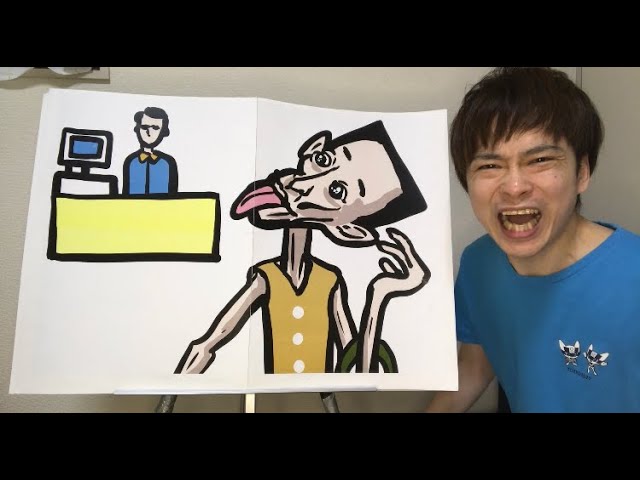
It’s a peaceful yet puzzling tongue twister about a sloth guarding peaches and simmered dishes so that no one else can have them.
The sloth standing in front of the peaches and stew makes you laugh, as you can sense its desire not to give them to anyone and its urge to keep them all to itself.
The key to the tongue twister is the mouth action for the “m” sounds—closing the lips before voicing—and when you add the breathy “n” sounds, it becomes harder to say.
It’s best to practice by separating each word, then gradually connecting them and increasing your speed.

Do you usually eat stew during an excision surgery?Kenta Otani
Although it’s supposed to be a tense scene of an excision surgery, this tongue twister depicts an impossible situation where someone is calmly eating stew.
The sentence seems to pose a question, so it conjures an image of someone being surprised at the sight of the stew-eater.
Using the classic tongue-twister staple “surgery” as its base, it also features words before and after that combine the s- and t-rows with “chu,” further increasing its difficulty.
Because similar-sounding words appear in succession, it’s important to pronounce them accurately while keeping the order of each word in mind.
Water-stealing horned owlKenta Otani
This is a tongue twister depicting a bizarre situation where drinking water that should have been left there gets stolen by a horned owl.
The image of the owl leaving while clutching the water—and the impossibility of the scenario—adds to the humor.
As a tongue twister, the key is the repeated “mi” sound, which tests how smoothly you can produce a sound that starts with closed lips.
It’s important to find a mouth shape that makes “mi” easy to say, while also trying not to laugh at the absurdity of the situation.
a very sick snow crabKenta Otani
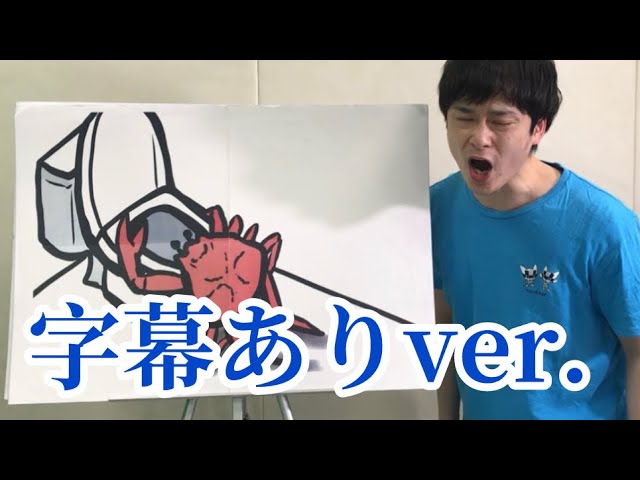
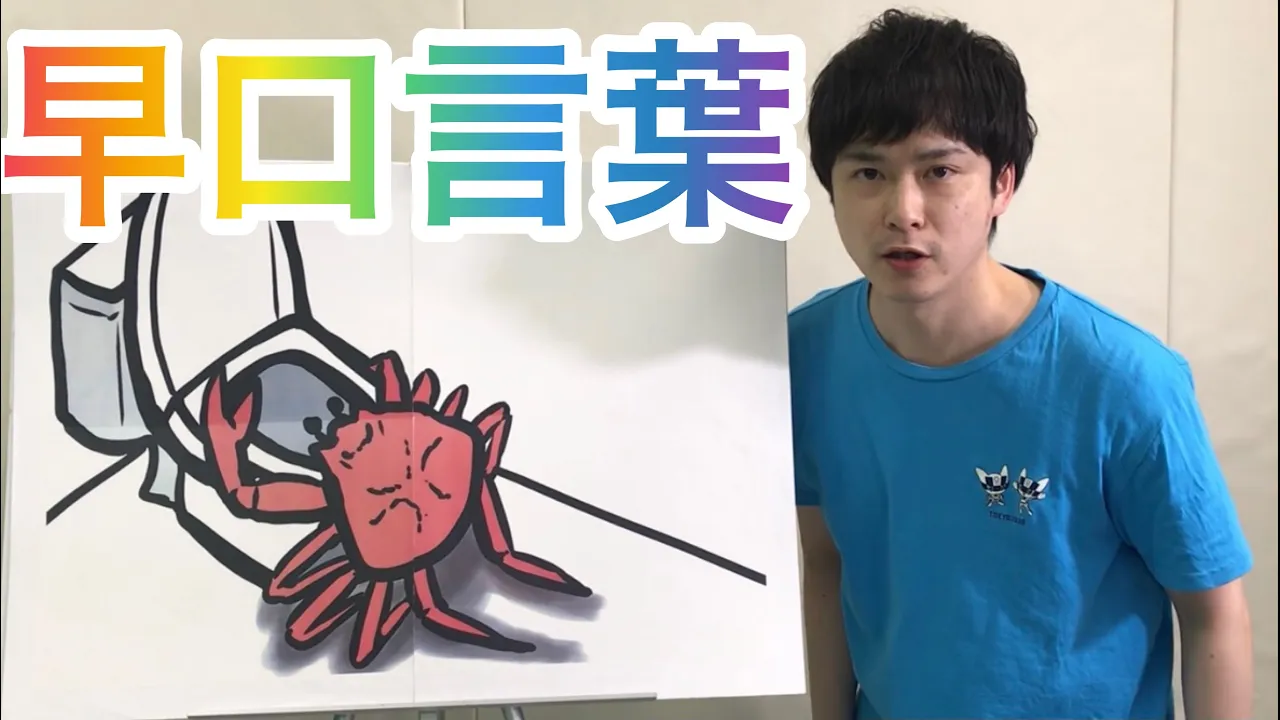
It’s a tongue twister that describes a snow crab crouching and looking unwell, making you hesitate over whether to be concerned.
The prop card shows it squatting in a bathroom, but the fact that it’s hard to picture the situation from words alone is part of the fun.
The tricky part is the similar-sounding words—sugoi (amazing), guai (condition), warui (bad), and zuwai (snow crab)—which test your ability to articulate with big mouth movements.
Since mouth shape matters, it might even be good to exaggerate it on purpose.
Double-Walk Seared KalbiKenta Otani
It’s a tongue twister that describes a strange situation where two people are walking while searing short ribs.
Even if searing ribs makes sense, doing it while walking is what makes it funny.
The key is the placement of the “r” sounds in “double,” “walking,” “searing,” and “kalbi,” and those subtle differences create overall difficulty in pronunciation.
It’s important to proceed while checking how your mouth shape changes between the surrounding sounds and the “r,” and figuring out how to say it smoothly.