

[For seniors] Classic spring kigo: beautiful words that evoke the season

When you sense the arrival of spring, there are seasonal words that you can’t help but hum to yourself, aren’t there? In this article, we’ll introduce plenty of spring kigo that are especially friendly and familiar for older adults.
Beautiful words like “harumeku” (to take on a springlike feel) and “spring breeze,” which evoke vivid scenes just by hearing them, are perfect for haiku-making or sparking conversation.
Enjoy wordplay using seasonal terms in recreation or everyday chats, and you’ll feel the changing seasons more closely.
Please savor to your heart’s content the rich world of words unique to spring.
- [For Seniors] Interesting spring haiku: introducing verses with striking kigo and unique expressions
- [For Seniors] Spring Haiku. Spring Activity
- [For Seniors] Haiku for March: Enjoying a Spring Moment with Famous Verses
- [For Seniors] Fun Brain Training! Spring-Themed Quiz
- [For Seniors] Spring Songs You'll Want to Hum: Feel the Season with Nostalgic Classics
- [For Seniors] Fun Spring Recreational Activities: A Collection of Games and Play Ideas
- [For seniors] April haiku. Exciting
- [For Seniors] Beautiful four-character idioms: Introducing words whose appearance and meanings are elegant, expressed with rich nuance
- [For Seniors] Haiku for February: A Collection of Famous Verses Depicting the Transition from Winter to Spring
- [For Seniors] Never Run Out of Conversation Starters! A Collection of Fun Facts About April and Spring
- [For Seniors] Enjoy a Warm Spring! April Health Topics Roundup
- For Seniors: Feel the Arrival of Warm Spring. Introducing Origami Ideas
- [For Seniors] Uplifting four-character idioms: Introducing beautiful, heart-touching words
[For Seniors] Classic Spring Seasonal Words: Beautiful Expressions that Evoke the Season (11–20)
Early springNEW!

Haruasashi is a term that describes the early spring from early to mid-February, when the cold remains harsh even after Risshun has passed and true spring still feels distant.
In noun form, expressions like “asakiharu” or “senshun” are also possible, so choose based on balance with surrounding words.
Though warmth and cold coexist, the blooming of plum blossoms and the sprouting of butterbur buds evoke spring—this single word conveys the seasonal transition.
It carries a sense of expectation as signs of spring gradually appear and is a word that conveys the poignancy of a shallow, nascent spring.

YakenoNEW!

Yakeno is a word that describes the blackened fields left after burning dead grasses in the hills and fields in early spring.
As a task necessary for farming—both to control pests and to encourage new sprouts—it conveys the start of the season and the expectation of harvests to come.
Because it hints at the green budding that follows, it also evokes the powerful rhythms of life and the contrast between the black earth and the blue sky.
It’s a word that seems to express both the preparations for spring’s budding and the sense of storing energy for the abundance ahead.
pussy willowNEW!

Catkins, a type of willow that grows wild along riverbanks and similar places, are striking plants whose springtime flowers have a distinctive appearance.
The name comes from the way the flower buds, covered in silvery white silky hairs, look like a cat’s tail.
Not only do they bloom in spring, but their soft look also evokes the season’s sunlight and warmth.
Since they mainly inhabit river embankments, they can also be associated with snowmelt—suggesting they could be used in a variety of expressions.
tranquilNEW!
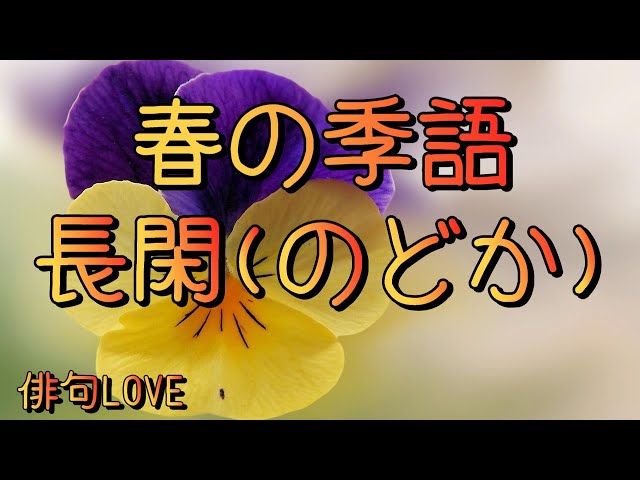
Nodoka is a word that expresses the calm, warm, and leisurely scenes and moods of spring.
It’s read as “nodoka,” and even the sound of the word conveys a gentle, tranquil atmosphere.
It evokes the image of harsh winter having passed, with time seeming to flow more slowly in the sunlight, and a sense of soft, warm rays.
A closely related seasonal word is uraraka, but that term is more often used for the spring sunlight itself, while nodoka is used to express time—this is the difference.
As a way of expressing time shaped by warmth, it’s a word that feels richly layered.
thawNEW!

The word “yukidoke” refers to snow that has accumulated in winter gradually melting with the arrival of warmer seasons.
Beyond simply meaning that the snow melts, in snowy regions it is also used as a joyful word heralding the coming of spring.
As the piled-up snow disappears, you begin to see things that had been hidden beneath it, and you can picture the water as it melts and flows away.
When depicted together with the budding of spring, it gives an impression that the change of seasons is felt even more strongly.
It may also be important to consider what colors unfold from the whiteness of the snow as it thaws.
In conclusion
Among spring kigo (seasonal words), there are many expressions that let us suddenly feel the changing of the seasons in everyday life.
If you weave them into haiku or conversation, your daily recreations will turn into richer, more flavorful moments.
As you look back on nostalgic memories of spring, try enjoying wordplay that incorporates seasonal kigo.