

![[For seniors] Classic spring kigo: beautiful words that evoke the season](https://media.ragnet.co.jp/img/1200__png__https://www.ragnet.co.jp/files/2026/03/1166094b969ec1a8a2ac57eb48a7e746.webp)
[For seniors] Classic spring kigo: beautiful words that evoke the season

When you sense the arrival of spring, there are seasonal words that you can’t help but hum to yourself, aren’t there? In this article, we’ll introduce plenty of spring kigo that are especially friendly and familiar for older adults.
Beautiful words like “harumeku” (to take on a springlike feel) and “spring breeze,” which evoke vivid scenes just by hearing them, are perfect for haiku-making or sparking conversation.
Enjoy wordplay using seasonal terms in recreation or everyday chats, and you’ll feel the changing seasons more closely.
Please savor to your heart’s content the rich world of words unique to spring.
[For seniors] Classic spring kigo: Beautiful words that evoke the season (1–10)
twitteringNEW!

Saezuri is read as “saezuri” or “saedzuri,” and it can also be written as “saezuri” with the suffix -ri.
In spring, when the breeding season arrives, small birds chirp loudly—chun-chun, chee-chee.
Of course, birds vocalize year-round, but in the world of haiku, “saezuri” (birdsong) is considered a seasonal word for spring.
With males guarding their territories and both males and females engaging in courtship, the springtime chorus is wonderfully lively.
The bush warbler’s “hō-hokekyo” and the skylark’s chattering “pīchiku-pāchiku” are famous examples.
The voice that sounds like “tsutsu-pii, tsutsu-pii” belongs to the great tit.
It makes you want to prick up your ears and go in search of birdsong, doesn’t it? When using it in haiku, it’s best not to explain the saezuri at length.
the other shore; the afterlife; equinox week (Higan) in BuddhismNEW!
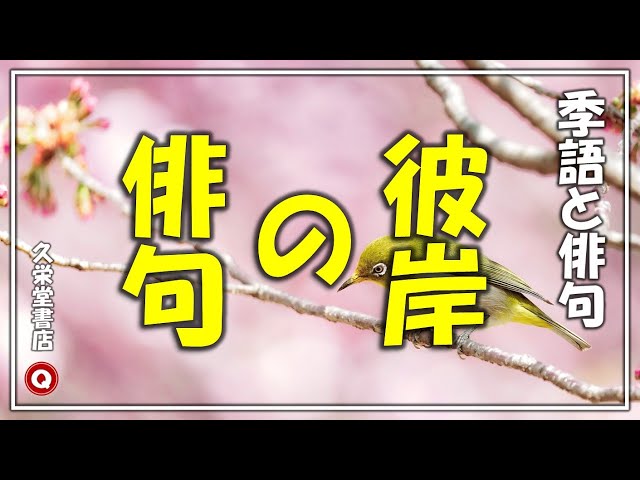
Speaking of Higan, it comes in both spring and autumn.
Even so, when simply saying “Higan,” in the world of haiku it’s treated as a seasonal word for spring.
Incidentally, the autumn Higan is called “Aki-Higan.” The Buddhist observance of honoring one’s ancestors and praying for rebirth in the Pure Land has, these days, lost some of its conscious significance, and for many people it has vaguely become “a day to visit the graves.” For spring Higan, think “anticipation of warmth, gentle sunlight”; for autumn Higan, think “the approaching footsteps of winter, gratitude for the harvest.” If you picture such things, you’ll surely compose good haiku.
spring breezeNEW!

Even in spring, when there are many days of balmy warmth, sudden windstorms and rain can strike—yes, the spring storms.
They are natural phenomena brought by developing extratropical cyclones from around March to May, and many of them deepen the season and usher in the rainy spell to come.
You might even miss cherry-blossom viewing, lamenting, “All those blossoms have fallen…” The haru-ichiban, the first strong south wind of spring, could be called the leadoff batter of these spring storms, also known as May storms.
If you were to make a haiku of it, I think it would turn out well if you fashioned it to evoke a certain sense of bustle and clamor.
to feel like spring; to become spring-likeNEW!

What makes you feel the arrival of spring? Is it when the water from the tap feels just a touch warmer, or when you notice buds beginning to form on the flowers swaying by the roadside? You might also think, “Ah, it’s spring,” when words like entrance ceremonies and graduation ceremonies appear around you.
The beauty of the expression “-meku” isn’t limited to spring, but it somehow carries a vigor that seems to spur on the breath of life.
It’s one of those seasonal words you’ll want to use more and more—whether as a casual greeting added to a letter or as the star of a favorite postcard.
spring rainNEW!

You’ve probably heard the line “It’s a spring rain—let’s go and get wet,” spoken by Banzuiin Chōbei in the Kabuki play A Masterpiece: Banzuiin Chōbei.
Even if Kabuki is all Greek to you, for some reason that one line is familiar, isn’t it? And along with it, many people have become aware of the word “harusame,” or spring rain.
Spring rain is characterized by fine strands of rainfall that descend quietly, like a haze.
Mist and fog also evoke spring, so spring rain seems to sit along that same continuum.
There are many related seasonal words for spring rains as well, such as spring drizzle, rapeseed-blossom rains, and spring sleet.
They all carry a somewhat languid, wistful mood.