

[For Seniors] Fun Brain Training! Lively Whiteboard Activities


In this article, we’ll introduce recreational activities for seniors that use a whiteboard! All you need is a whiteboard and some markers, making it easy and convenient to play.
There’s a wide variety—from brain-training games to quizzes and voice-based activities—so it’s fun to start by discussing and choosing together.
These activities are perfect for senior facilities like day service centers when you’re short on time and wondering what to do.
They’re enjoyable even in brief sessions, so give them a try!
- [For Seniors] Play Long and Have Fun! A Whiteboard Activity with Brain-Training Elements
- [For Seniors] Brain-Training Recreation Using a Whiteboard
- [For Seniors] Lively Wordplay Game: Fun Recreation for Elderly Care
- [For Seniors] Brain Training with a Whiteboard! Fill-in-the-Blank Exercises & Quizzes
- [For Seniors] Test Your Memory!? Ideas for Whiteboard Games
- [For Seniors] Brain Training! Recall Quiz Collection!
- [For Seniors] Simple Recreational Activities You Can Enjoy While Seated
- [Brain Training] Lively Word Quiz for Seniors
- For seniors: Fun shiritori—enjoyable and easy to play
- [For Seniors] Fun Recreational Activities Without Equipment
- Recommended for brain training: a proverb quiz using a whiteboard
- [For Seniors] Simple Tabletop Games: Fun and Engaging Recreational Activities
- [For Seniors] Recreational Activities Enjoyable in Large Groups
[For Seniors] Fun Brain Training! Lively Whiteboard Activities (21–30)
Let’s find words within a word.

I’d like to introduce a game where everyone can play at the same time and get excited: a “find words inside a word” game.
In this game, you rearrange or extract letters from a given target word and see how many other words you can make.
For example, if the target is “とうもろこし” (corn), you can make words like “うし” (cow) or “しも” (frost).
Decide on a target word and a time limit, and you can compete to see who can find the most words.
You can also share with each other, saying, “Here are the words I found.”

fill-in-the-blank calculation

Doing ordinary addition and subtraction is enough to train the brain, but “fill-in-the-blank” calculations are perfect for stimulating it even more! For example, instead of leaving the answer blank in a problem like “6 + 5 = 11,” you make it a fill-in-the-blank by leaving the 6 or the 5 blank instead.
This requires a bit more thinking than regular calculation.
But that’s exactly what makes it great brain training! Create lots of problems on a whiteboard and have them solved one by one.
Start with simple one-digit addition problems, and once they get used to it, it’s also recommended to introduce two-digit numbers, subtraction, and multiplication!

Upside-down characters

The Upside-Down Letters Game is a game where you write a word on the board starting from the last character and moving backward, and everyone guesses what the word is.
After warming up with short words like “carrot” (ninjin) or “frying pan” (furaipan), try tackling longer ones! Using old proverbs or famous haiku really livens things up.
For haiku, splitting the writing into three lines raises the difficulty and makes it a great brain workout, so it’s highly recommended.

A word-making game using the A-row and K-row

This is a game where you compete to see how many words you can create within a time limit using characters from the A-row or K-row.
The key point is how smoothly you can recall words from your own knowledge.
If you write down the words you come up with on a whiteboard, it’s easy to see which characters you’ve used and which ones are left.
Encourage players to try multiple times so they can pick up tips, like not overusing letters in a single word.
It’s also fun to try combinations from other rows, not just the A-row or K-row.

Naka-tori

Instead of playing shiritori by connecting the last letter of each word, let’s challenge our brains further with “naka-tori”! As the name suggests, naka-tori is a game where you connect words using the middle letter, just like shiritori.
Because it uses the middle letter, it only works with words that have an odd number of characters, like three or five.
Unlike shiritori, it’s okay if a word ends with “n,” but words whose middle letter is “n” are not allowed.
It’s trickier than you’d think! To make the middle letters easy to see, it’s helpful to write the letters on a whiteboard as they come up.
It’s guaranteed to be even more exciting than shiritori!
Food-matching quiz
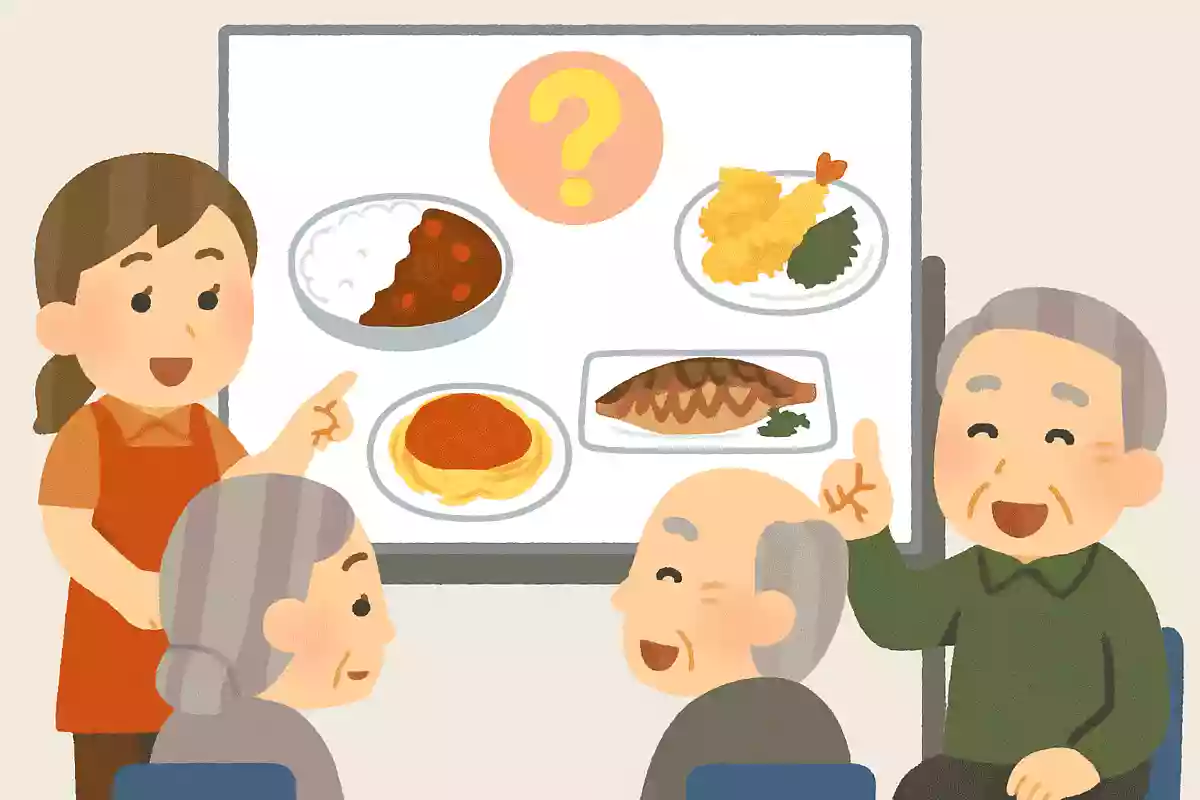
The cooking-guessing quiz is a game where you draw ingredients on a whiteboard and guess what dish they make! It’s best to start with simple, familiar dishes for the quiz.
Once everyone gets used to it, having participants take turns as the quizmaster is a great way to engage their thinking and have fun! If drawing is difficult, you can also prepare illustrations and stick them on the board to enjoy the game.
Shiritori Anywhere

“Anywhere Shiritori” is a game where you draw a grid on a whiteboard, write a single word, and then continue a shiritori chain from there.
For example, you can set a constraint by limiting it to the category “foods” and build the chain according to that rule.
You can connect words vertically or horizontally and freely continue, but you must not go outside the grid.
Fill in the grid while adding your own original rules.
