

Pick up Beethoven’s famous and representative works!

Ludwig van Beethoven created innovative music that served as a bridge from the Classical to the Romantic era, leaving a profound influence on later generations.
His music is passionate yet rich in beautiful melodies, and it conveys a sense of essential depth, as if pursuing things to their very core.
There are many masterpieces that everyone has heard at least once, such as “Fate” (Symphony No.
5) and “Für Elise.”
In this article, we’ve picked out some of Beethoven’s famous and representative works.
Why not immerse yourself in the music of Beethoven, one of the great composers?
- Mozart: An Introduction to His Signature and Popular Works
- Classical music by Japanese composers. Recommended classical music.
- Timelessly beautiful classical masterpieces. Recommended classical music.
- Cool classical masterpieces. Recommended classical music.
- [For Piano Recitals] Simple yet Cool Classical Pieces
- [Masterpiece Classics] A special showcase of gem-like masterpieces so beautiful they’ll move you to tears
- Debussy’s masterpiece. Popular classical music.
- Beethoven: A selection of gem-like masterpieces that are easy to play on the piano
- [Tchaikovsky] Pick up famous and representative pieces!
- Masterpieces by Franz Schubert: Sparkling classical works left by the King of Song. Recommended classical music.
- [Orchestra] Introducing famous and popular pieces
- J.S. Bach | Introducing Famous and Representative Works
- [Violin] A curated selection of beloved classic masterpieces and popular pieces that continue to be cherished across eras
[Beethoven] Picking Up Masterpieces and Signature Works! (151–160)
Violin Concerto in D major, Op. 61: Rondo – AllegroLudwig van Beethoven

The only completed violin concerto written by Beethoven.
It is one of the works from Beethoven’s middle period, which produced numerous masterpieces and is often called his “heroic” or “masterwork” period.
The third movement is in rondo form: after the violin presents the main theme as a solo, the orchestra repeats it to begin.
The violin then plays a secondary theme followed by rapid passages, and returns to the main theme, which the orchestra again repeats—a typical rondo structure.
After the solo violin sings a beautiful cadenza, it heads toward the climax together with the orchestra.

Six Variations, WoO 70, on the duet ‘Pria ch’io l’impegno’ (My heart is already growing faint) from Paisiello’s opera ‘La molinara’Ludwig van Beethoven

Beethoven’s renowned piece “Six Variations on the Duet ‘Nel cor più non mi sento’ from Paisiello’s opera La molinara, WoO 70,” often performed at children’s recitals, unfolds brilliantly as it follows the sequence of movements.
Although Variation 6 is somewhat long at 47 measures, its overall difficulty is low, placing it at the upper end of beginner or intermediate level.
Because it serves as good practice for sixteenth-note patterns, those who have finished practicing playing with both hands separately are encouraged to give it a try.

Piano Sonata No. 12 in A-flat major, Op. 26 “Funeral March”Ludwig van Beethoven

Beethoven’s masterpiece, Sonata No.
12 in A-flat major, Op.
26 “Funeral March.” It’s not as difficult as the “Pastoral,” but for beginners it can be challenging—overall it’s about an intermediate-level work.
That said, the difficulty varies by movement: the first and fourth movements are approachable for new intermediate players.
The second movement is difficult and requires substantial practice.
Fast arpeggios and passages appear in every movement, so you’ll also need exercises to improve finger agility.
Piano Sonata No. 8, Op. 13 “Pathétique,” Second MovementLudwig van Beethoven

The masterpiece that has etched its name in music history, Ludwig van Beethoven’s Piano Sonata No.
8 in C minor, Op.
13 “Pathétique,” Second Movement.
Alongside the “Moonlight” Sonata, it is a popular choice for recitals.
Because the first movement and the finale are technically demanding, performing the entire sonata is quite challenging; however, the second movement is relatively accessible, so focusing on this movement alone is also recommended.
Practice triplets, the balance between accompaniment and melody, and pedaling with care to achieve a polished, high-quality performance.
Piano Sonata No. 8 “Pathétique,” Second MovementLudwig van Beethoven
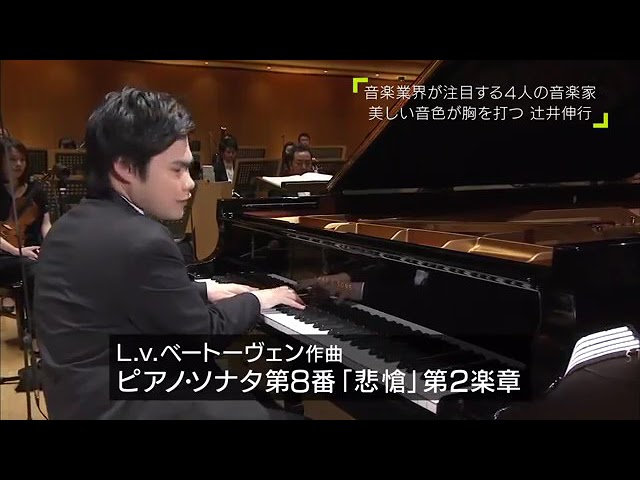
Ludwig van Beethoven’s Piano Sonata No.
8.
In particular, the second movement is often said to be one of the most beautiful melodies Beethoven ever wrote, and it has been used as incidental music in many films and television dramas.
Composed between 1798 and 1799, this piece coincides with the period when Beethoven began to notice changes in his hearing.
Although the melody is simple and its range is not very wide, the accompanying parts have a rich texture, so if you don’t listen carefully to the balance while playing, the melody tends to get buried.
Aim for a calm performance that keeps in mind the gently flowing, elegant melody that warmly embraces the listener, supported by the weighty harmonies beneath it.
Piano Sonata No. 14Ludwig van Beethoven

This is a piece Beethoven composed when he was 30 years old.
Nicknamed the “Moonlight Sonata,” it features a melody set over a gentle accompaniment that is very delicate and wistful.
As indicated in the score—“to be played with the soft pedal depressed”—it is a very quiet piece, so be sure to give it a listen.
Piano Sonata No. 14 “Moonlight,” First MovementLudwig van Beethoven

The first movement of Piano Sonata No.
14 “Moonlight,” composed by Ludwig van Beethoven of Germany, has long been affectionately known as the “Moonlight Sonata.” It is said that Beethoven, who suffered from hearing loss and chronic illness, dedicated this piece to Countess Giulietta Guicciardi, with whom he was romantically enamored.
Of its four movements, the first shows a heavy, leisurely character; as the movements progress toward the finale, the work takes on a weightier, well-balanced, and characteristically Beethovenian, finely structured form.

Piano Sonata No. 14 “Moonlight Sonata”Ludwig van Beethoven

A famous piano sonata composed by Beethoven in 1801.
He dedicated it to Giulietta Guicciardi, his piano student and the woman he loved.
Because of their difference in social status, their romance could not develop; Guicciardi married another man and left Beethoven.
The unrequited love he knew could never be fulfilled blends beautifully with a melody that evokes a moonlit lake surface.
Even today in Japan, it is frequently used in films and on television.
It’s a piece best listened to quietly on a night with a beautiful moon.
Piano Sonata No. 20, Op. 49 No. 2, First MovementLudwig van Beethoven

A work by Beethoven, a composer who shines in the history of classical music.
Despite its simple character, this piece exudes high artistry.
Composed around 1795, it is said to have been written as teaching material for beginner pianists, yet its content is refined and reveals profound musical expression.
It opens with the tonic chord, followed by a lively stream of eighth notes that leaves a strong impression.
In the middle section, a series of modulations adds depth to the music.
Recommended not only for piano students but also for classical music enthusiasts.
Why not perform this pleasant, melody-rich piece—showcasing Beethoven’s brilliance—at your next recital?
Piano Sonata No. 29 in B-flat major, Op. 106 “Hammerklavier”Ludwig van Beethoven

Ludwig van Beethoven, a master who shines brilliantly in the history of music.
Among the masterpieces he composed while losing his hearing, the “Hammerklavier” is hailed as the Everest of piano sonatas for its grandeur and technical difficulty.
From the powerful opening of the first movement, through the grief-laden third, to the fourth movement capped by a complex fugue, it is a work that truly reaches the summit of musical achievement.
It demands not only formidable technique but also profound emotional expression, making it an ultimate challenge for pianists.
Its monumental scale and innovative musical language leave listeners in awe.