

[For Seniors] Improve Your Body Concerns! A Summary of Exercises for Urinary Leakage

When we ask older adults about their physical concerns, many mention urinary leakage or incontinence.
It’s said that aging can lead to decreased function of the pelvic floor muscles and issues with the urethra, making leakage more likely.
Urinary leakage, which troubles many older adults, can hurt their sense of modesty and self-esteem, and may make them reluctant to go out or interact with others.
Ongoing leakage can also cause skin problems and infections.
In this article, we introduce exercises to strengthen the pelvic floor muscles.
Some can be done standing, while others can be done seated or lying down, so you can find movements that suit each individual.
Incorporate these exercises into your daily routine and enjoy a more comfortable, fulfilling life.
- For Seniors: How to Strengthen Your Inner Muscles. Fall Prevention
- For Seniors: Back-Strengthening Exercises, Calisthenics, and Stretches—Workouts Women Can Do Without Strain
- [For Seniors] Stretching Exercises: Easy and Safe to Do
- [For Seniors] Balance-Training Exercises: Preventing Falls
- [For Seniors] Recommended exercises to relieve constipation.
- For seniors: Leg-strengthening exercises you can do without overexertion.
- For seniors: Enjoyable exercises done while seated, accessible for wheelchair users.
- [For Seniors] Leg and lower-back training: Fall prevention
- [For seniors] Turn negatives into positives: Ways to interact that inspire motivation
- [For Seniors] Simple pelvic floor exercises: various trainings in standing, sitting, and supine positionsNEW!
- Summary of exercises for seniors: introducing preventative care movements by body part.
- [Seated] Fun Health Exercises for Older Adults and Seniors
- [For Seniors] Rehabilitation exercises targeting each body part: Introducing easy routines you can incorporate without strainNEW!
[For Seniors] Improve Body Concerns! Summary of Urinary Leakage Exercises (1–10)
You can do it standing! Pelvic floor muscle trainingNEW!

This is a standing pelvic floor exercise.
First, bring your heels together and open your toes about the width of a fist.
Then slightly open your knees, engage your thighs and bring your knees together, and raise your arms overhead while shifting your weight onto your toes.
When shifting your weight to your toes, imagine pushing your hip joints forward.
As you move your hips forward, be careful not to let your belly protrude.
Focusing on the tops of your thighs/hip creases can help.
Move slowly to avoid falling.

Pelvic floor muscle training in a standing positionNEW!

Here’s a standing training you can try.
First, align your body as if gently drawing your navel forward, then squeeze your glutes “tightly” and hold slowly for about 10 seconds.
This helps not only the pelvic floor but also the inner thighs and deep core engage more easily.
Next, lightly hollow the belly so the ribcage feels like it’s gently lifting; this helps align your whole-body axis and gives you a sense of firm stability around the pelvis.
If you also add a bit of tension to your inner thighs and thighs, you’ll cultivate the support that works in tandem with the pelvic floor muscles, and standing posture will start to feel easier.
Don’t hold your breath—keep it comfortable and continue slowly at a relaxed pace.

Pelvic floor muscle training in a kneeling positionNEW!

Pelvic floor exercises performed in a kneeling position not only strengthen the muscles but also enhance stability around the pelvis and help support the entire core.
The pelvic floor supports structures like the rectum, and by engaging and tightening it firmly as shown in the video, its function can more easily normalize.
In a kneeling position, the deep muscles of the glutes and lower abdomen are also naturally stimulated, offering the benefit of improved core stability in daily life.
Another advantage is that it’s easy to continue and safe to practice.
Rather than using maximum force, gently tighten while maintaining your breath; this makes it easier to sense the pelvic floor and leads to strength gains that are useful in everyday activities.
[For Seniors] Improve Your Body Concerns! Summary of Urinary Leakage Exercises (11–20)
Yoga to Strengthen the Pelvic Floor MusclesNEW!

Let’s strengthen the pelvic floor with simple yoga.
It can help with urinary leakage, pelvic alignment, and reducing a bloated lower belly.
In the first half, lie on your back, bend your knees and open/close them, and move your extended legs up and down.
In the second half, sit with your knees up and open them wide to each side.
Next, cross both legs and fold your upper body forward.
Finish with Child’s Pose to release the lower back and spine.
Since it’s yoga, be mindful of your breathing throughout.
One set takes about 8 minutes.
Pelvic floor muscle exercise: squatNEW!
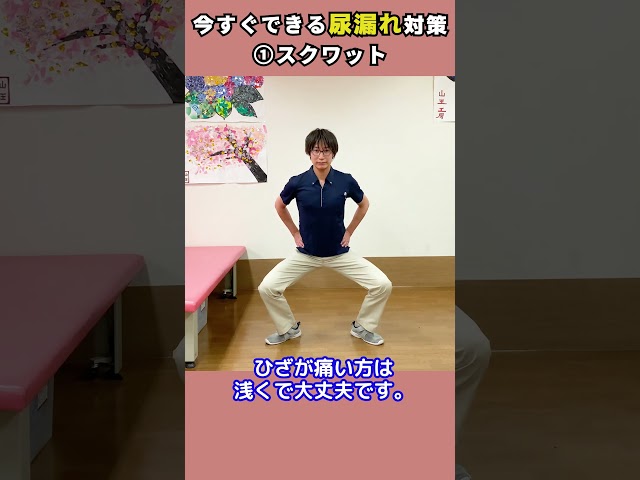
Stand with your feet just a bit wider than shoulder-width and your toes pointed outward.
As you slowly exhale, lower your hips as if pulling your buttocks back.
At this time, gently focus on and engage the anus and lower abdomen to effectively stimulate the pelvic floor muscles.
If your knees hurt, you don’t need to squat deeply—do a shallower range within your comfort.
When the pelvic floor muscles work together with the inner thighs and glutes, it becomes easier to develop core stability.
Inhale as you slowly return to the starting position, and repeat about five times without holding your breath.
If you can do three sets, you’ll find it easier to feel your pelvic floor working in everyday movements.
Fun exercises to prevent urinary leakage

Here’s an easy pelvic floor exercise you can do while seated to help prevent urine leakage.
It’s very simple: sit in a chair and make a fist with your hand.
Place your fist between your knees, then press your knees together to hold it in place.
Next, tighten as if you’re squeezing your anus.
Hold this position for 10 seconds.
You might find yourself counting in a funny or high voice, which could make you laugh and lose tension—but don’t worry.
The stimulation from making sounds or laughing can also be an effective part of the training.
It’s something you can enjoy doing, so give it a try!

Pelvic floor exercises

Introducing a pelvic floor muscle exercise you can do while lying down that’s effective for preventing urinary incontinence.
It’s simple: lie on your side and press your legs together.
As if tightening your anus, gently engage the muscles and slowly open both knees while keeping your feet together.
Do this carefully 10 times a day, and you’ll target the muscles that help prevent urinary incontinence.
It’s said that one in two Japanese people aged 40 and over struggle with frequent urination, so please try this exercise and enjoy greater peace of mind in your daily life.