

Summary of exercises for seniors: introducing preventative care movements by body part.

To stay healthy in both body and mind for as long as possible, preventive care is essential.
Whole-body training is effective for preventive care.
In this article, we introduce exercises for older adults, organized by body part.
Since there are exercises that work the entire body from the neck to the toes, we recommend doing different body parts on different days.
Be careful not to try doing everything at once, as it may tire you out.
Use this article to help maintain the health of older adults.
- [For Seniors] Easy and Fun Core Training
- [For Seniors] Fun Exercises You Can Do While Seated
- [For Seniors] Recommended Easy Strength Training
- For seniors: Enjoyable exercises done while seated, accessible for wheelchair users.
- For Seniors: Fun and Lively Exercise Recreation
- Energetic and Lively! Sing-and-Exercise Program for Seniors
- [Seated] Fun Health Exercises for Older Adults and Seniors
- [Recommended for seniors] Rejuvenating Rock-Paper-Scissors Exercise
- Let's extend our healthy lifespan! Care exercises to stay active and energetic forever
- [Today's Recommendation] Gentle Health Exercises for Seniors
- [For Seniors] Hand and finger play roundup: Finger exercises that lead to brain training
- [For Seniors] Recreational activities and games that let you have fun while strengthening your legs
- [For Seniors] Have Fun and Relieve Stress! Introducing Dances Everyone Can Enjoy Together
Summary of exercises for seniors: Introducing preventive care exercises by body part (61–70)
Ankle exercisesNEW!

To make walking easier, incorporate ankle exercises into your daily routine.
You can do them easily while seated, so give them a try.
First, sit back deeply in a chair with a backrest, extend your legs hip-width apart, and gently sway your ankles from side to side.
Next, with your knees at a 90-degree angle and your soles firmly on the floor, lift your heels alternately as if going up on tiptoes.
We’ll also loosen and strengthen the ankles with various other movements.
Taking care of your feet can help prevent falls and swelling.

Dishcloth wringing exerciseNEW!

A training exercise that’s easy to incorporate into everyday life is the “wringing-a-cloth” drill.
It’s very simple: imagine a towel as a cleaning rag and wring it tightly with both hands.
This strengthens your grip and wrist movements.
The key is to avoid overexertion, keep your elbows close to your sides, and move slowly while focusing on the muscles in your palms and fingers.
Little by little, your hand strength will improve, making your grip and finger movements smoother.
It’s easy to keep up since you can do it while watching TV or alongside your laundry, and it also boosts blood flow to your hands, warming them up.
It’s a fun way to build healthy, lively hands, so give it a try!

Neck and shoulder exercisesNEW!

Here are some recommended exercises that can also help relieve stiff shoulders.
Start by stretching the muscles at the front and back of your neck, then the sides, followed by the muscles around your shoulders, chest, and back.
After relaxing your body this way, move on to shoulder exercises.
The first is lifting and lowering your shoulders; the second is shoulder rolls.
Moving every day improves circulation and helps ease shoulder stiffness.
Key points for this routine are to avoid using momentum and not to hold your breath.
Doing it before bed may also improve your sleep quality.
Yoga to Strengthen the Pelvic Floor MusclesNEW!

Let’s strengthen the pelvic floor with simple yoga.
It can help with urinary leakage, pelvic alignment, and reducing a bloated lower belly.
In the first half, lie on your back, bend your knees and open/close them, and move your extended legs up and down.
In the second half, sit with your knees up and open them wide to each side.
Next, cross both legs and fold your upper body forward.
Finish with Child’s Pose to release the lower back and spine.
Since it’s yoga, be mindful of your breathing throughout.
One set takes about 8 minutes.
Pelvic floor muscle exercise: squatNEW!
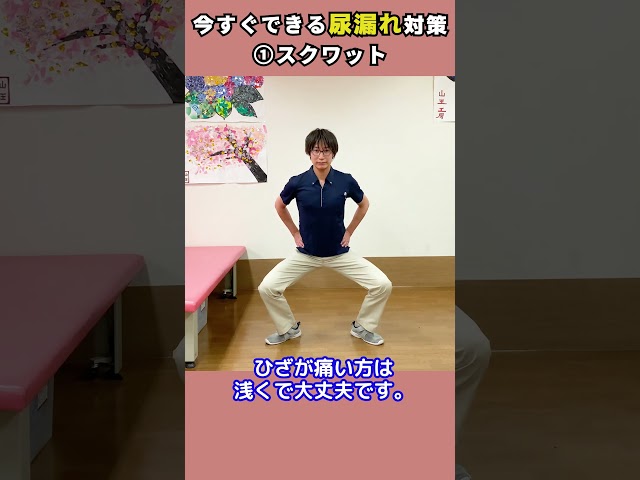
Stand with your feet just a bit wider than shoulder-width and your toes pointed outward.
As you slowly exhale, lower your hips as if pulling your buttocks back.
At this time, gently focus on and engage the anus and lower abdomen to effectively stimulate the pelvic floor muscles.
If your knees hurt, you don’t need to squat deeply—do a shallower range within your comfort.
When the pelvic floor muscles work together with the inner thighs and glutes, it becomes easier to develop core stability.
Inhale as you slowly return to the starting position, and repeat about five times without holding your breath.
If you can do three sets, you’ll find it easier to feel your pelvic floor working in everyday movements.
Pelvic floor exercise: lungeNEW!

The “lunge,” done standing with one foot stepped forward, is also an exercise that helps you gently engage your pelvic floor.
As you slowly exhale, shift a little of your weight onto the front foot and try tightening your abdomen and around the anus.
It’s fine to hold onto something for balance.
When you slowly return to the starting position while inhaling, the key is to keep breathing without holding your breath.
If you can do three slow reps on each side, alternating, for three sets, it will help your pelvic floor and surrounding muscles work together more easily.
Try incorporating it into your daily routine.
Foot training using a ball

These are lower-body exercises performed while sitting in a chair using a ball.
A major advantage of using a ball is that it makes it easier to understand how to engage your muscles.
In the exercise where you hold the ball between your knees and slowly squeeze it, you can help improve bow legs (O-legs) and strengthen the pelvic muscles.
In the exercise where you place the ball on the front of your thigh from above and slowly lift your leg, it promotes pelvic stability and can also improve walking.
If you can’t apply enough force to compress the ball, it’s recommended to switch the ball for something with less rebound, such as a floor cushion, and perform the exercises.
