

[For Seniors] Recommended Even for People with Dementia! Simple Recreational Activities

Recreation activities conducted at nursing and care facilities aim to improve brain and physical functions.
They are said to help activate the brain and can be expected to prevent dementia or slow its progression.
However, it is also important to maintain emotional well-being through feelings like “this is fun, I feel happy” and communication with others.
If people push themselves too hard for functional improvement and the things they “can’t do” become a source of stress, they won’t be able to enjoy the activities.
So this time, we’re introducing “simple recreation” ideas!
These are easy, accessible activities designed for older adults to enjoy.
Please feel free to make use of them.
- [For Seniors] Easy and fun seated activities you can do in your room
- Simple games for preventing and improving dementia
- [For Seniors] Fun Recreational Activities Without Equipment
- Recommended recreational activities for older adults with dementia
- [Brain Training for Seniors] Recommended Hand-Play Recreation for Dementia Prevention
- [For Seniors] Fun and Engaging Brain-Training Recreation
- [Elderly Day Service] Let’s all have fun! Games and recreational activities
- [For Seniors] A Collection of Fun Classic Caregiving Activities
- [For Seniors] Today’s Recommended Activity: Fun and Engaging
- Hand games that liven things up for seniors—also great brain training
- [For Seniors] Easy to try. Fun, crowd-pleasing recreation
- [For Seniors] Simple Recreational Activities You Can Enjoy While Seated
- For Seniors: Effective Recreation for Preventing Care Needs—Have Fun While Staying Healthy
[For Seniors] Recommended for People with Dementia! Simple Recreational Activities (21–30)
Ball fishing game

Let me introduce a game that lets you practice fine motor skills while having fun.
It’s a game where you use a stick to pick up rubber balls.
The tip of the stick is fitted with the sticky side of tape, so the rubber balls attach to it.
It gets even more exciting as a two-player competitive game for older adults.
You’ll grip the stick and move your arms and hands a lot.
The person who picks up more balls than their opponent wins.
It can be played while seated, and with a bit of ingenuity, people who have difficulty moving their bodies freely can also participate.
Please use this as a reference and enjoy a fun time.

Color Game

How about a color game as a whiteboard activity? For this game, prepare papers with color words written on them.
The key is to make the kanji different from the actual color of the text.
Instead of reading the words on the papers attached to the whiteboard, ask the participating seniors to say the color of the letters.
It may seem easy, but it actually trips people up and often leads to lots of laughs.
Because you see with your eyes and think with your head, it’s effective for reflexes and brain training.
Start by letting them answer slowly and thoughtfully, then gradually pick up the pace.

For Seniors: Recommended for People with Dementia Too! Simple Recreational Activities (31–40)
Finger rotation exercise

Let me introduce a finger-rotation exercise where you touch the same fingers of both hands together and rotate them.
This exercise was devised by an internist, and it’s said to help improve cognitive function, speed-reading ability, and calculation skills.
Amazingly, more than a third of the cerebrum is devoted to moving and controlling the hands and fingers.
So simply moving your fingers stimulates and activates the brain.
Since you’ll be moving your fingers, it might help to gently massage the bases of your fingers before you start.
The motion is simple—just twirling your fingers—so it seems easy to fit into small pockets of time.
Seated Rhythm Exercises to Classic Showa-Era Hits

This time, we’ll introduce a singing exercise routine that moves your body to nostalgic Showa-era classics.
Since it involves physical movement, it’s best to start with songs at a slower tempo.
When you move your body to music, your brain continuously engages in activities like keeping rhythm, coordinating movement, and deciding what to do next.
Because of this, the abundant stimulation activates the brain and is said to offer cognitive training benefits.
Once you get used to it, adding singing while you move can further stimulate your brain.
Do it within a comfortable range, and enjoy yourself as you go.

Word search with hiragana cubes

Prepare eight cubes with hiragana written on them and roll the cubes.
Combine the hiragana that appear to form as many table-friendly words as you can.
If the word changes, it’s okay to use the same hiragana more than once.
Since the hiragana change each time, you’ll get a different kind of stimulation every time you play.
There are many ways to enjoy it, such as changing the number of cubes or trying to form as many words as possible within a time limit.
Finding words and assembling them from characters activates the brain, so you can enjoy yourself while getting brain-training benefits.
Find the theme words

Find answers that match a given theme from jumbled letters.
The themes include fruits, flower names, vegetable names, animal names, food names, Japanese events, and greetings, and both the number of answers and how many you need to find gradually increase.
In the latter half, the number of letters grows, and combined with the time limit, the difficulty rises.
It’s important to stay calm and read the questions carefully.
Watching as a video works well, and turning it into a whiteboard or printed activity makes it fun for both small groups and larger groups.
It’s also recommended for recreational activities at senior facilities.
This kid had a hard time writing katakana, didn’t they? I wonder if they didn’t cry?
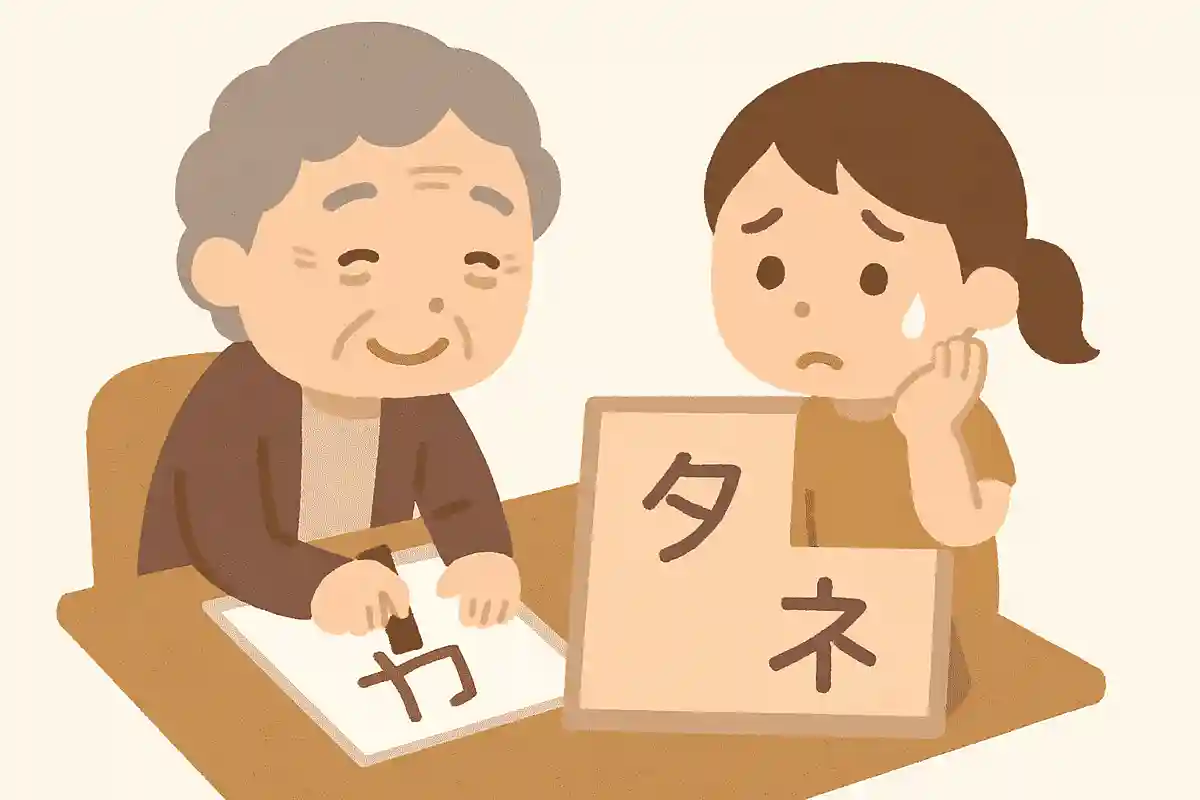
“Kono ko nakanaka katakana kakenakatta na, nakakanakatta kana?” is quite a long tongue twister.
Are they worried that the child who couldn’t write katakana didn’t end up crying? Words with similar sounds like nakanaka and katakana run together almost like a reverse reading.
Plus, the repeated ka sounds create a string of identical syllables, which adds to the difficulty of reading.
Tongue twisters can make you rush, but the key is to stay calm and read through without hurrying.