

[For Seniors] Guaranteed to Liven Things Up! A Collection of Brain Training Activities That Will Spark Laughter


The time filled with laughter is a meaningful time that refreshes both mind and body, isn’t it? This time, we’re introducing word games and quizzes that you can enjoy together with seniors.
Try a game where you combine the names of Chinese dishes, a paired game where partners write the same answer, and a fill-in-the-blank quiz using Silver Senryu poems.
How about spending a fun time together that naturally brings smiles? Recreational activities like word games and quizzes stimulate the brain and can help prevent dementia.
They not only enrich the heart but also spark natural conversation, letting everyone enjoy a wonderful time together.
- [For Seniors] Lively Wordplay Game: Fun Recreation for Elderly Care
- [Brain Training] Lively Word Quiz for Seniors
- [For Seniors] Laugh-Out-Loud, Crowd-Pleasing! Fun Quiz
- For seniors: Fun, crowd-pleasing word association game ideas
- [For Seniors] Fun and Engaging Brain-Training Recreation
- [For Seniors] Fun and Lively! Recommended Quiz Questions
- [For Seniors] Fun Riddles That Stimulate the Brain
- Hand games that liven things up for seniors—also great brain training
- For seniors: Fun shiritori—enjoyable and easy to play
- Conversations Made Easy! A Collection of Topics That Elderly People Enjoy
- Recommended fun performances that will appeal to elderly people
- [For Seniors] Fun Small-Group Recreation
- [For Seniors] Guaranteed to Be a Hit! Popular Day Service Recreational Activities
Hand Play and Exercises (11–20)
Stick Stack

Introducing “Stick Staff,” a senior-friendly game that builds balance and concentration while having fun.
You can buy a commercial version, but a homemade one is just as enjoyable.
It’s easy to make: create a base from cardboard, stand a straw in the center, and fix a shallowly cut paper cup on top.
Players then take turns placing one straw or chopstick at a time.
The tension of moving your hand gently so the tower doesn’t collapse is irresistible.
If a straw falls or the base topples, that player loses—simple rules with big appeal.
It’s thrilling to watch, too! A quick, accessible indoor activity that’s engaging for both groups and individuals, with surprising depth.

A balance game using toilet paper rolls
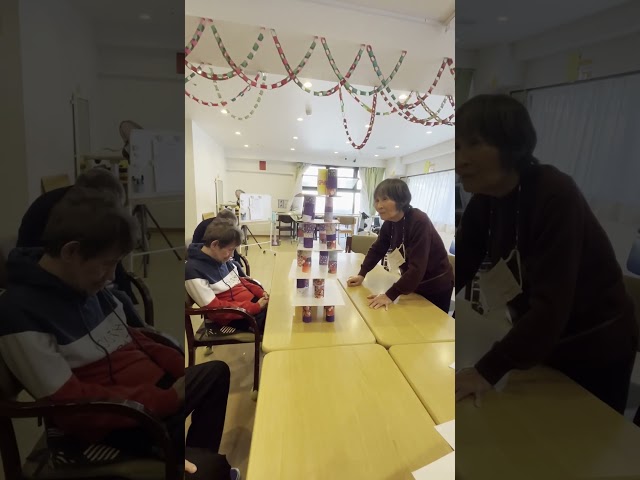
Introducing a thrilling and laughter-filled recreation activity for seniors: the Toilet Paper Roll Balance Game.
First, randomly place toilet paper cores on a table and stack thick paper or cardboard on top to build a tower.
That’s when the real challenge begins! Take turns gently removing one roll at a time without toppling the rest.
Much like Jenga, it helps train fingertip control, decision-making, and concentration.
The rules are simple: whoever causes the collapse loses, so anyone can jump in right away.
It’s easy to prepare with everyday materials.
This safe, exciting game is perfect for homes and care facilities, letting participants enjoy it comfortably without overexertion.
Singing game of “Antagata Dokosa”

Some older adults may have memories of playing ball games to the temari song “Antagata Dokosa.” Here’s a finger play that matches the “Antagata Dokosa” song.
Make a gun shape and a fox shape with your fingers to match the imagery in the lyrics.
To the melody, alternate the finger shapes between left and right.
Once you get used to it, try speeding up the tempo.
In addition to moving your fingers, taking on tasks that feel “a bit difficult” is also said to activate the brain.

Flag-raising game

This is a game where you move red and white flags in your hands up and down according to given instructions.
Your ability to listen carefully and then move—distinguishing between commands like “raise” vs.
“don’t raise” and “lower” vs.
“don’t lower”—is put to the test.
Once you get used to it, it’s recommended to gradually increase the speed of the instructions.
By requiring quicker decisions, you can further stimulate the brain.
To help players focus on listening and moving, it’s also a good idea to make the flags easier to hold—for example, by forming them into rings.

Inchworm Brain Training Exercise

Let’s stimulate your brain with a finger play that mimics an inchworm’s movement.
Inchworms move by stretching and contracting their bodies, right? We’ll recreate that motion with your fingers as a hand game.
Touch the tips of your index finger and thumb together on both hands.
From there, bend one thumb and touch it to the index finger of the other hand.
Then alternate by bending an index finger to touch the thumb on the other hand, and keep repeating this pattern.
The motion looks like an inchworm, doesn’t it? At first, it can be hard to make each finger meet the opposite one smoothly, but working to make the connections is said to help activate your brain.
Makimaki Apple Game

Let me introduce a recreation activity that makes great use of the hands and wrists: the Rolling Apple Game.
Attach a stick to a sheet of paper with tape, and place an apple on the paper.
Your goal is to bring the apple to your feet using only the motion of winding the stick—pulling is not allowed, so the winding action is key.
You need to use your fingertips and wrists, and if you wind too fast the apple will fall off, so you must decide whether to prioritize speed or focus on keeping the apple from falling.
Watching the apple make its way toward you is fun in itself, so spectators can’t help but cheer.
It’s enjoyable while also training the fingers and hands, making it a great recommendation for recreational activities in senior facilities.
High touch rec

A high five is when two people clap each other’s hands, often when greeting brightly or feeling happy.
Let’s turn this high five into a recreation activity that seniors can enjoy.
Have everyone sit in a circle on chairs and high-five the person next to them.
Try high-fiving with just one hand, or flip the hands over to change the palm orientation as you go.
Make the seated circle smaller so people can reach to tap someone’s hand, or do double high fives with both hands.
Thinking about who has a free hand and counting to ten while high-fiving can also help train the brain.
It’s an activity that may spark conversations with people who don’t usually talk and broaden communication.