

Lesser-known facts about Mother’s Day that might surprise you—tidbits you’ll want to share with someone

When we think of Mother’s Day, we often picture a day to express gratitude to our mothers and give them carnations.
However, there may be surprisingly few people who know about its origins or how it’s celebrated around the world.
Trivia related to Mother’s Day is full of stories that will make you want to share them with someone the more you dig in! In this article, we’ll introduce a wide range of Mother’s Day trivia.
The more you learn, the more Mother’s Day may feel like an even more special day than it does now!
- Not taught in school! A roundup of historical trivia and fun facts
- Trivia & fun facts about June
- Mother’s Day gifts are best when handmade! A collection of heartfelt ideas
- Will you like May even more once you know? Fun May trivia elementary schoolers should know
- [For Elementary School Students] A Collection of Fun, Educational Quiz Ideas for Mother's Day
- Surprisingly, there’s a lot we don’t know? A quiz to learn trivia about May!
- A fun quiz you can use to kill time by yourself or with everyone
- Handmade gifts to give on Mother’s Day: a collection of heartfelt ideas
- A collection of handmade card ideas for Mother’s Day: heartfelt ideas that convey your feelings
- [Valentine's Day] Trivia and fun facts you'll want to share: A big reveal of secrets about Valentine's Day and chocolate
- Exciting! Trivia quizzes that you’ll want to tell others about. A collection of surprisingly little-known facts.
- Trivia about hydrangeas. A collection of fun facts related to ajisai (hydrangeas).
- [For General Audience] Little-Known Trivia and Fun Facts About Hay Fever
Lesser-Known Trivia About Mother’s Day: Fun Facts You’ll Want to Share (21–30)
There is a rare blue-purple carnation called “Moondust.”

The blue-purple carnation “Moondust,” jointly developed by SUNTORY FLOWERS and Florigene, has been on sale in Japan since 1997.
Because it lasts longer than other carnations, it is popular as a Mother’s Day gift.
Moondust comes in four colors of the standard type, which bears one flower per stem, and two colors of the spray type, which bears multiple flowers on branched stems.
The shades of the petals vary, making it fun to choose.
Its flower language is “eternal happiness.”

In the UK, people give daffodils on Mother’s Day.
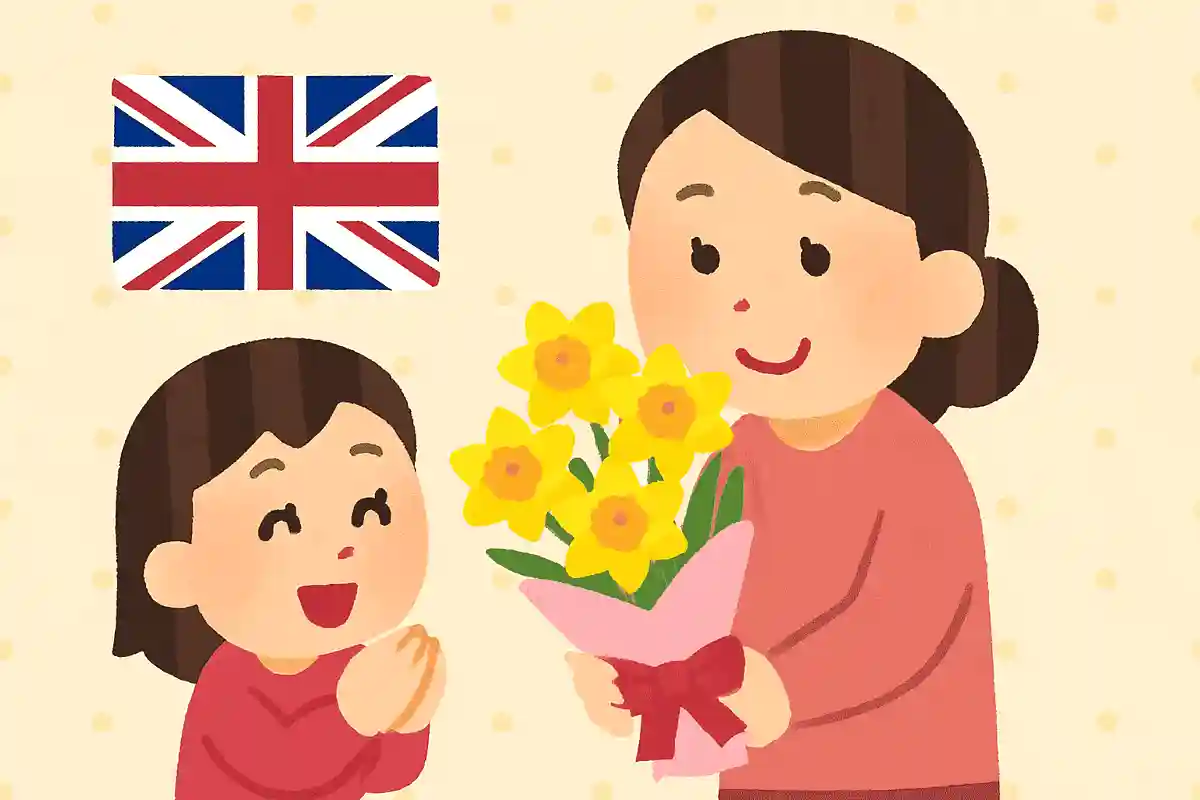
In Japan, Mother’s Day falls on the second Sunday of May, but in the UK it takes place three weeks before Easter, so the date changes every year.
Also, while giving carnations is the norm in Japan, it’s customary in the UK to give daffodils.
Daffodils carry the meaning of “respect,” making them a perfect flower to give to mothers.
Incidentally, the meaning of carnations varies by color, but the classic red carnation signifies “a mother’s love.”
Japanese names for carnations include “Oranda-sekichiku” and “Oranda-nadeshiko,” among others.
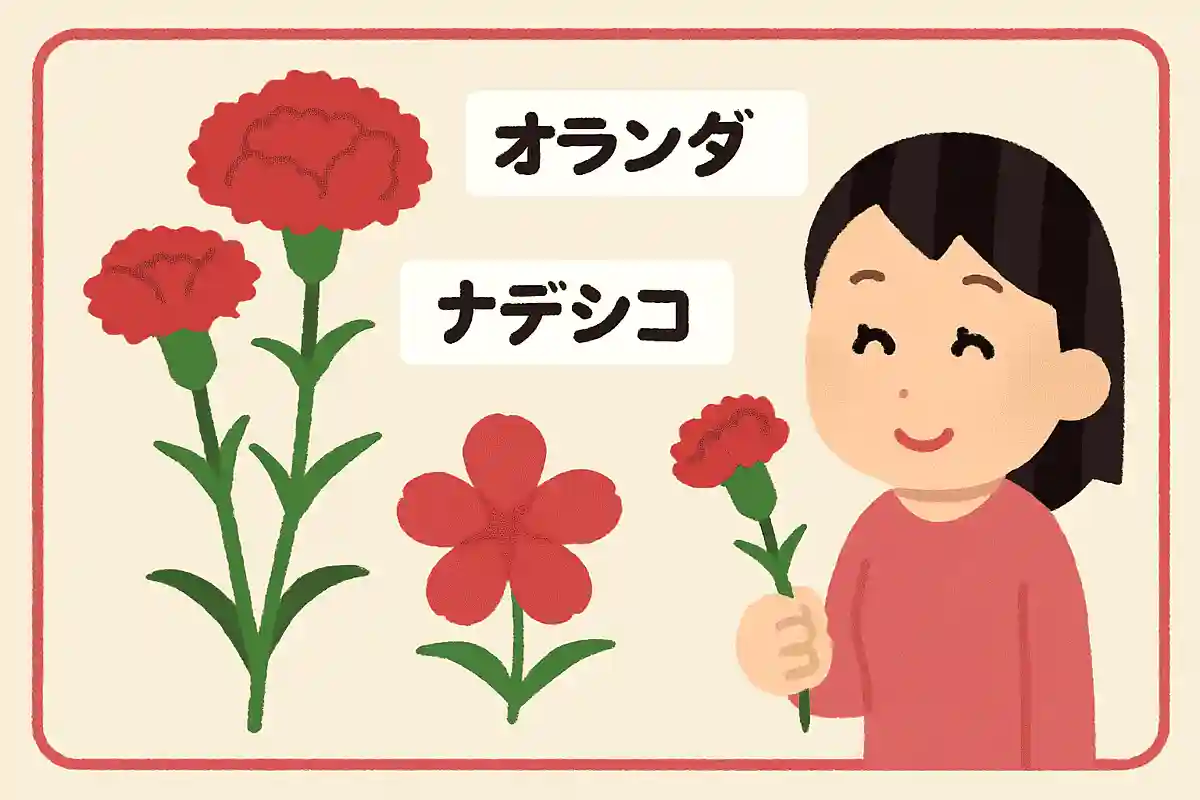
Carnations are like a symbol of Mother’s Day.
Many people have probably given them as a gift to express gratitude to their mothers.
Carnations are perennial plants of the genus Dianthus in the family Caryophyllaceae.
Hence their alternative names: “Oranda-nadeshiko” and, in Japanese, “Oranda-sekichiku.” But why do they include “Oranda” (Dutch)? Carnations were brought to Japan in the early Edo period by the Dutch, who were Japan’s trading partners at the time.
Their Japanese names reflect the idea of a flower in the Caryophyllaceae family that came from the Netherlands.

There are about 3,000 varieties of carnations in the world.

Carnations bloom in a variety of colors—red, pink, yellow, orange, and more.
They’re the classic flower for Mother’s Day, aren’t they? Did you know that there are actually many different kinds of carnations? Selective breeding has been carried out for generations, and even now the range of colors and varieties is growing every year—there are over 3,000 types.
While carnations in general carry the meaning “pure and deep love,” the flower language differs by color.
For example, red means “a mother’s love,” pink means “gratitude,” and white means “pure love.” How about giving your mom carnations in an unusual color this Mother’s Day, along with their symbolic meaning?
When carnations were first imported to Japan, they were called “Anjaberu” or “Anja.”
Carnations, the classic Mother’s Day gift, are flowers that were introduced to Japan from the Netherlands during the Edo period.
At the time of their arrival, they were called Anjaberu or Anja.
They also had various other names, such as Dutch nadeshiko and musk nadeshiko, but none of these took root then; it was from the Meiji era, after the varieties had been improved, that the name “carnation” became established.
The fact that the name hadn’t been fixed suggests the varieties themselves hadn’t yet been settled—an anecdote that gives a sense of history.

Colombia is the world’s top producer of carnations.

Since carnations are the classic flower for Mother’s Day in Japan, many people might assume they’re produced domestically.
In fact, about 60% of Japan’s carnations are imported, and 40% of those come from Colombia! Bogotá, the capital of Colombia, sits at an elevation of about 2,600 meters and, being close to the equator, enjoys a stable climate year-round.
This environment is said to be well-suited for growing carnations.
In Saudi Arabia and Egypt, the vernal equinox is Mother’s Day.
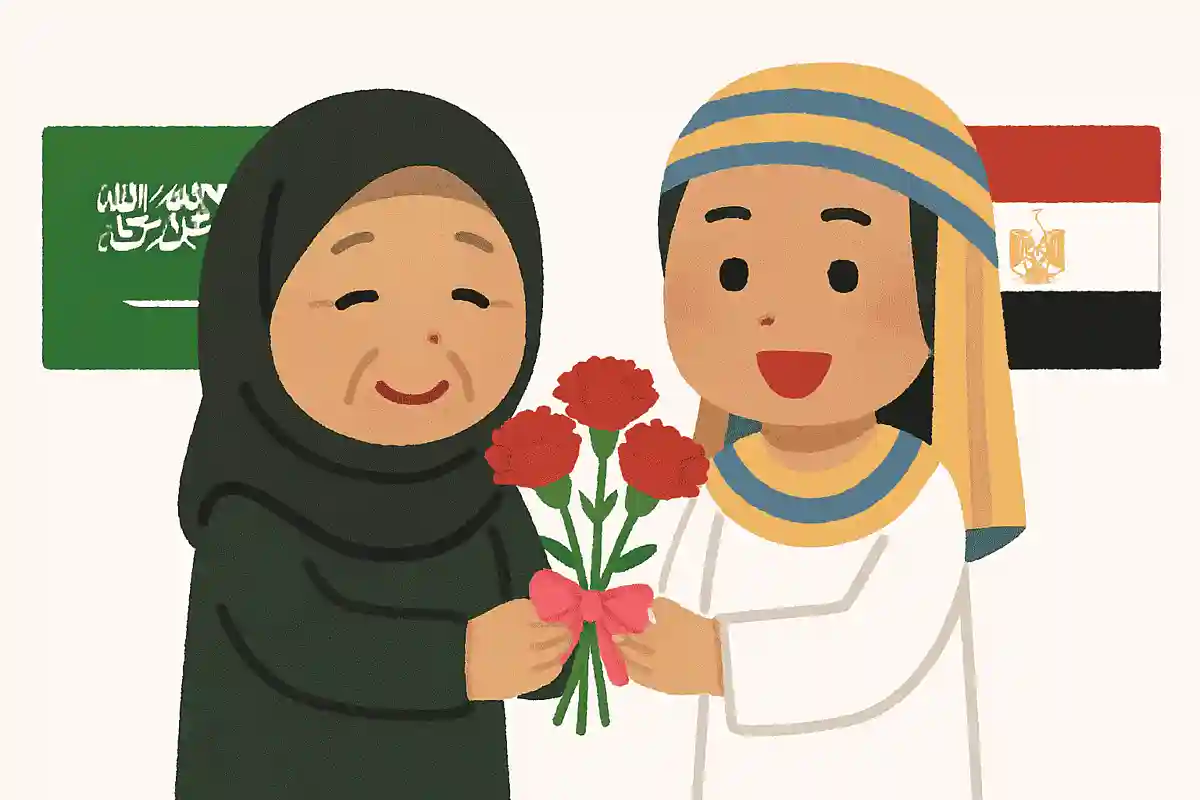
Mother’s Day is a global celebration observed not only in Japan but also in many other countries.
However, did you know the date varies by country? In Japan, Mother’s Day falls on the second Sunday of May, while in many Islamic countries such as Saudi Arabia and Egypt, it is commonly celebrated on March 21, the vernal equinox.
Elsewhere, France observes it on the last Sunday of May, and in the United Kingdom and Ireland, it is held on the Sunday two weeks before Easter.
In the United States, Australia, Italy, Finland, and several other countries, Mother’s Day is the same as in Japan—the second Sunday of May.