

Mozart: An Introduction to His Signature and Popular Works

Wolfgang Amadeus Mozart, who had a profound impact on classical music.
He began composing at the age of five, displayed his talents from an early age by performing before European royalty, and left behind more than 800 works during his 35-year life.
He also produced masterpieces in every musical genre of his time and excelled not only as a composer but also as a conductor, pianist, organist, and violinist, earning him the title of a musical genius.
In this article, we introduce some of Mozart’s signature and most popular pieces.
Please enjoy his music—melodies that are catchy and familiar, yet of high quality and imbued with a charm that defies simple description.
- Pick up Beethoven’s famous and representative works!
- [Masterpiece Classics] A special showcase of gem-like masterpieces so beautiful they’ll move you to tears
- Classical masterpieces. Recommended classical music.
- [Tchaikovsky] Pick up famous and representative pieces!
- Classical piano masterpieces: legendary performances from around the world you should hear at least once
- J.S. Bach | Introducing Famous and Representative Works
- Timelessly beautiful classical masterpieces. Recommended classical music.
- Brahms's masterpieces. Popular classical music.
- Cool classical masterpieces. Recommended classical music.
- Today's Classics: Recommended classical music and great performances to listen to today
- Jacques Ibert Popular Song Ranking [2026]
- Famous pieces recommended for opera beginners. Recommended opera songs.
- Masterpieces of Ballet Music: Introducing Classic Favorites
[Mozart] Introducing Representative and Popular Pieces (91–100)
Andante in C major, Rondo in D majorWolfgang Amadeus Mozart

Listening to this truly makes the sound of the flute sink into my heart.
It usually feels weak, but here it’s powerful, and the very beautiful, delicate melody really stays with me.
It offers such a lovely melody and gentle tone.
It makes me want to keep listening forever.
Oboe Concerto in C major, K. 314Wolfgang Amadeus Mozart

When I listen to this piece, I’m reminded that the oboe truly has a one-of-a-kind timbre.
It offers a very lovely melody that gives the impression of being played with a touch of freedom, letting us hear a graceful and beautiful line.
[Mozart] Introducing representative and popular pieces (101–110)
Horn Concerto No. 1Wolfgang Amadeus Mozart

I usually think it’s not an instrument that stands out much, but the horn really shines in this piece—it’s a great song.
By the way, I’m pretty sure I’ve heard the piece itself before, since it often played in the Nodame Cantabile drama and such, but the horn sounds really wonderful to me.
Fantasia in D minor, K. 397Wolfgang Amadeus Mozart

It has a very mysterious tone that resonates in my heart.
It’s so wonderful and beautiful that it carries a poignant sadness, making tears flow naturally.
The melody is so delicate that it defies imagination.
It made me want to listen to it again.
String Quartet No. 14 in G major, K. 387 “Spring”Wolfgang Amadeus Mozart

Among Wolfgang Amadeus Mozart’s string quartets, this piece is known as a particularly captivating work.
Completed in 1782, it is the first of the set of six quartets dedicated to Haydn.
Distinguished by bright, lively melodies that evoke the arrival of spring, each of its four movements presents a different character.
From the energetic themes of the first movement to the gentle, song-like melody of the third, it is as if the music expresses the many faces of spring.
Showcasing Mozart’s genius for composition to the fullest, this work is recommended not only for classical music enthusiasts but also for those encountering a string quartet for the first time.
Variations on “Twinkle, Twinkle, Little Star,” K. 265Wolfgang Amadeus Mozart

I think it’s a simple, very easy song, but it’s actually deep—truly a masterpiece among masterpieces.
I believe this melody is sung in many countries.
In Japan, too, the opening part is performed and sung by young children, right? And there’s actually more to it after that.
It’s just wonderful.
Piano Concerto No. 23 KempffWolfgang Amadeus Mozart
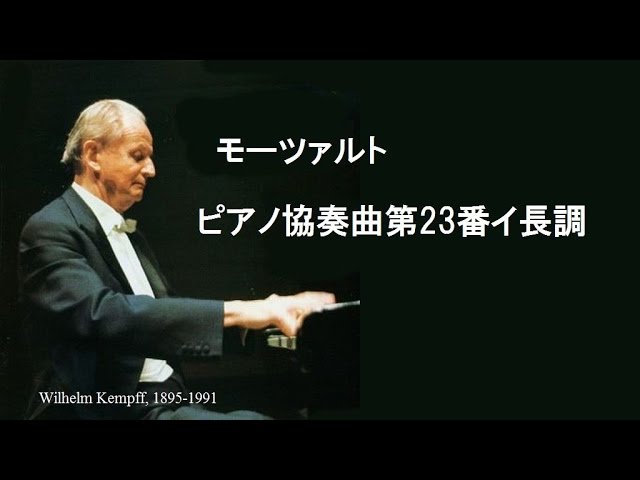
This is the first movement.
It has a very lovely tone, and it’s so pleasant to listen to that you feel as if you’re being drawn into the music.
Strangely, it calms the mind, so I think listening to it before an exam or an important performance will help you feel at ease.
It also makes you feel ready to move forward and do your best.