

Mozart: An Introduction to His Signature and Popular Works

Wolfgang Amadeus Mozart, who had a profound impact on classical music.
He began composing at the age of five, displayed his talents from an early age by performing before European royalty, and left behind more than 800 works during his 35-year life.
He also produced masterpieces in every musical genre of his time and excelled not only as a composer but also as a conductor, pianist, organist, and violinist, earning him the title of a musical genius.
In this article, we introduce some of Mozart’s signature and most popular pieces.
Please enjoy his music—melodies that are catchy and familiar, yet of high quality and imbued with a charm that defies simple description.
- Pick up Beethoven’s famous and representative works!
- [Masterpiece Classics] A special showcase of gem-like masterpieces so beautiful they’ll move you to tears
- Classical masterpieces. Recommended classical music.
- [Tchaikovsky] Pick up famous and representative pieces!
- Classical piano masterpieces: legendary performances from around the world you should hear at least once
- J.S. Bach | Introducing Famous and Representative Works
- Timelessly beautiful classical masterpieces. Recommended classical music.
- Brahms's masterpieces. Popular classical music.
- Cool classical masterpieces. Recommended classical music.
- Today's Classics: Recommended classical music and great performances to listen to today
- Jacques Ibert Popular Song Ranking [2026]
- Famous pieces recommended for opera beginners. Recommended opera songs.
- Masterpieces of Ballet Music: Introducing Classic Favorites
[Mozart] Introducing representative and popular pieces (101–110)
Piano Concerto No. 23 KempffWolfgang Amadeus Mozart
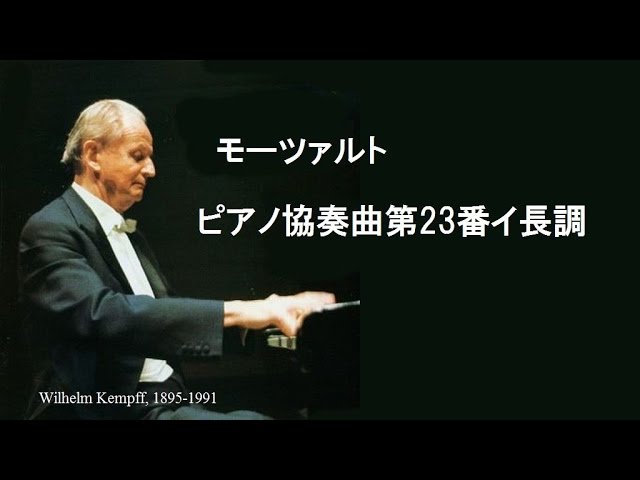
This is the first movement.
It has a very lovely tone, and it’s so pleasant to listen to that you feel as if you’re being drawn into the music.
Strangely, it calms the mind, so I think listening to it before an exam or an important performance will help you feel at ease.
It also makes you feel ready to move forward and do your best.
Piano Sonata K. 545, 1st MovementWolfgang Amadeus Mozart

Among Wolfgang Amadeus Mozart’s piano works, this piece is especially famous.
Even those who aren’t well-versed in classical music might say, “I know this melody!” Composed in June 1788 with piano learners in mind, it captivates with its bright and light character.
However, despite its familiarity, playing it beautifully is by no means easy.
It’s filled with essential techniques, such as maintaining balance with the left-hand accompaniment while keeping the right-hand melody even and well-articulated.
Performing such a renowned piece at a recital is sure to boost your confidence—and the sense of accomplishment when you master it is exceptional.
Piano Sonata No. 11 in A major, K. 331, Third Movement “Turkish March”Wolfgang Amadeus Mozart

A staple piece for piano recitals and one of Wolfgang Amadeus Mozart’s most popular piano works, the “Turkish March.” Originally the third movement of the Piano Sonata No.
11 in A major, K.
331, it is often performed on its own in concerts and recitals rather than as part of the full sonata.
Its familiar melody is arranged in a variation-like manner, with the difficulty increasing toward the latter half.
To ensure you can play through to the end without losing lightness or momentum, carefully polish the finer techniques through diligent practice.

Piano Sonata No. 16 in C major, K. 545Wolfgang Amadeus Mozart

A piece that beginners often tackle when stepping up to the intermediate level is Piano Sonata No.
16 in C major, K.
545.
It’s frequently performed at recitals, so many of you are probably familiar with it.
The work is notable for its structure, which combines easy sight-reading with elements that are essential for beginners.
Many players tend to unintentionally double the tempo where the sixteenth notes appear, so you must take great care there.
If you aim for a crisp, articulate tone, it will make for a wonderful performance—so do give it a try.

Piano Sonata in C major, K. 545, 1st movementWolfgang Amadeus Mozart
Included in collections such as the Sonata Album and Sonatina Album, Wolfgang Amadeus Mozart’s Piano Sonata in C major, K.
545 is so widely studied that it’s no exaggeration to say many piano learners practice it at least once.
In particular, the first movement is very popular among children who take piano lessons and is frequently performed at recitals.
The arpeggios are used in the first of the three sections—Exposition, Development, and Recapitulation—namely, the Exposition.
The ascending left-hand arpeggio followed by the descending right-hand arpeggio adds a beautiful sense of flow to the lively character of the piece.
[Mozart] Introducing Representative and Popular Pieces (111–120)
Piano Sonata K. 545 in C majorWolfgang Amadeus Mozart
This is a masterpiece by Mozart, the genius composer who represents 18th-century classical music.
It consists of three movements, each creating a different atmosphere.
The first movement features a bright, lively tune; the second offers a calm, lyrical melody; and the third is a cheerful rondo, making for a richly varied structure.
Mozart mentioned this work in a letter to his sister Nannerl on August 2, 1788, suggesting it is a piece imbued with his personal feelings.
It is an approachable work recommended for piano learners and newcomers to classical music.
Piano Sonata No. 16 in C major, K. 545, No. 1Wolfgang Amadeus Mozart
A piece that beginners often tackle when stepping up to the intermediate level is Piano Sonata No.
16 in C major, K.
545.
It’s frequently performed at recitals, so many of you are probably familiar with it.
The work is notable for its structure, which combines easy sight-reading with elements that are essential for beginners.
Many players tend to unintentionally double the tempo where the sixteenth notes appear, so you must take great care there.
If you aim for a crisp, articulate tone, it will make for a wonderful performance—so do give it a try.