

Interesting four-character idioms for elementary schoolers! Words you'll want to use once you understand their meanings

“I want to teach fun four-character idioms to elementary school kids!” If that’s what you’re looking for, you’re not alone.
Among the four-character idioms we casually see and hear, there are actually tons with funny meanings and origins that really capture children’s imaginations.
The sound of the words is enjoyable too, making them perfect to learn together with kids! In this article, we’ll introduce four-character idioms that will make elementary schoolers exclaim, “Wow!” with sparkling eyes—and that adults can enjoy learning alongside them.
- Learn the meanings too! Cool four-character idioms that elementary school students will want to remember
- Easy-to-remember, positive four-character idioms for elementary school kids! Words that brighten the heart
- Popular even among elementary school students! Stylish and easy-to-remember four-character idioms
- A four-character idiom quiz that elementary schoolers will love! Questions become fun once you understand the meanings
- Perfect for elementary school slogans! A collection of four-character idiom ideas you'll want to use
- [For Elementary Students] A Collection of Beautiful Four-Character Idioms to Know
- Recommended for elementary school class goals! A collection of impactful ideas using four-character idioms
- [Elementary School Students] Perfect for Kakizome! A Collection of Four-Character Idiom Ideas
- For Elementary School Students: Four-Character Idioms You Can Use for New Year’s Resolutions — How to Set Cool Goals!
- Easy for elementary school students to remember! A four-character idiom that expresses the feeling of trying your best
- Boost your vocabulary with four-character idioms that include numbers! A collection of four-character idioms for elementary school students to learn.
- [For Elementary School Students] Four-character idioms you can use in sports! Words that are helpful for cheering and goal setting
- Amusing four-character idioms you’ll want to use right away! A collection of expressions to remember as general knowledge.
Interesting four-character idioms for elementary schoolers! Words you'll want to use once you understand their meanings (21–30)
Fall down seven times, get up eight.
@az0202za #Fall down seven times, get up eight #Yojijukugo (four-character idiom) #Indomitable spirit to keep challenging #Nanakorobi yaoki (fall seven, rise eight)
♬ Original Song – 0202civo – az0202za
Many of you have probably heard the four-character idiom “shichiten hakki” (七転八起).
It’s said to mean “no matter how many times you fail, you don’t give up—you get back up and see it through.” It’s read as “shichiten hakki,” though some people read it as “nanakorobi yaoki.” When you’re working toward a goal, you may fail or run into obstacles.
Even then, you reset your mindset and keep striving toward your goal.
Isn’t this idiom just right for someone like you?
bizarre; mysterious; strange and uncanny (kiki-kaikai)
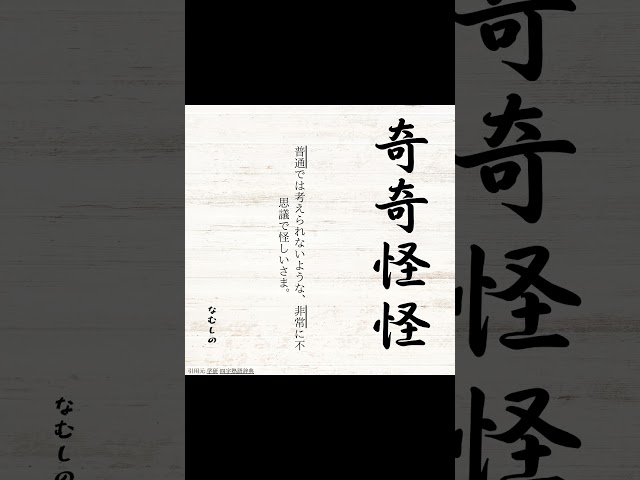
A four-character idiom meaning “something very strange and beyond ordinary understanding,” it has long been used to refer to ghost stories and mysterious happenings.
Many older people will naturally have heard it.
With a catchy rhythm that even children want to imitate, it’s friendly on the surface, yet its content is a bit eerie and mysterious.
It carries a nostalgic ring that recalls ghost-story programs and storytelling shows from the Showa era.
Used in daily life, it’s a handy word that can liven up a conversation with a touch of humor.

Ikonikimi

It’s a four-character idiom with a striking, powerful visual impact.
All the characters look similar, so people seeing it for the first time might do a double-take.
It means “there’s no real difference between the two; they’re much the same.” It’s used, for example, to refer to people whose personalities or behavior are very similar, or to things that hardly differ.
Both the forms of the characters and their meaning are unique, leaving an unforgettable impression once you learn it.
It’s also a fun conversation piece and a bit of mental exercise for older folks—turning it into a quiz like “How do you read this?” or using it as an icebreaker would likely liven up the conversation.
Gokuraku-tonbo (carefree person; lit. “paradise dragonfly”)

Some people might be reminded of a certain comedian by how it sounds, but in fact it’s a bona fide four-character idiom.
It means “a person who lives carefree, playing around without thinking about the future.” Combining the image of a dragonfly flitting about and the word “paradise,” it has come to symbolize a laid-back, optimistic personality.
It can be used to tease someone with a touch of irony, but it also carries an endearing charm that keeps it from feeling mean.
Older folks may feel nostalgic, thinking, “We used to use this expression a lot back in the day.”
every nook and cranny

Among four-character idioms, some have a sound that just makes you want to say them out loud.
This expression is one of them.
It means “all over the country, everywhere,” but don’t its humorous look and catchy rhythm feel strangely appealing? It has a light, song-like bounce to it, making it exceptionally easy to remember.
Since ancient times it has been used in waka and haiku, cherished as a handy phrase to denote the broader world.
Today it also appears in news and advertising, often used to emphasize geographic breadth.
Forge ahead with courage
@shi_chan.ikoi_shodo march forward with courageFirst calligraphy of the yearRelaxing CalligraphyCalligraphyhanging scroll (calligraphy scroll)semi-cursive script[Yuō Maishin] Advancing boldly and straight ahead. It means to push forward single-mindedly toward one’s goal without hesitation or fear. “Yūō” = to proceed without hesitation; “Maishin” = to advance rapidly without fear.
♬ Blessings – Rye
It is a phrase that signifies the attitude of boldly pushing forward.
When faced with hardship or adversity, many people feel hesitation and anxiety, but this phrase teaches the importance of continuing to challenge without fear.
Even if the goal is high and the path is steep, the way will open by taking sure steps one by one.
Persistence that refuses to give up until you get there, and the courage to forge ahead without wavering—these are the only real means to overcome difficulties.
For those who keep challenging themselves, it is truly a guiding principle for action.
A sudden resolve; making a firm decision (to start afresh).
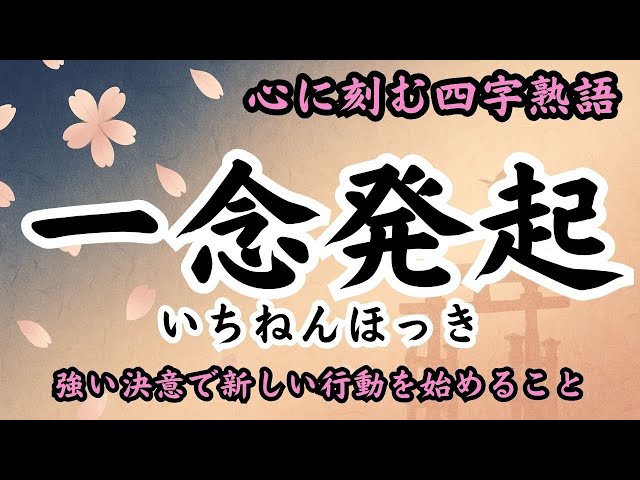
It is a phrase that means making up your mind firmly to accomplish something and taking action.
When facing difficulties, having the courage to take the very first step can be the biggest hurdle.
In such moments, it helps you shake off hesitation and flip the switch toward challenge.
Whether you’re starting to study for a certification or deciding to change your lifestyle, the future begins to move from the moment you decide to do it.
To cultivate a spirit that doesn’t give up, you need the resolve not to waver once you’ve made your decision.
This phrase can be seen as a powerful ally that stands beside you at the start of any challenge.